SPWM in Voltage source inverter

Thread Starter

mothermohammad

Joined May 17, 2014
69
Hello,

I hope you are doing well.
In Chapter 15 of the Rashid book, it is mentioned that because the maximum amplitude of the fundamental phase voltage in the linear region (ma ≤ 1) is vi/2, and the maximum amplitude of the fundamental ac output line voltage is √3vi/2.
But, obtaining the amplitude of the fundamental voltage by series Fourier is very time consuming.
I am thankful if you let me know the relation 15.30 in the Rashid book is obtained.
Thank you for your kind help

Best regards
Mohammad
 

Attachments

Thread Starter

mothermohammad

Joined May 17, 2014
69
Thank you for proposing this video clips.
Yes, my question is related to the mathematics. But, I think it is simple.
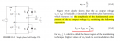
Actually, I want to know why in the linear region of the modulating technique (ma <1), the fundamental component of the ac output voltage is ma * maximum value of the ac output voltage (vi/2). Please see this pictures (Fig. 15.2 and 15.3 of Rashid book)

1699738833320.png
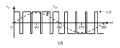
and, this is the ac output voltage:
1699738752699.png
As long as ma < 1 (the Sinuous is less than triangle carrier signal), the ac output is in the linear region, and we have formula 15.3. But, why?
Thank you
 

nsaspook

Joined Aug 27, 2009
16,249
Thank you for proposing this video clips.
Yes, my question is related to the mathematics. But, I think it is simple.
Actually, I want to know why in the linear region of the modulating technique (ma <1), the fundamental component of the ac output voltage is ma * maximum value of the ac output voltage (vi/2). Please see this pictures (Fig. 15.2 and 15.3 of Rashid book)

View attachment 307319
and, this is the ac output voltage:
View attachment 307318
As long as ma < 1 (the Sinuous is less than triangle carrier signal), the ac output is in the linear region, and we have formula 15.3. But, why?
Thank you
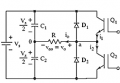
I think I see now. You can't modulate the PWM waveform output waveform voltage for more than Vi/2 if N is the connection port to half-bridge output a. N acts as a virtual neutral/ground point at 1/2 of the Vi.

1699741114104.png
 

Thread Starter

mothermohammad

Joined May 17, 2014
69
Yes, the maximum voltage is vi/2 but I am talking about fundamental component of the output (except harmonic).
And this fundamental can be increased if ma is more than 1
 

nsaspook

Joined Aug 27, 2009
16,249
Yes, the maximum voltage is vi/2 but I am talking about fundamental component of the output (except harmonic).
And this fundamental can be increased if ma is more than 1
The fundamental component is a sine wave. How can you make the peak of that higher than the 100 modulation index peak for that circuit?
 

Thread Starter

mothermohammad

Joined May 17, 2014
69
The fundamental component is a sine wave. How can you make the peak of that higher than the 100 modulation index peak for that circuit?
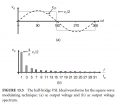
When the modulation index is more than 1, the ac output voltage is square, so the amplitude of the fundamental is grater than vi/2. Please see this figure:
1699777347001.png
 

nsaspook

Joined Aug 27, 2009
16,249
Isn't that telling you that at a modulation index of more that one the output becomes a squarewave (fundamental and harmonics) instead of an increasing amplitude single fundamental sine wave.
 

MrAl

Joined Jun 17, 2014
13,667
Thank you for proposing this video clips.
Yes, my question is related to the mathematics. But, I think it is simple.
Actually, I want to know why in the linear region of the modulating technique (ma <1), the fundamental component of the ac output voltage is ma * maximum value of the ac output voltage (vi/2). Please see this pictures (Fig. 15.2 and 15.3 of Rashid book)

View attachment 307319
and, this is the ac output voltage:
View attachment 307318
As long as ma < 1 (the Sinuous is less than triangle carrier signal), the ac output is in the linear region, and we have formula 15.3. But, why?
Thank you
Hello there,

I am not entirely sure what you are asking here but it sounds like you just want to know why the maximum output voltage is limited to Vi/2.

If that is the case, it is because it is assumed that you do not want significant distortion in the output waveform. This is a synthesized sine converter and that means that one of the goals would be to obtain a sine wave output will low distortion. That means no clipping.
It's true that you can get a *higher* average output by going greater than 1 for ma, but doing that means the distortion will go up pretty fast, especially since the root of the distortion is near the peak of the sine which is the most THD sensitive part.
BTW, that Vi/2 is the peak voltage not the RMS voltage.

So while you can get a higher average output voltage by going with ma>1, you will end up violating the whole point of making a good sine wave converter if you do so because of the objectionable THD that will cause to the output wave.

When I worked in this industry we would shoot for 90 percent efficiency and less than 1 percent THD. Going to even 10 percent THD would be unheard of in the more modern designs.
 

Thread Starter

mothermohammad

Joined May 17, 2014
69
Hello there,

I am not entirely sure what you are asking here but it sounds like you just want to know why the maximum output voltage is limited to Vi/2.

If that is the case, it is because it is assumed that you do not want significant distortion in the output waveform. This is a synthesized sine converter and that means that one of the goals would be to obtain a sine wave output will low distortion. That means no clipping.
It's true that you can get a *higher* average output by going greater than 1 for ma, but doing that means the distortion will go up pretty fast, especially since the root of the distortion is near the peak of the sine which is the most THD sensitive part.
BTW, that Vi/2 is the peak voltage not the RMS voltage.

So while you can get a higher average output voltage by going with ma>1, you will end up violating the whole point of making a good sine wave converter if you do so because of the objectionable THD that will cause to the output wave.

When I worked in this industry we would shoot for 90 percent efficiency and less than 1 percent THD. Going to even 10 percent THD would be unheard of in the more modern designs.
Thank you for you explanation. I know why it is limited to vi/2. My question is why as long as the amplitude of the sinuous wave is less than the carrier amplitude (ma <1), the first harmonic (or fundamental) component of the ac output voltage is linear with the amplitude of the sinuous wave. Please see chapter 15 of the Rashid book to understand my question please. I attached it.
Thank you so much
 

Attachments

MrAl

Joined Jun 17, 2014
13,667
Thank you for you explanation. I know why it is limited to vi/2. My question is why as long as the amplitude of the sinuous wave is less than the carrier amplitude (ma <1), the first harmonic (or fundamental) component of the ac output voltage is linear with the amplitude of the sinuous wave. Please see chapter 15 of the Rashid book to understand my question please. I attached it.
Thank you so much
Hi,

Well you would have to think in terms of pure theory here, and that would mean that the reason why it appears to be linear is for the same reason a buck output voltage appears to be linear with pulse width. For the sine output, all of the widths, presumably, vary in proportion to where they appear at the respective sine angle.
So near the middle if they change by 1 percent, then near zero they change by 1 percent, and near 50 percent output they change by 1 percent. If you like you can envision this as separate buck circuits, where each buck is putting out a different voltage. If one puts out 100v with a pulse width of 100us and the other puts out 50v with a pulse width of 50us, then to cut the 100v output down to 80v you set the pulse width to 80us, and to get the 50v output down to 40v you set the pulse width to 40us. You would have changed the pulse width of both by the same factor: 0.80, and the voltage output follows linearly in all cases. This would work the same for a sine wave where one angle was at 100v and another angle at 50v, and you wanted to reduce them the same way. This is because the peak amplitude is a linear factor in the output of a sine wave:
V=Vpk*sin(w*t)
When you change Vpk you change all parts of the sine wave and you get another sine wave of either reduced or increased amplitude, and since the pulse widths work the same way we get a variation in the sine output that follows from the pulse widths.

In real life however, this may not be the case. There could easily be other factors that cause either slight or gross nonlinearities. This is one of the reasons for using negative feedback in order to keep the output voltage at the right level.

I hope that answers your question.
 

nsaspook

Joined Aug 27, 2009
16,249
Last edited:

Thread Starter

mothermohammad

Joined May 17, 2014
69
Thank you for your explanation. But, it doesn't related to lookup table or anything else.
You have a triangle carrier wave (whose amplitude is 1) that is compare to a sinuous wave whose amplitude is ma (ma <1). The The output is pulse which is positive and negative. Why the fundamental component of the output which is sinuous wave is ma
 

nsaspook

Joined Aug 27, 2009
16,249
Thank you for your explanation. But, it doesn't related to lookup table or anything else.
You have a triangle carrier wave (whose amplitude is 1) that is compare to a sinuous wave whose amplitude is ma (ma <1). The The output is pulse which is positive and negative. Why the fundamental component of the output which is sinuous wave is ma
I'm using digital synthesis from table as an example to show the PWM signals at various levels of modulation should be linear and how that affects the levels of distortion. The principle is the same without a lookup table.

The question I have for you is why would the ac output voltage NOT BE linear with the amplitude of the sinuous wave.
 

Thread Starter

mothermohammad

Joined May 17, 2014
69
When ma > 1 the fundamental component of the ac output voltage is 4/pi of the maximum value which can be obtained by series Fourie's.
But for ma < 1, there is linear relation between output fundamental component and amplitude of the sinuous. I am asking why? Is it obtained by Fourie's ?
 

MrAl

Joined Jun 17, 2014
13,667
When ma > 1 the fundamental component of the ac output voltage is 4/pi of the maximum value which can be obtained by series Fourie's.
But for ma < 1, there is linear relation between output fundamental component and amplitude of the sinuous. I am asking why? Is it obtained by Fourie's ?
Hello again,

I am not sure why you brought up a lookup table. That would be an after thought after you find the answer to your question. If there was to be a lookup table, then that would be constructed later.

Anyway, you can certainly use Fourier to analyze the fundamental, why not, but there is a simpler explanation based on the pulse widths and how they are generated by the triangle wave, and the average voltage within one switching period.

If you look at the diagram attached, you will see a red wave section and a blue wave section. The red wave section is due to the time between the two red vertical lines. The blue wave section is due to the time between the two vertical blue lines. Now if the red wave section has an average voltage of 1 and the pulse width is 100us, then if the blue wave section has a pulse width of 50us then the average voltage of the blue wave is 0.5 and that is because of the way the triangle intercepts the input sine signal. The output sine signal will have a corresponding amplitude because of the pulse widths being generated by the triangle and the input sine signal. As the sine single gets lower, the pulse widths get more narrow, and they get more narrow at the same rate as the amplitude change. This can be seen by viewing the red pulse and the blue pulse, and the pseudo sine wave they would generate.
The reason it stays linear is because of the triangle, which measures a 50 percent wide pulse for a 50 percent amplitude input sine, and a 25 percent wide pulse for a 25 percent amplitude input sine, etc.
If that does not seem understandable yet, you can get a better idea how this works by averaging the input sine within one switching cycle when the sine is higher, then again when it is lower, then maybe even a 3rd time when it is every lower yet. As the sine gets lower, the pulse widths will follow accordingly in proportion to the amplitude and that means the output sine will be PWM'd in the same manner.

What this means is you should be able to get there by using the average voltages and correlating those to the input sine amplitude, and if that's not enough for your satisfaction, then correlate the resulting pulse widths to the output sine average voltages also.

It's not that hard to calculate the Fourier components for these pulses because they are all the same amplitude. It may help to write a program though, which also is not that difficult. If you like I can show you how to do this. I should have a program for this already actually that I wrote many years ago, I'll have to check if I still have it. It was used to check different synthesized sine patterns.
 

Thread Starter

mothermohammad

Joined May 17, 2014
69
Hello again,

I am not sure why you brought up a lookup table. That would be an after thought after you find the answer to your question. If there was to be a lookup table, then that would be constructed later.

Anyway, you can certainly use Fourier to analyze the fundamental, why not, but there is a simpler explanation based on the pulse widths and how they are generated by the triangle wave, and the average voltage within one switching period.

If you look at the diagram attached, you will see a red wave section and a blue wave section. The red wave section is due to the time between the two red vertical lines. The blue wave section is due to the time between the two vertical blue lines. Now if the red wave section has an average voltage of 1 and the pulse width is 100us, then if the blue wave section has a pulse width of 50us then the average voltage of the blue wave is 0.5 and that is because of the way the triangle intercepts the input sine signal. The output sine signal will have a corresponding amplitude because of the pulse widths being generated by the triangle and the input sine signal. As the sine single gets lower, the pulse widths get more narrow, and they get more narrow at the same rate as the amplitude change. This can be seen by viewing the red pulse and the blue pulse, and the pseudo sine wave they would generate.
The reason it stays linear is because of the triangle, which measures a 50 percent wide pulse for a 50 percent amplitude input sine, and a 25 percent wide pulse for a 25 percent amplitude input sine, etc.
If that does not seem understandable yet, you can get a better idea how this works by averaging the input sine within one switching cycle when the sine is higher, then again when it is lower, then maybe even a 3rd time when it is every lower yet. As the sine gets lower, the pulse widths will follow accordingly in proportion to the amplitude and that means the output sine will be PWM'd in the same manner.

What this means is you should be able to get there by using the average voltages and correlating those to the input sine amplitude, and if that's not enough for your satisfaction, then correlate the resulting pulse widths to the output sine average voltages also.

It's not that hard to calculate the Fourier components for these pulses because they are all the same amplitude. It may help to write a program though, which also is not that difficult. If you like I can show you how to do this. I should have a program for this already actually that I wrote many years ago, I'll have to check if I still have it. It was used to check different synthesized sine patterns.
I am so thankful for your complete explanation. I understand your theory. But, my problem is we can not prove that mathematically. Indeed, I am going to find an analytical solution.
Would you let me know how you obtain the Fourie's coefficient in Simulink?
Additionally, I inquired about my question from Professor Espinoza Castro, the author of Chapter 15 of Rashid's book. I asked him how they obtained the relationship between the AC output voltage and ma in both the linear and nonlinear regions (over-modulation). This is his answer:
"I did use FFT of the linear and nonlinear regions… and a carrier big enough… I'm not sure how big… but you can try bigger than 10 p.u.
Regards, "
 

owais_2246

Joined Oct 17, 2024
1
Hello,

I hope you are doing well.
In Chapter 15 of the Rashid book, it is mentioned that because the maximum amplitude of the fundamental phase voltage in the linear region (ma ≤ 1) is vi/2, and the maximum amplitude of the fundamental ac output line voltage is √3vi/2.
But, obtaining the amplitude of the fundamental voltage by series Fourier is very time consuming.
I am thankful if you let me know the relation 15.30 in the Rashid book is obtained.
Thank you for your kind help

Best regards
Mohammad
Can you please share the Fourier Series Analysis to obtain v_1=V/2
 
Top