Speaker crossover help

Thread Starter

Tonyr1084

Joined Sep 24, 2015
9,744
I believe the value is in pF, K is 1000
I certainly can't argue that. But in years gone by K, J and other alpha designations had to do with either the quality of the product or the percentage of accuracy. It's been since the 80's that I worked with such caps with mil-spec numbers like 5135K (guessing from vague memory) whereas other caps of the same F might have been designated as 5035J or something like that. This is part of the reason why I'm finding some confusion.

I've been through my stock of caps in a box (purchased as sets) and have scanned through a bunch of scrap boards looking for the illusive values of 4.7µF and 10µF. Did not find anything closer than 1µF and 0.47µF. @MisterBill2 suggested
at the very low power level an electrolytic that is polarized should work very well.
using an electrolytic cap of same value would be OK. But the issue of polarization raises some question as to whether that's actually an acceptable approach. It's been hundreds of years since I messed with Tri-Axial speakers with filter caps on them and I can't remember if I saw EC's or non-EC's. This is why I asked about series caps with Pos to Pos or Neg to Neg in series. As for voltage, the supply I have is 12 volts. Going through my junk I just found a 24VDC supply. The project says it runs on 8VDC to 24VDC. So I'd imagine going with a 35 or 50 volt cap should be well within tolerances.
 

crutschow

Joined Mar 14, 2008
38,512
using an electrolytic cap of same value would be OK. But the issue of polarization raises some question as to whether that's actually an acceptable approach.
Electrolytics would probably not be recommended for Hi-Fi speakers, but I see no problem with using two back-to-back in your application.
If you want non-polarized types, even non-polarized electrolytics which internally have two caps back-to-back, Parts Express is a good source.
 

Thread Starter

Tonyr1084

Joined Sep 24, 2015
9,744
So two 10µF's back to back would still give me 10µF? See - that's what confuses me. I know resistors in series add to overall resistance whereas parallel reduces resistance below the lowest resistor. But caps are opposite ? ? ? Two series caps remains the same value? I think I know two parallel caps of - say - 10µF each will give me 20µF. But does that affect the voltage? If so - how ? ? ?
 

Audioguru again

Joined Oct 21, 2019
6,826
Going through my junk I just found a 24VDC supply. The project says it runs on 8VDC to 24VDC. So I'd imagine going with a 35 or 50 volt cap should be well within tolerances.
Doubling the power supply voltage increases the amplifier maximum output power 3.5 times to 4 times more.
Then the tiny squeakers will soon die.
 

Thread Starter

Tonyr1084

Joined Sep 24, 2015
9,744
Please read my post #39
I'm a slow learner. But I got it now. Did a spread sheet. That way I stay dumb. But I got it. Two series 10's equal one 5 and two parallel 10's equal 20. I'll have to commit that to memory. Yeah, I know, it's an easy thing to remember. But the last time I worried about this must have been decades ago.

In conclusion I can take two 20's in series to get a single 10. And I'm guessing I can put them pole to pole.
 

MrChips

Joined Oct 2, 2009
34,817
I don't know if this will help you but let's give it a try.

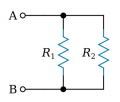
Two resistors in parallel = higher conductivity, add the conductivity, where conductivity = 1/R
1708900085637.png

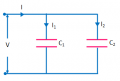
Two capacitors in parallel = higher capacitance, add the capacitance

1708900183343.png
 

Thread Starter

Tonyr1084

Joined Sep 24, 2015
9,744
Well, all's done. The speakers are built, wired and installed on a board. Going to upload a video to Youtube. However, no matter how good my speakers sound they will not sound better than the speakers you're using when listening to them. They COULD have a little more base but that's OK. They sound clean and plenty loud. In fact I had to adjust the PCB volume down so the wife can't blow the speakers out.

I'll be back when I have the video uploaded.
 
Top