source and sink related to transistors

Thread Starter

falade47

Joined Jan 24, 2017
178
Pls i need. A brief explanation on sourcing and sinking of current..am new to electronics andd i read an article that the pnp transistor turns on when a voltage is not applied to the base..does that mean that my led will turn on when aa base current or voltage is not applied..

Thanks in advance
 

ian field

Joined Oct 27, 2012
6,536
Pls i need. A brief explanation on sourcing and sinking of current..am new to electronics andd i read an article that the pnp transistor turns on when a voltage is not applied to the base..does that mean that my led will turn on when aa base current or voltage is not applied..

Thanks in advance
You might be thinking of the difference between bipolar and FETs.

Bipolar transistors regardless of polarity require appropriate base current to flow to get collector current.

Depletion mode JFETs are conducting with no bias - a reverse bias on the gate pinches off the channel and halts conduction.

Enhancement mode JFETS would be a bit impractical because it isn't a good idea to forward bias the gate junction.

MOSFETs can be either enhancement or depletion - power MOSFETs are usually enhancement, depletion mode is probably the most likely in low power RF devices.
 

Kermit2

Joined Feb 5, 2010
4,162
I always used the middle letter to tell me.

PNP middle letter is N. NEGATIVE in relation to emitter for purposes of forward bias (turn on transistor)


NPN middle letter is P. POSITIVE in relation to emitter.

For the schematic symbol
P oint iN P
Not Point N
 

dl324

Joined Mar 30, 2015
18,350
i read an article that the pnp transistor turns on when a voltage is not applied to the base..does that mean that my led will turn on when aa base current or voltage is not applied..
Please post a schematic so we can better understand what you're talking about.

BJTs don't normally conduct with no voltage applied to the base.

By voltage not applied to the base, does that include connecting the base to ground through a resistor?
 

Thread Starter

falade47

Joined Jan 24, 2017
178
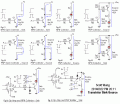
Thanks very much...sorry to ask...I tried designing a H bridge with just pnp traansistors but it diddnt work out..i'll uploadd the schematics
 

ErnieM

Joined Apr 24, 2011
8,415
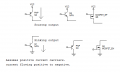
"Source" and "sink" in this context would mean the direction of (conventional) current into or out of a transistor.

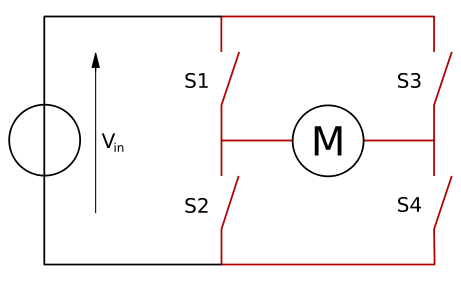
To eliminate some confusion about what transistor is used for now, here is an H bridge made of switches:


One could say that S1 and S3 are sourcing current, as current flows out of them to the motor. Similarly S2 and S4 are sinking current.

In normal operation these are turned on in pairs, S1 and S4, or S3 and S2. That drives the motor in one direction or another.
 

ian field

Joined Oct 27, 2012
6,536
Can I design my H bridge to use just npn transistors
At one time; all NPN half-bridge audio amplifiers were popular - using 2 output stages as full bridge is effectively a BTL amplifier. When there were plenty of old 8 track players in the salvage sources, I made BTL amplifiers out of a stereo unit.

Most SMPSUs - whether full or half-bridge; use all NPN.

Most early audio amplifiers and all SMPSUs use a driver transformer with a separate secondary for each transistor - design is not trivial for pulse drive.

Modern audio amplifiers use a combination of Darlington and Sziklai pairs to arrange for all the high power transistors to be NPN, they require temperature compensated automatic bias. I've never seen the arrangement used in a SMPSU. There's probably a difficulty with base carrier storage time delaying turn off - for a brief instant; both transistors conduct at once across the supply and punch through.
 
Top