Sound Reactive LED Circuit for Comment

Thread Starter

Sir Kit

Joined Feb 29, 2012
213
The circuit below is intended to make the intensity of a 10mm red LED fluctuate in unison with the amplitude of music fed in at about 2Vpp from a single channel of a stereo headphone socket. It includes a sensitivity adjustment (VR1) and 47uF cap (C2) for smoothing. The transistor would be a 2N2222 or similar.

Before I start building, any comments or suggestions would be appreciated. I live in a rural area and sometimes need to plan ahead for obtaining parts.

sound-to-led-circuit.png
 

Thread Starter

Sir Kit

Joined Feb 29, 2012
213
Showing my age again. Seems like ASCII diagrams are no longer in style.

The LED is shown as an arrow between the collector and GND. Being there, it isolates the collector and high side of the cap from ground.

R1 and R3 are 1K. R2 is 100K. Yes, I should have included those values.
 

atferrari

Joined Jan 6, 2004
5,001
I never used that style which is hard to read and I am 77++

Drawing with paper and pencil is easy. Taking a picture nowadays, even more. And then a PDF is a breeze.
 

Thread Starter

Sir Kit

Joined Feb 29, 2012
213
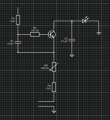
By popular demand, here is a readable circuit diagram. I miss LTSpice since migrating to Linux so this was done online at: https://www.circuit-diagram.org/editor/

5VDC feeds in at R2. R3 accepts a 2Vpp input from a headphone socket. VR1 is a sensitivity adjustment. C2 is for smoothing. The NPN is a 2N2222. LED is 10mm red.

I look forward to comments or suggestions regarding this circuit. My apologies for the prior confusion.

sound-reactive-led.png
 

AnalogKid

Joined Aug 1, 2013
12,043
Do you mean that 5 Vdc is connected to the floating end of R1? Through different components, both the collector and emitter are connected to GND. I don't see a valid current path for the LED. Also, based on the direction of the emitter arrow, the LED is backwards.

And, even if there were some LED current, it has to go through the emitter circuit to GND, and there is a 100K resistor in series with it. At 50% rotation, the best case current is 60 microamps. A standard LED will not make light visible in a lit room. And, the audio source must sink all of the LED current. Not good.

Is this supposed to be some kind of voltage-variable current source?

Separate from all of that, a more conventional approach is for the audio to drive the base of the transistor, which is configured as an emitter follower. In this way, the gain of the transistor works in you favor.

ak
 
Last edited:

Thread Starter

Sir Kit

Joined Feb 29, 2012
213
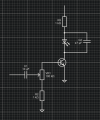
The circuit in my OP was one I found online. I can now see that it contained obvious errors. Here is a revised circuit based upon AnalogKid's expert comments.

Any further corrections or improvements?

Is R2 in the right place, or should it be in series with the input signal path?

sound-reactive-led-v2.png
 

AnalogKid

Joined Aug 1, 2013
12,043
R2 location: Depends on the peak amplitude of the incoming audio.

As shown, VR1 presents a varying load to the audio source, not a varying voltage to Q1. Better to tie the base to the wiper, and the audio source to the top (pin 3) of the pot.

What is the purpose of C2?

ak
 

Thread Starter

Sir Kit

Joined Feb 29, 2012
213
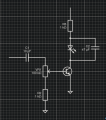
Thank you for your further comments. Please see revised circuit below. The intended purpose of C2 is to "smooth" the light fluctuations of the LED.

sound-reactive-led-v3.png
 

MisterBill2

Joined Jan 23, 2018
27,172
As shown in post #10, an audio voltage relative to "ground", fed in thru C1, will probably be able to occasionally illuminate the LED. To have it vary the brightness there must also be a base bias to establish some current independent of the audio signal.
 

Thread Starter

Sir Kit

Joined Feb 29, 2012
213
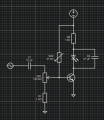
Following MisterBill2's suggestion, I have added a trim pot between the power supply and base. Is 47K a good choice?

In terms of perceived "brightness/steadiness", I assume its adjustment will interact with both VR1 and the value of C2.

Is there anything else I should be aware of before testing this circuit?

sound-reactive-led-v4.png
 

MisterBill2

Joined Jan 23, 2018
27,172
Considering that the intended operation of the circuit : is intended to make the intensity of a 10mm red LED fluctuate", the bias current minimum needs to be set for the LED to be glowing a small amount with no audio signal. So, depending on the current gain of the transistor, it may not take much bias current to achieve that level. So I am guessing that an additional fixed resistor may be required in series with VR2. Or that VR2 be a greater value device, to allow setting the minimum LED current.
Also, I am a bit concerned about the effect of the negative portions of the input audio signal. What effect will that have??
 

Thread Starter

Sir Kit

Joined Feb 29, 2012
213
Yes. I can certainly increase the value of VR2.

With regard to the negative swing of the input, I assumed C1 would remove any DC bias relative to GND. I may be wrong. If so, what is your solution? Given my limited knowledge, I cannot predict what visible effect a negative voltage on the 2N2222's base would have.

Another feature of the circuit is that there be a pass-through for the audio so a small speaker amplifier can be connected on the output side of the device.
 

AnalogKid

Joined Aug 1, 2013
12,043
Separate from that, the transistor still is running "wide open"; that is, at its maximum gain without any stabilization. This means that a very small change in average input voltage will cause a large change in average brightness. Basically, the transistor is acting as a comparator, with its Vbe as the threshold voltage. The two trimpots probably can be adjusted to hit a "sweet spot" in the circuit's operation, but this will not be stable. It will drift away from the spot with room temperature changes and aging, because both of these conditions affect both the Vbe and Hfe.

Depending on the input signal voltage range, it might be better to have the transistor configured as an emitter follower. With the addition of VR2, the transistor now would act as a rectifier with an adjustable Vf; input amplitude variations would be preserved. Think of it as an AM detector. Combined with VR1, the circuit would have a much wider latitude, giving a better correlation between loudness and brightness.

ak
 
Last edited:

Thread Starter

Sir Kit

Joined Feb 29, 2012
213
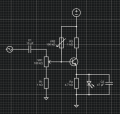
The input signal is from a headphone socket, nom 2Vpp. I have redrawn the circuit (see below) based upon my understanding of AnalogKid's advice to use an emitter follower. Have I done this correctly?

Thanks to everyone's input so far, I am learning a lot here.

sound-reactive-led-v5.png
 

Thread Starter

Sir Kit

Joined Feb 29, 2012
213
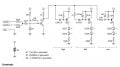
Here is a "color organ" I just found with a similar configuration. It would seem that by placing a cap across VR2 in my circuit I could weight the response toward a particular range of audio frequencies.

color-organ-circuit.jpg
 
Top