Sort of electric fence deterrent...

Thread Starter

Externet

Joined Nov 29, 2005
2,628
Hi.
The plan is to lay on top of soil, about 20cm away from concrete foundation around a house, a bare wire, galvanized or copper or barbed, connected to the live 120VAC line after a 0.5Ampere fuse. Will it work ?

120VAC----./ .----fuse----lamp---------------------------------------------------------------------------------------------------------------------------------

soil--------------------------------------------------------------------------------------------------------------------------------------grounded neutral

To avoid the frequent attempts from evicted marmots to dig under the foundation to re-establish residence under the dwelling causing cracks in foundation.
I buried long and heavy leftovers of polished marble slabs along and are working preventing digging as paws do not work on them, but still attempting to dig under them.

If the wire option giggles/jolts them or worse, I do not care. My house standing has priority. There will be some current leak from the live-to-ground on top of soil among plants and weeds, but I do not care a bit about the electrical waste. Perhaps worse after a rain; still, do not care. Prefer not to try high voltage.... yet. By the way; how many volts are in standard electric cattle fences ?
 

crutschow

Joined Mar 14, 2008
38,392
If may work.
But if you do that, make sure you have good liability insurance to pay the lawsuit for the dead kid that touched the wire, since electrocution requires only a few tens of mA through the body. :eek:

Besides that, rain will likely cause enough current to blow the fuse, even if normal dry ground current doesn't.

Better and safer to use a standard electric fence controller which puts out a short, safe pulse of a few thousand volts every second or so.
But you will have to suspend the wire slightly above the ground with insulators to prevent shorting of the signal.
 

MaxHeadRoom

Joined Jul 18, 2013
30,590
Electric fences start at around 2Kv, & up.
I built one for deer using a small PICmicro and MOSFET.
Single strand of galv. wire.
Run the wire just above ground and smear with something that attracts them. ;)
 

Tonyr1084

Joined Sep 24, 2015
9,744
I'm thinking of a worm tickler. An electric device that you put two probes into the ground and then charge the ground with a voltage. Supposedly it brings the worms to the surface where you can pick them up and use them for fishing. IF SUCH DEVICES EXIST - they would require your presence operating it. You can send a charge through the ground and make anything in the ground uncomfortable, possibly encouraging them to leave. I don't KNOW if this would work, but it seems reasonable to think it would.
 

Tonyr1084

Joined Sep 24, 2015
9,744
Just watched a video on how to make an electric worm tickler. I'm not posting a link because the guy uses 120VAC. I can't recommend you do that. But I'd imagine there is a way you can make something that works only when you push and hold a button. Whatever you do - before you energize it bring it here for us to pick it apart and let you know what NOT to do.
 

Thread Starter

Externet

Joined Nov 29, 2005
2,628
Thanks all.
Tony: to have current flowing from point A to point B both buried, would be different than from surface point A to grounded neutral in soil. The first could be DC or floating, isolated from mains. The mains above at line A to soil B would not be isolated.
The conductivity of the worm (or marmot paws) should be better than the conductivity of the soil in order to be effective (as on electrofishers) I believe a digger would not feel any deterring shock until paws get in the current path...

Perhaps a few MΩ in series could add some safety and still deliver the giggles for the mains on top of soil ?

120VAC-------(~)------MΩ------./ .------------------------------------------------------------------------------------------------------------------------

Pushing a button would not work as Murphy's law clearly states you can be a year waiting for the marmot to show up to dig and will happen only when you leave the button to take a leak.

I have available isolated from mains, solar 130VDC at that location but only during daylight; which brings the other Murphy's law stating diggers will come at night time.
 

Thread Starter

Externet

Joined Nov 29, 2005
2,628
Found some videos, thanks. What direction would a worm decide to move towards when shocked ? Why upwards or deeper or dryer or wetter or left or right ? Who knows...:)
 

crutschow

Joined Mar 14, 2008
38,392
Why are you apparently avoiding the use of a standard electric fence charger, which would seem to be an effective, as well as safe solution?

deciBel forever!
 

Tonyr1084

Joined Sep 24, 2015
9,744
Not that I am any kind of expert, but a digging animal can easily dig under the wire and miss the whole thing. I gravitated toward the worm tickler because it puts energy into the ground. Based on things I've seen, worms come up to the surface. I have no idea why but they do. The point is there's electricity in the ground. Again I wouldn't recommend 120VAC lines voltage being used. Even though in the video they are not using neutral, only hot. depending on the ground circuit, that electrical energy will go somewhere. And the resistance of a worms body must apparently be lower than the resistance of the soil. Also apparent is it doesn't kill them, just motivates them toward the surface.

The thinking on this end is having electricity in the ground MIGHT be enough of a deterrent to solve your problem. Use of 130VDC would probably work just as well but then you'll need both positive and negative points in the ground. Not undoable. So having power in the ground at all times may work just as well. Perhaps even electric fence pulses being put into the soil might make things uncomfortable for the pest.

Now I'm thinking. I get wasps nesting in the grass over the winter. Perhaps some sort of electric circuit might encourage them out of the ground only to freeze and die, DIE! DIE! DIE! You pesky Wasps. Grasshoppers are another scourge in my area.
 

Tonyr1084

Joined Sep 24, 2015
9,744
The thing I'm concerned about is the possibility of someone walking barefoot through the grass and getting a good zapping. Dad built an electric edger many years ago using a washing machine motor. Once, while trimming the grass I noticed an electrical charge between me and the ground (bare feet). It was definitely noticeable but not anything injurious. Still, be careful. You never know when something will go wrong.
 

Thread Starter

Externet

Joined Nov 29, 2005
2,628
Thanks, fellows.
Not that I am any kind of expert, but a digging animal can easily dig under the wire and miss the whole thing. I gravitated toward the worm tickler because it puts energy into the ground. Based on things I've seen, worms come up to the surface. I have no idea why but they do.
Interesting but flawed. The worms coming to the surface are the ones we see, with total uncertainty if most go deeper or away from the field or left or right.
The marmots always dig just next to the foundation trying to get to the heating system warmth under the house and there is a proper location for a surface conductor(s) that will always be in their way. Hard to explain, but that is the way it is.

Crutschow; am not avoiding anything; am exploring other unconventional ways for a wire over soil instead of the commercial fence meant for higher levels and animals. The marmots are 20KG animals with extraordinary strength and persistence am dealing with for a year, with some lost battles and most won so far. There is none under the house now and for about 8 months.
The marble has been successful but am not going to say it is digging-proof. If you have dealt with chewed doors, subfloors, hardwood floors, heating ducts, destroying basement vents, well... you can install your standard electric fence charger. Or light up flares into their tunnels.

Am aware of a remote chance of anyone walking in a rural area. Just aiming my priorities to later tackle any dangers. This post is for electricity not safety policies. Leave that MY risk. Am conscious and was not born yesterday, and thanks for your collaboration.

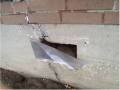
Original vents destroyed where removed, replacement metal mesh destroyed, metal ripped off from concrete anchoring screws to gain entry, cracked concrete foundation :

1757373149238.png

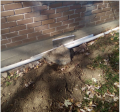
Added marble strips, stones and bricks along foundation :
1757373375850.png

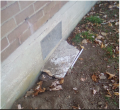
And marble slabs much larger than in the image, at several other key places over the dig. Replaced metal mesh with a thicker 3mm. That worked (for the vents) !:
1757373549352.png

Am never toying posting at the forum, this is a serious battle, so do not take me lightly...
 

crutschow

Joined Mar 14, 2008
38,392
am exploring other unconventional ways for a wire over soil instead of the commercial fence meant for higher levels and animals.
If you have dealt with chewed doors, subfloors, hardwood floors, heating ducts, destroying basement vents, well... you can install your standard electric fence charger.
Not sure what all that means.

I'm pretty sure an electric fence wire could be mounted a couple cm above the ground on insulators and would discourage the marmots.
I don't see how the fact that the wire is usually mounted at a higher level for larger animals is relevant.

You can certainly use some "unconventional way" of electric deterrence, but I don't see what that will gain you, other than the chance of electrocution.
 

Tonyr1084

Joined Sep 24, 2015
9,744
I had cats in an apartment that didn't allow animals. Cats were always in the windows and getting seen. Made my own electric fence for the window sills. Consisted of a spark coil from an old stove with electronic ignition. Used wire tape (two copper wires in a tape form, separated and made for placing on the wall). Cut slits in the surface tape to expose an electrical pathway for the spark. The gap was too large for the spark to jump but when a cat got into the window - snap! After that you could pick the cat up by the back and try to force them into the window. It was like trying to push two very strong magnets, similar poles together. No matter how hard you tried you could not get the magnets to touch. And you could not force the cats on to the window sills.

Electricity is a good deterrent. For anyone who thinks that was cruel, I could place my hand on the tape and feel the electrical snap. Like flicking your finger into the palm of the other hand. Didn't hurt, didn't injure, didn't cause sudden loss of all 9 lives.

I take good care of my pets. Pests ? ? ? Now that's another subject. Marmots? Perhaps the electric fence zapper is the way to go. The wire needs to be over bare dirt, no vegetation, grass, weeds, flowers. High voltage / low amperage will definitely encourage your pest to go elsewhere. For spacers get some plastic spikes and hot melt glue a bare wire to the tops of the spikes, holding it an inch or two above the ground. Energize the wire with something like an electric fence kit or an old igniter box from an old appliance. As long as the wire is supported off the ground the pest won't know what hit him/her and it'll leave rather than experience that ghostly force that makes your muscles twitch and ache.
 

Thread Starter

Externet

Joined Nov 29, 2005
2,628
There is other considerations not disclosed/exposed because they are non-electrical and would needlessly inflate the thread. What you see not green grass in images is soil piled up from excavated soil. How to deal with a couple of cm high wire suspended on insulators when mowing ? Massaging a keyboard on the forum ignores the real world. Thank you.
I do not want suspended electric wires, period. Can be touching soil, can be 2cm under soil (against digging, not against presence) :
...plan is to lay on top of soil, about 20cm away from concrete foundation...
From another irrelevant non-electrical point of view, laws about wildlife considered, it is not simple as massaging a keyboard on a forum proposing solutions, it is very different dealing with reality.
Rural locations may forbid to release them to other far locations if trapped; trapped animals must be released within a certain time to avoid their suffering/starving, animals released far away may not find their way back and their offsprings may have a bad end. Animals released away can succumb to territorial clans. Some species can be untouchables. Killing off the question, it is a very complicated situation to get rid-of legally depending on location.
Electrical deterrent seems plausible, they can go dig anywhere else but not where can damage property. Protecting a foundation or garden will always have to consider risks as children.

-Nice anti-cat strategy, Tony.
 

Tonyr1084

Joined Sep 24, 2015
9,744
-Nice anti-cat strategy, Tony.
Thanks. The point was that once an animal has a non-lethal, non-injurious but frightening experience they generally tend to stay away from that same area.

No suspended wires; got it. Buried wires; would likely need to be an isolated system. And sacrificial. Two wires buried in very close proximity would (in my imaginations) need to be sacrificial because the animal will likely destroy the wires when they dig. However, I can't imagine a scenario where soil doesn't cause a resistive short circuit. The worm tickler was something that could be applying energy into the ground so that anything in the ground would find it unpleasant to be there, even if a nest already exists. Wasps and grasshoppers in my case have me thinking about using such a device to get rid of those creatures. No telling what else would come out. The power pole transformer is adjacent my yard and grounding cables are plenty. Use of 120VAC would likely disturb any and all living things in the ground. However, there has been a garter snake in my yard I don't want to send away. First saw it a few years ago for a couple years. Then last year no sign of it. This year the snake has made one appearance. I'm hoping it will be back now that I've enlarged my pond. Only, there are some new small fish that the snake might be big enough to eat. But that's nature. And the snake is not damaging my property.

While digging the new pond I unearthed an empty den. No telling how long it had been there. But before proceeding I made sure it was empty. I, too, appreciate non-harmful wildlife. Ferrel cats - that's another story.
 

crutschow

Joined Mar 14, 2008
38,392
What you see not green grass in images is soil piled up from excavated soil.
...............................
I do not want suspended electric wires, period.
Okay, now we get the rest of the story.
So lay down an insulating layer of some sort (plastic sheet, etc.), and then put the wire for the electric fencer on top of that.
 

Thread Starter

Externet

Joined Nov 29, 2005
2,628
OK, getting somewhere... Thank you. Two buried barbed wires will not be sacrificial, they are tough. Safer to a pedestrian, mowable. I can do that. The scenario for a soil causing a short circuit is avoided by a lamp or MΩ in series.

And wise; buried or surface conductor in/on loose insulating film that will be unwrapped/dislodged by claws when dug will deliver the giggles, kind of safer to pedestrians and mowing. I can do that.

1757448187303.png
 

crutschow

Joined Mar 14, 2008
38,392
Two buried barbed wires will not be sacrificial, they are tough. Safer to a pedestrian, mowable. I can do that. The scenario for a soil causing a short circuit is avoided by a lamp or MΩ in series.
Okay.
But I have my doubts that you can generate a voltage gradient in the soil over a long area, sufficient to deter them without a high current consumption from your voltage source, especially if the soil gets damp.
 
Top