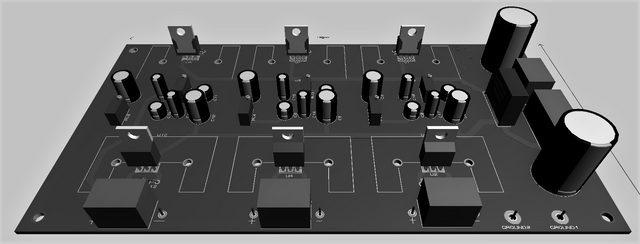
Some improvemente for this PSU?

Thread Starter

DaniKowa

Joined Sep 23, 2020
218
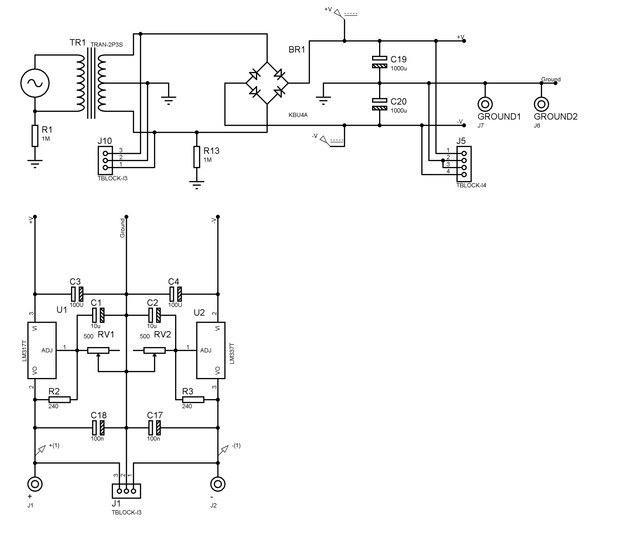
Hi, I ask for a possible improvement for this circuit. In particular (but not only) if it is necessary to add or remove something to improve the noise. Even though it should be pretty quiet already. It should / can be used to power low noise devices (eg opamp or jfet).

Thank you!


MrChips

Joined Oct 2, 2009
34,807
What voltages on the outputs do you require?
If they are fixed, I would use fixed voltage regulators.

What is the max current output required?

Remove R1 and R13.
 

dl324

Joined Mar 30, 2015
18,326
Why did you draw the regulator circuitry sideways? It's normally drawn with the input on the left and the output on the right.
In particular (but not only) if it is necessary to add or remove something to improve the noise. Even though it should be pretty quiet already. It should / can be used to power low noise devices (eg opamp or jfet).
You're using linear regulators. Where do you think noise would come from?
 

dl324

Joined Mar 30, 2015
18,326
I would have liked to have used more current regulators like an LM1084 but there doesn't seem to be the negative counterpart.
You can increase current capability by adding an external pass transistor. The datasheet gives an example.

However, they don't show you how to do it in a way that the regulator can protect the pass transistor.
 

MrChips

Joined Oct 2, 2009
34,807
Do you need both positive and negative voltage output?
Are the two voltages the same amplitude or are they independently adjusted?
 

Thread Starter

DaniKowa

Joined Sep 23, 2020
218
Ok for R1 and R13. According to the regulators I believe the maximum current is 1.5A with a good heatsink. In the first possible intended use I will use a stage at + -5Volt max 100mA and a second stage at + -12Volt always 500mA. The transformer comes out with 18 0 18. Also for this reason I have also prepared large heatsinks on the 5V.

The heatsink fingerprint is suitable for models ranging from 3 to 4.8C / W i.e. these .

The original design includes multiple adjustable output stages but I have only brought back one. What I want to have is the ability to have a power stage with multiple simultaneous outputs if needed. I would have liked to have used more current regulators like an LM1084 but there doesn't seem to be the negative counterpart. Unless 1084 is both positive and negative.

As for the noise of linear regulators, it is true that they are normally silent but I have seen linear stages that had inductors on the output. From here I thought they were needed for the noise.

Lastly, I also ask for an estimate of the width of the regulator input and output tracks. Currently they are set 0.1in. making them wider makes little sense given the width of the pads. I err?

Thank you.
 

Thread Starter

DaniKowa

Joined Sep 23, 2020
218
You can increase current capability by adding an external pass transistor. The datasheet gives an example.

However, they don't show you how to do it in a way that the regulator can protect the pass transistor.
Yes, I could use a transistor like a 3055 but I am trying to contain the PCB size which is already big enough.
 

dl324

Joined Mar 30, 2015
18,326
I could use a transistor like a 3055 but I am trying to contain the PCB size which is already big enough.
You could use a power transistor in a TO-220 package. Stand it up near the edge of the board so the heatsink can hang over the side. Doing that would likely make it difficult to have the regulators protect the pass transistors.

EDIT:
Regarding improvements. Those regulators aren't guaranteed to regulate with less than a 10mA load current. The current set resistor value you chose won't do that, so the regulators might not work until you increase the load current to at least 10mA. I once had an LM317 (from STM) that needed more than 10mA before it would work.
 
Last edited:

Ian0

Joined Aug 7, 2020
13,131
Texas instruments make some very low noise regulators for both positive and negative voltages.
https://www.ti.com/power-management/linear-regulators-ldo/products.html#p238max=7.01;30
But they can't manage anywhere near 1.5A.
But if you have some very low-noise circuitry, I can't imagine it needing anywhere near 1.5A.
Perhaps your low-noise circuitry should have its own regulator, so that other circuitry connected to the same regulator can't introduce noise. In that case you won't need 1.5A.
 

Thread Starter

DaniKowa

Joined Sep 23, 2020
218
You could use a power transistor in a TO-220 package. Stand it up near the edge of the board so the heatsink can hang over the side. Doing that would likely make it difficult to have the regulators protect the pass transistors.

EDIT:
Regarding improvements. Those regulators aren't guaranteed to regulate with less than a 10mA load current. The current set resistor value you chose won't do that, so the regulators might not work until you increase the load current to at least 10mA. I once had an LM317 (from STM) that needed more than 10mA before it would work.
Thanks for the advice. However in this case I don't really care about having more current. certainly it is the basis for having a good laboratory dual power supply. One last question if possible: Are there switching power supplies (such as those for driving LED strips) with both positive and negative outputs? Thanks again.
 

Ian0

Joined Aug 7, 2020
13,131
Are there switching power supplies (such as those for driving LED strips) with both positive and negative outputs?
No, I can't imagine why you would need one.
LED drivers don't tend to specify whether they are positive or negative output as it is rarely important. Most type have the LED load connected to V+ (so you could call them negative output), but some have the LED load connected to 0V (LM3404, for example).
I don't recall seeing any voltage-output switched-mode ICs which have a negative input and produce a negative output. There are several that take a positive input and produce a negative output; and there are types which produce an isolated output which you can make into negative, positive or both.
 

MrChips

Joined Oct 2, 2009
34,807
Why do you think you need both positive and negative supplies?

If there is a good reason for positive and negative supplies, why do you think that they need to be independently adjusted?
 

Thread Starter

DaniKowa

Joined Sep 23, 2020
218
@MrChips beacuse often i use devices they use dual supply.
@dl324 I had mistakenly posted the incomplete answer. I deleted it and published it complete.

I didn't ask for a switching power supply to drive LEDs but I was thinking about the possibility of using a switching instead of linear regulators. I know it can be done with two single power supplies but I was wondering if dual also existed. @Ian0 has already replied no. Why use switching instead of linear? Because with the same current it is much smaller and heats less. But it does filter well because it is louder.
 

dl324

Joined Mar 30, 2015
18,326
I deleted it and published it complete.
It's considered impolite to modify or delete posts that a member has responded to. It comes across as an attempt to make a member look clueless. In my case, I quoted your post, so nothing you did could remove it.
I didn't ask for a switching power supply to drive LEDs
It seemed to me that you did because you mentioned switching power supplies, LED drivers, and bipolar outputs in the same sentence.
I was wondering if dual also existed. @Ian0 has already replied no.
I don't see why they wouldn't. Computer power supplies are switching and have multiple positive and negative output voltages. Eliminating the transformer in a bipolar bench supply wouldn't be out of the question.
Why use switching instead of linear? Because with the same current it is much smaller and heats less. But it does filter well because it is louder.
Switching supplies are typically used when there's a large input to output differential voltage and high output current. These days, switching supplies should be using frequencies above the audible range.
 

Thread Starter

DaniKowa

Joined Sep 23, 2020
218
@dl324

Right observation on PC PSUs. Well if I can find a dual switching card maybe well filtered it could be a good alternative. I found dual switching cards but 1A maximum.

P.S. I didn't mean to be rude to anyone. I've never done it (at least voluntarily) and I don't think I have any reason to do it in the future either. .
 

dl324

Joined Mar 30, 2015
18,326
Well if I can find a dual switching card maybe well filtered it could be a good alternative
You could design your own. Filtering isn't very onerous, so any concerns with switching noise are usually unfounded.

I didn't mean to be rude to anyone. I've never done it (at least voluntarily) and I don't think I have any reason to do it in the future either. .
You can avoid any appearances of impropriety by not deleting posts that have been replied to. It's better to edit the post and make a note of what was changed. As I did in post #9.
 

MrChips

Joined Oct 2, 2009
34,807
It might sound logical and tempting to build a general purpose dual voltage power supply to fulfill all your future needs.

I would suggest that you first take a look at your immediate needs and see what you actually require.
For experimental breadboard needs I built my own triple power supply into the breadboard.

1A max @5V using 7805 regulator
100mA max @ 12V using 7812 regulator
100mA max @ -12V using 7912 regulator

This meets 99% of my experimental needs.
 
Top