Solving a circuit

Thread Starter

PsySc0rpi0n

Joined Mar 4, 2014
1,786
I'm posting here my calcs for V1... Gimme a couple of minutes!

\(\displaystyle{\frac{V_{1}-V_{4}}{4}+2=\frac{V_{1}}{3}\Leftrightarrow \frac{V_{1}-H_{1}-7}{4}+2=\frac{V_{1}}{3}}\)

\(\displaystyle{\frac{V_{1}-9\cdot \frac{V_{1}}{3}-7}{4}+2=\frac{V_{1}}{3}}\)

\(\displaystyle{\frac{\frac{3V_{1}-9V_{1}-21}{3}}{4}+2=\frac{V_{1}}{3}}\)

\(\displaystyle{-\frac{3V_{1}+21}{12}+2=\frac{V_{1}}{3}}\)

\(\displaystyle{-3V_{1}-21+24=4V_{1}}\)

\(\displaystyle{V_{1}=\frac{3}{7}}\,V\)
 
Last edited:

WBahn

Joined Mar 31, 2012
32,823
I'll use last image from post #28 to write some equations.

So, I think I already did this but I'll do it again.

3 nodes numbered from 1 to 3

Node 1 (note: I'll call Vn3 the voltage at node 3 to distinguish from the dependent voltage source also named V3 in the circuit and Vn1 the voltage at node 1 to distinguish from source voltage 1):
I1 = IR + I2 <=> 20 = IR + I2
<=> 20 = (Vn1/R) + ((Vn3+V1-Vn1) / R2)
<=> 20 = Vn1/3 + (Vn3-5-Vn1)/4

(not sure about the sign of the orange element value)
If you aren't sure about the sign of elements in your setup equations, then what is the point of proceeding any further until you are?

If your set up isn't correct, you are guaranteed to waste your time and get a wrong solution.

In short, you end up saying things like:

Ok, after all this work, I know this is wrong!
Uh... yeah!!

Garbage in, garbage out.

When you say that I1 = IR + I2, you are requiring that I2 be the current flowing UPWARD in R2. So that is the OPPOSITE of how the simulation schematic you are using defines it.

You then proceed to calculate I2 as the current flowing DOWNWARD in R2.

Then you proceed to replace V1, which is 5 V, with -5 V. Why?
 

WBahn

Joined Mar 31, 2012
32,823
Indeed. I forgot that result. But why I'm not getting the same result here?
Because you aren't setting up your equations consistent with the definitions you are using.

I've said this many times before -- annotate your drawings with EVERY quantity that you use in ANY of your equations!

Draw every current and every voltage that you use, including the polarity.

Then verify that your setup equations are consistent with those definitions. THIS is where ALL of the EE is at! Everything after this is just math. If your setup equations are not correct, the math can't catch it because as far as it knows you are simply solving a different circuit. Put in the time and effort to make sure that your set up equations are correct before proceeding any further.
 

MrAl

Joined Jun 17, 2014
13,702
I'm posting here my calcs for V1... Gimme a couple of minutes!

\(\displaystyle{\frac{V_{1}-V_{4}}{4}+2=\frac{V_{1}}{3}\Leftrightarrow \frac{V_{1}-H_{1}-7}{4}+2=\frac{V_{1}}{3}}\)

\(\displaystyle{\frac{V_{1}-9\cdot \frac{V_{1}}{3}-7}{4}+2=\frac{V_{1}}{3}}\)

\(\displaystyle{\frac{\frac{3V_{1}-9V_{1}-21}{3}}{4}+2=\frac{V_{1}}{3}}\)

\(\displaystyle{-\frac{3V_{1}+21}{12}+2=\frac{V_{1}}{3}}\)

\(\displaystyle{-3V_{1}-21+24=4V_{1}}\)

\(\displaystyle{V_{1}=\frac{3}{7}}\,V\)

Hi,

You really need to review some basics here. It's not hard to do, but you have to be consistent as WBahn has been pointing out.
There are some things you can be casual about, but with nodal analysis you have to do it the same way each time without variation.
Because of this and the way you seem to be doing things, it might be best if you adopt one single method and stick with that, at least for now. The most often taught way is to simply sum all the currents into the node of interest. That has some requirements that must be met too however.

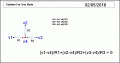
If you look at the attachment you will notice a certain symmetry. For one thing, ALL the current arrows are pointing AT the node of interest, which here is node 4. That means the assumed current direction is into node 4. That results in the symmetry as shown in the three calculations for those currents. You'll note that there are columns that have rows that have the numbers 1,2,3 but there is one column that has all 4's in it. That column is because of node 4, so v4 is always subtracted from any other node voltage. THere are three others v1,v2,v3 so we see three subtractions, and each subtraction is divided by the respective resistance R1,R2 or R3.

The equation at the bottom is the equation that sums all the currents into that one node 4.

If you reverse anything you have to change the way you write the equation, so maybe you should stick with that one way of doing it until you get a better feel for how to write these equations.
 

Attachments

Thread Starter

PsySc0rpi0n

Joined Mar 4, 2014
1,786
But YOU already know the result of V1 -- from Post #28. It's -130.5 V.
Yes, but that's because LTSpice told me, not that I have found it by calculating it!

If you aren't sure about the sign of elements in your setup equations, then what is the point of proceeding any further until you are?
Well, because only at the end, when I plugged in values into the equations, I noticed values weren't adding up! But only at the end. That's I haven't stopped before... Because I didn't know!

If your set up isn't correct, you are guaranteed to waste your time and get a wrong solution.

In short, you end up saying things like:


Uh... yeah!!

Garbage in, garbage out.
Well, same as above!

When you say that I1 = IR + I2, you are requiring that I2 be the current flowing UPWARD in R2. So that is the OPPOSITE of how the simulation schematic you are using defines it.

You then proceed to calculate I2 as the current flowing DOWNWARD in R2.
Wait... I'm not sure you're aware of my goal here... My goal is to try to solve this as if I haven't done anything in LTSpice, ok? So, I'm not supposed to follow anything from what LTSpice shows... I picked up node 1 and "chose" I1 going into node 1 and IR and I2 going out of node 1. I'm not thinking about what LTSpice is saying at this moment.

Then you proceed to replace V1, which is 5 V, with -5 V. Why?
When I wrote +V1 in the equation I meant only that I'm summing the voltage drops. But this might be a positive or a negative value depending on the direction I'm considering no? If I choose the clockwise for the net direction, values are 'x', if I choose anti-clockwise values will be '-x', no? That's why I said I was not sure about that orange part.

Because you aren't setting up your equations consistent with the definitions you are using.

I've said this many times before -- annotate your drawings with EVERY quantity that you use in ANY of your equations!

Draw every current and every voltage that you use, including the polarity.

Then verify that your setup equations are consistent with those definitions. THIS is where ALL of the EE is at! Everything after this is just math. If your setup equations are not correct, the math can't catch it because as far as it knows you are simply solving a different circuit. Put in the time and effort to make sure that your set up equations are correct before proceeding any further.
That's that consistency I was not sure. And that's why I'm trying t do this here with you guys, so that you can help me fixing and understanding my errors. I would like to be encouraged. "Uh... Yeah. Garbage in, garbage out..." doesn't seems very encouraging.

But I appreciate the the underlined text.

Hi,

You really need to review some basics here. It's not hard to do, but you have to be consistent as WBahn has been pointing out.
There are some things you can be casual about, but with nodal analysis you have to do it the same way each time without variation.
Because of this and the way you seem to be doing things, it might be best if you adopt one single method and stick with that, at least for now. The most often taught way is to simply sum all the currents into the node of interest. That has some requirements that must be met too however.

If you look at the attachment you will notice a certain symmetry. For one thing, ALL the current arrows are pointing AT the node of interest, which here is node 4. That means the assumed current direction is into node 4. That results in the symmetry as shown in the three calculations for those currents. You'll note that there are columns that have rows that have the numbers 1,2,3 but there is one column that has all 4's in it. That column is because of node 4, so v4 is always subtracted from any other node voltage. THere are three others v1,v2,v3 so we see three subtractions, and each subtraction is divided by the respective resistance R1,R2 or R3.

The equation at the bottom is the equation that sums all the currents into that one node 4.

If you reverse anything you have to change the way you write the equation, so maybe you should stick with that one way of doing it until you get a better feel for how to write these equations.
That's what I tried to do.

First I tried to write the nodal equations for nodes 1, 2 and 3. For node 3 I said I was not sure how to do it but I did it for the other 2. I'm just not sure where it went bad!

@MrAl those equations and calcs I did them using your stating equations you posted before! Then I just tried to simplify and come up with a value!

Where did I went wrong?
 

WBahn

Joined Mar 31, 2012
32,823
Well, because only at the end, when I plugged in values into the equations, I noticed values weren't adding up! But only at the end. That's I haven't stopped before... Because I didn't know!
So when you said that you weren't sure of the signs in the setup equations, was that only after the fact?

If so, that's not at all evident reading the post since we can't tell that you went back and made that term orange and added some text in there. We pretty much have to assume that what we read is in the same order that you wrote it.

Wait... I'm not sure you're aware of my goal here... My goal is to try to solve this as if I haven't done anything in LTSpice, ok? So, I'm not supposed to follow anything from what LTSpice shows... I picked up node 1 and "chose" I1 going into node 1 and IR and I2 going out of node 1. I'm not thinking about what LTSpice is saying at this moment.
And I wasn't referring to the simulation at all. Draw the circuit on a piece of paper.

When you wrote

I1 = IR + I2

You are saying either that I1 is flowing into the node and IR and I2 are both flowing out, OR you are saying that I1 is flowing out of the node and IR and I2 are both flowing in. Since I1 is defined as flowing into the node, you are defining IR and I2 to be flowing out, which means that IR is flowing from right to left through R and I2 is flowing UPWARD through R2.

That's perfectly fine. If you want to define things that way, then define them that way. But then you must be CONSISTENT with that definition.

The current flowing UPWARD through R2 is (V1 - V4)/R2.

But in your equation, you use (Vn3+V1 - Vn1)/R2, which is (V4 - V1)/R2, which is the current flowing DOWNWARD through R2.

You are not being consistent with your definitions!

Notice that no where in here have I made ANY reference to the LTSpice simulation.

When I wrote +V1 in the equation I meant only that I'm summing the voltage drops. But this might be a positive or a negative value depending on the direction I'm considering no? If I choose the clockwise for the net direction, values are 'x', if I choose anti-clockwise values will be '-x', no? That's why I said I was not sure about that orange part.
V1 is the voltage of the 5 V supply and it is, by definition, the voltage of the positive terminal relative to the negative terminal. In terms of the node voltages, it is V43 = (Vn4 - Vn3).

Let's deconflict the notation by calling the two voltage supplies Vs1 and Vs2 and the current supply Is. That way we can use the node voltage directly, namely V1, V2, V3, and V4.

You can always fall back to basics. The voltages around that right hand loop can be written as

0 V = V00 (V00 is the voltage at Node 0 relative to the voltage at Node 0).

Using the double subscript definition that

Vab = Va - Vb

Then

Vac = Va - Vc = Va - Vb + Vb - Vc = Vab + Vbc

You can then expand this one step at a time until you go around the loop.

0 V = V00
0 V = V01 + V10
0 V = V01 + V14 + V40
0 V = V10 + V14 + V43 + V30

If you want to use

Is = Ir + I2, then, as already stated, you are defining Ir and I2 to be flowing OUT of node 3. So

Is = V30/R + V34/R2

We also have

V41 = 5 V = -V14
 

Thread Starter

PsySc0rpi0n

Joined Mar 4, 2014
1,786
Ok, I'm going to redraw the circuit and name all nodes differently and in such way no conflicting names are going to mess our communication.

Gimme some minutes!

PS: I'm also going to remove the pins labels to make the circuit a bit cleaner as @MrAl suggested!
 

WBahn

Joined Mar 31, 2012
32,823
Ok, I'm going to redraw the circuit and name all nodes differently and in such way no conflicting names are going to mess our communication.

Gimme some minutes!
Sounds like a good plan. I'm going to be leaving shortly and probably won't be back online until late tonight.
 

Thread Starter

PsySc0rpi0n

Joined Mar 4, 2014
1,786
I'll try to take a better picture when I get home @WBahn.

@MrAl I only have wrote the current equations and I would like to know if they are correct before continue, so that I'm not throwing work to the trash.
If you can check them from the picture I posted, please check. If not, I'll post a better picture when I get home!

Thanks
Psy
 

MrAl

Joined Jun 17, 2014
13,702
I'll try to take a better picture when I get home @WBahn.

@MrAl I only have wrote the current equations and I would like to know if they are correct before continue, so that I'm not throwing work to the trash.
If you can check them from the picture I posted, please check. If not, I'll post a better picture when I get home!

Thanks
Psy
Hi,

Yes please post a better picture and try to explain what you are trying to accomplish in each diagram.
 

WBahn

Joined Mar 31, 2012
32,823
I was able to get it so that I can see the image fine.

It would help if you started out with a full schematic and identified the nodes.

Your top node equation (Node 3) looks fine.

Your left node equation (Node 2) looks fine.

You next node equation (Node 1) makes no sense.

I'm assuming that this is for the right-hand node. But it has R3 connected to it and I3 coming out of it. However, that means that its Node 3.

You might want to revisit that node.
 

WBahn

Joined Mar 31, 2012
32,823
Oh yes... I messed it up in Node one!

Let me fix it and I'll post the new picture here!
Spend a bit of time thinking about what I do (or someone else does) to check if your equations are correct.

We look at what you have written and then we look at the node and see if we agree with each term in the equation, including the directions for the currents. We also check to see if your definition for the currents and their directions are consistent from one equation to the next.

Isn't that something that YOU should be able to do?

You really need to get in the habit of performing those kinds of checks for EVERY equation you set up.

The reason is simple: You WILL make mistakes on a regular basis -- we ALL do. So you really need to focus on developing the habit of always checking your work. Just treat it like something that someone else gave to you asking you to check it for them and then approach it as though you don't know anything about the problem.

It will pay off HUGE if you do this.
 

Thread Starter

PsySc0rpi0n

Joined Mar 4, 2014
1,786
Ok, i tried to do that and I think my equations are correct. But still need confirmation for that Node 1. I took a new picture. Hope it is better now.
20180206_212752.jpg
 
Top