[SOLVED] power suppy board issue

Thread Starter

Kiki443

Joined Oct 8, 2023
22
Hello,

I have a power supply PCB, that serves as power supply in a laser printer (recieving 220-250VAC, outputing the same for fuser, and 'unknown' power for the rest), the reason I say 'unknown' is because it doesn't output any power or voltage at the time I tested it, while it was supposed to.

so the beginning:
I recieved this printer to fix it, and it doesn't turn on, (it should power on via a circuit breaker on the PCB itsself), the circuit breaker works, tested it eith my multimeter continuity test.
there is also 250 VAC on input and output terminals on the circuit breaker.

However now comes the wierd stuff, next in line is the fuse (250VAC/5A), it also passed continuity test, which indicates that the fuse itself is good, however, when I use my multimeter on the fuse terminals to mesure the input/output voltage, there is 0 V coming to and from the fuse, while the fuse is inserted.
As soon as I remove the fuse, the input terminal reads 250VAC, when I reinsert the fuse, the input terminal drops to 0 again, the power however still flows through the circuit breaker, and there is 250 VAC at the printer fuser terminals, as supposed.
That should not happen however, given the situation, as there is no power flowing through the PCB fuse, how is it that the fuser (the heater asambly in the printer), still has the power to it, unless that part is separate from the main fuse, or perhaps bypassed somehow. there is also something I find wierd, when messuring the wires going to the fuser heater, they read 0 V, but if I were to put my negative probe on the metal grounded casing, the multimeter would read 250VAC on both wires going to the heater, one of the wires should be ground, I belive, and if I disconnect these wires and messure the voltage on the pins, the reading is 250VAC on one, and 0 on another, as expected.

I pretty much have no idea what is happening there, the whole thing makes no sense to me, so I am looking for any ideas from someone more experienced, who might had at some point a simmilrar problem, and perhaps a way to solve it.
thanks
regards
 

Thread Starter

Kiki443

Joined Oct 8, 2023
22
It sounds like something in the power path has high resistance so a small current can drop the voltage.
Ok, but that still doesn't explain why there is voltage at the fuse input, when there is no fuse inserted, but as soon as the fuse is inserted, that voltage go to 0, the input voltage, while still being 250 VAC at the circuit breaker, if something was applying resistance on the path, it would have the same effect regardless of whether or not the fuse is inserted. Again if something was shorting it on the path, anywhere, than there would be no voltage anywhere at all.
Also I forgot to mention, I tried puting another fuse (250V/6.5A), it's the same.
 

Thread Starter

Kiki443

Joined Oct 8, 2023
22
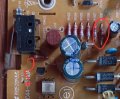
UPDATE: you gave me an idea to look deeper, there are actually two resistors in between the circuit breaker and the fuse input, both about 0,5Mohm, so while mesuring the resistance between the fuse input, and circuit breaker, it reads somewhere arround 1.1 Mohm

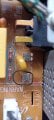
the image bellow, yellow is the circuit breaker terminals, blue, are the resistors, black is the fuse input
1696754187408.jpg
 

Jon Chandler

Joined Jun 12, 2008
1,560
When you say you measured the fuse, where exactly did you have the test leads?

Those resistors cannot be in series with the power path. What does Ohm's Law tell you about current flow vs. Voltage drop? They are likely across an input capacitor to discharge it when power is disconnected.

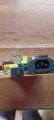
Can you show a picture of the front of the "circuit breaker"?
 

Thread Starter

Kiki443

Joined Oct 8, 2023
22
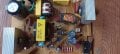
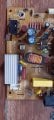
here are the pictures, took multiple so that everything is visible, if needed I can take pictures of speciffic elements.

while messuring the fuse, voltage that is, while it was inserted the red lead was on a metal thing touching the fuse (marked with black circle on previous image, black lead was on the printer's grounded casing, while messuring continuity both leads were on the fuse, one on each metal side.

as for the ohm's law, well I am not that knowlegable in physics to recite the law, I understand WHAT the resistors do, not HOW they do it.

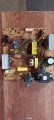
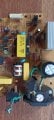
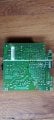
1696756951013.jpg1696756951013.jpg1696756951035.jpg1696756951013.jpg1696756951035.jpg1696756951072.jpg1696756951054.jpg1696756752989.jpg1696756752950.jpg1696756752970.jpg1696756752925.jpg1696756753005.jpg
 

Dodgydave

Joined Jun 22, 2012
11,395
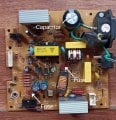
That's a switch-mode psu, the two resistors are across the filter capacitor to discharge it on power down.
Measure the voltage at the Capacitor for DC, there are also two extra fuses.


IMG_20231008_112921.jpg
 

Thread Starter

Kiki443

Joined Oct 8, 2023
22
Ok, I did my messurements with and than without the fuse, also messuring both AC and DC on both fuses and the capacitor, since I wasn't sure what kind of voltage to expect from any.

Capacitor without the fuse: - required about 20 min. to discharge all the way to 0, after removing the fuse, so that I can take an acurate messurement
AC: 0 v - messured with black lead connected to negative, and red lead connected to positive terminal
230v - messured with black lead connected to ground and a red lead to positive terminal or negative terminal
DC: 0 v - doesn't matter how the leads are connected

center fuse (F2) without the main fuse:
AC: 240v (red lead to either terminal, black lead to ground)
DC: 0v

edge fuse (F102) without the main fuse

AC: 240v (red lead to either terminal, black lead to ground)
DC: 0v


Capacitor with the fuse:
AC: 130v - messured with black lead connected to ground and a red lead to positive terminal
0v - messured with black lead connected to negative, and red lead connected to positive terminal
DC: 110v - messured with black lead connected to ground and a red lead to positive terminal
310v - messured with black lead connected to negative, and red lead connected to positive terminal
connecting the red lead to negative terminal results in negative voltage of the same value

center fuse (f2) with the main fuse:
AC: 0v (red lead to either terminal, black lead to ground)
DC: 0v (red lead to either terminal, black lead to ground)

edge fuse (F102) with the main fuse

AC: 90v (red lead to either terminal, black lead to ground)
DC: 0 v (red lead to either terminal, black lead to ground)

both F2 and F102 pass the continuity test

* center fuse is marked as F2 on the board and is the one in the physical center of the PCB
* edge fuse is the other one - marked F102 on the PCB located on the oposite side from the capacitor, right bellow the switch-sensor that detects whether or not the upper doors are closed on the printer.
 
Last edited:

Jon Chandler

Joined Jun 12, 2008
1,560
Your "circuit breaker" is just a power switch. A fuse in series with a circuit breaker doesn't make sense.

Some basic ideas, like understanding Ohm's Law, will help you eliminate "wacky ideas" and to understand the circuit. Sorry, my advice usually involves some teaching moments.

Ohms Law: V = I×R, where

V =:voltage across a resistor (volts)
I = current through a resistor (amps)
R = resistance (ohms)

Rearranging:

I = V / R

If the resistors are in series with the power supply, the equation becomes

I = 250 / 1100000 = 0.000227 AMPS =:0.227 mA

To put this in perspective, an LED requires around 10mA to light up. A current of less than a mA isn't going to power a laser printer, so it's easy to see that those resistors can't be in series with the line voltage.

Does R108 have a black band, or is it cracked in half? Can't tell from the picture.

What's the microswitch do? Cut off the power when a door is open? See if you have DC output voltage when it's pressed.

Screenshot_20231008_051859_Edge.jpg
 

Thread Starter

Kiki443

Joined Oct 8, 2023
22
A power switch, yes, I named it a circuit breaker, but whatever...

R108 has a red-black-red-gold bands on it in order.

the microswitch doesn't do anything to power supply, I belive it's just a signal switch, so when the doors are open the printer gives you an error, it doesn't shut down, at least it shouldn't, but I will check to make sure.
 

Thread Starter

Kiki443

Joined Oct 8, 2023
22
just checked, the microswitch doesn't change any voltages or anything on board, at least not for the capacitor and two fuses
 

Dodgydave

Joined Jun 22, 2012
11,395
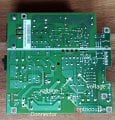
Okay what i the white connector for? (picture)
Measure the DC voltages at the test points.
Something is plugged into the connector and turns on the optocoupler to enable the output to work?

The switch-mode psu gives out DC voltage across the two capacitors when working, .
IMG_20231008_135421.jpg
 
Last edited:

Thread Starter

Kiki443

Joined Oct 8, 2023
22
again messured for both AC and DC with ands without main fuse:, black lead connected to ground.

Both Vlotage 1 and voltage 2 gave me 90-100 VAC, 0 VDC, regardless of the main fuse

not sure about the optocoupler, but the connector is the fuser unit, that is where it connects, I already explaineds what voltages I get from it.
 

Dodgydave

Joined Jun 22, 2012
11,395
again messured for both AC and DC with ands without main fuse:, black lead connected to ground.

Both Vlotage 1 and voltage 2 gave me 90-100 VAC, 0 VDC, regardless of the main fuse

not sure about the optocoupler, but the connector is the fuser unit, that is where it connects, I already explaineds what voltages I get from it.
You need to measure the voltages across the capacitors in DC directly, use the ground at the junction of the two capacitors.
it's an isolated supply, I can tell you don't know anything about switch-mode PSUs.
 

Thread Starter

Kiki443

Joined Oct 8, 2023
22
You need to measure the voltages across the capacitors in DC directly, use the ground at the junction of the two capacitors.
it's an isolated supply, I can tell you don't know anything about switch-mode PSUs.
ok, I will do that.


You are right, I don't know, I fix computers, so I know some small things, but not enough to fix such problem on my own, I never had an issue of this kind happen to me there, but If I knew, I wouldn't be asking for help.
 

Dodgydave

Joined Jun 22, 2012
11,395
If the the DC voltages are on the two capacitors then the psu is working, if not then its not kicking up, so that's why I said check the large Capacitor on the mains side to see if it had a mains supply, then check the output voltages.

These supplies are isolated from the mains they don't share the same grounds, so what you're saying is that something plugs into the white connector and is turned on by the power supply?
 

Thread Starter

Kiki443

Joined Oct 8, 2023
22
the problem is, I get no voltage in DC at the marked messuring points, only AC, and while before it was 100 VAC, after like 20 minutes, now it's 240 VAC, it was just sitting there pluged in
 

Thread Starter

Kiki443

Joined Oct 8, 2023
22
If the the DC voltages are on the two capacitors then the psu is working, if not then its not kicking up, so that's why I said check the large Capacitor on the mains side to see if it had a mains supply, then check the output voltages.

These supplies are isolated from the mains they don't share the same grounds, so what you're saying is that something plugs into the white connector and is turned on by the power supply?
the large capacitor only had the same voltage as input, when the fuse was removed, and was messured with black lead on the ground , red on either terminal, the rest of the time it's 100 or so.


yes the fuser unit plugs into the white connector, as it is rated for 240 VAC.
 

Dodgydave

Joined Jun 22, 2012
11,395
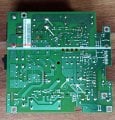
Right ( reference to the picture)measure the voltage across test points 1 negative and 2 positive DC , this is the mains input supply, it should be around 300V , if there is no voltage then the mains is not getting to the bridge rectifier.

If so then check the output voltages using test point 3 as the Negative lead and test points 1 and 2 positive, it will be giving out a DC supply , if it's not then the psu is not working.

IMG_20231008_150510.jpg
 
Top