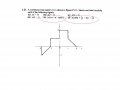
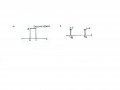
The x(t)*u(t) signal is the part of x(t) that is in the RHP.
The x(-t)*u(t) signal is the part of x(t) that is in the LHP, reversed into the RHP.
So, the sum of those to signals should be x(t)=0 until t=0. Then a straight line at amplitude 3 from t=0 to 1. And from t=1 to 2 you have a straight line from 1 to -1. The rest of time is x(t)=0.
Part f -
They're not really equations that you solve, but descriptions of signals. For example, u(t) describes the unit step signal which is defined as the signal whose amplitude is zero at time ranging from negative infinity to 0 and 1 at time ranging from 0 to positive infinity.
I have attached a pdf that shows drawings of what I am trying to say.
I just realized that on part f I drew the samples backward. At t=-3/2, the signal should have amplitude of -1/2, and at t=3/2 the signal should have amplitude of 1/2. Sorry about that.
It is so by definition. In order to analyze complex waveforms it helps to consider them as being made up of a sum of simple waveforms. The reason they are so useful in linear systems is that in a linear system you can use the principle of superposition to decompose things into simpler forms, solve them, and recombine the results.
Like Papabravo was saying... it is a definition. X(2t) is a signal, X(-2t) is a signal and u(t) is a signal. The resultant signal from adding, time distorting, and multiplying does not change the signal itself.

 Facebook
 Google
 GitHub
 Linkedin