solid aluminum caps

Thread Starter

Gibson486

Joined Jul 20, 2012
360
I am looking at Solid aluminum caps. How does solid tantalum caps differ from solid electrolytic/aluminum caps? From what I see, both are comprised as polymer. Looking on line, they both seem to have the same pros. Since most articles online are from the vendors themselves, they do not really say what the cons of each are. Any comments on this?
 

#12

Joined Nov 30, 2010
18,224
I was wondering how anybody would make a solid aluminum capacitor.
It turns out the electrolyte is solid.
 

cmartinez

Joined Jan 17, 2007
8,727
I am looking at Solid aluminum caps. How does solid tantalum caps differ from solid electrolytic/aluminum caps? From what I see, both are comprised as polymer. Looking on line, they both seem to have the same pros. Since most articles online are from the vendors themselves, they do not really say what the cons of each are. Any comments on this?
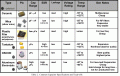
Tantalum caps are far more stable over temperature fluctuations than aluminum caps, they also have a much longer lifetime.... and of course, are more expensive, especially at at higher capacitance. Also, commercially available tantalum caps seldom reach values of more than 100µF ... although values of up to 10,000µF can be found ... for a pri¢e ...
 

#12

Joined Nov 30, 2010
18,224
Tantalum caps are far more stable over temperature fluctuations than aluminum caps, they also have a much longer lifetime...
I'm not quite sure of this, but...a solid electrolyte could resolve several weaknesses in aluminum capacitors just by eliminating the liquid. Color me hopeful.
 

cmartinez

Joined Jan 17, 2007
8,727
I'm not quite sure of this, but...a solid electrolyte could resolve several weaknesses in aluminum capacitors just by eliminating the liquid. Color me hopeful.
Your knowledge almost certainly surpasses mine... is your question regarding my assertion of temperature stability, or of its lifetime?
Also, I'm under the impression that tantalum caps react faster than aluminum for ripple suppression... would that mean that they have a lower equivalent resistance?
Again, of course I could be mistaken.

EDIT: silly me, the table I just posted says that tantalum's ESR is higher than aluminum. Still, why is there less ripple in some sims when I change aluminum to tantalum?
 

GopherT

Joined Nov 23, 2012
8,009
I'm not quite sure of this, but...a solid electrolyte could resolve several weaknesses in aluminum capacitors just by eliminating the liquid. Color me hopeful.
Solid polymers and ionic polymer liquid electrolytes help that. Some newer technology aluminum electrolytics will last 'forever'. The manufacturers are not as optimistic as some of the materials suppliers so no clear identification on the packages yet - but, I am sure the facts and figures collected from the field tests will start to build confidence in the next few years.
 

#12

Joined Nov 30, 2010
18,224
Your knowledge almost certainly surpasses mine... is your question regarding my assertion of temperature stability, or of its lifetime?
It wasn't a question. I was just saying I am optimistic about eliminating liquids in aluminum capacitors. I think any metal in contact with a caustic electrolyte will eventually leak, and aluminum is notoriously active (chemically). And...this being new technology, I do not have an advantage over you. (I think) Both of us learned about this today.
 

cmartinez

Joined Jan 17, 2007
8,727
It wasn't a question. I was just saying I am optimistic about eliminating liquids in aluminum capacitors. I think any metal in contact with a caustic electrolyte will eventually leak, and aluminum is notoriously active (chemically). And...this being new technology, I do not have an advantage over you. (I think) Both of us learned about this today.
So I guess we'll all have to wait and see... I'm working on an application in which the lifetime of a 400µF cap working at 12V will be crucial.
 

#12

Joined Nov 30, 2010
18,224
I'm working on an application in which the lifetime of a 400µF cap working at 12V will be crucial.
The latest information I have on that is: Using a capacitor rated for UP TO twice the actual voltage will maximize its lifetime".

Personally, I have a 1978 thermostat still running with a 50 volt capacitor on a 12 volt supply (because that's what I had in the junk box). This makes me suspect the manufacturers note that I just quoted might be true.
 

cmartinez

Joined Jan 17, 2007
8,727
The latest information I have on that is: Using a capacitor rated for UP TO twice the actual voltage will maximize its lifetime".

Personally, I have a 1978 thermostat still running with a 50 volt capacitor on a 12 volt supply (because that's what I had in the junk box). This makes me suspect the manufacturers note that I just quoted might be true.
Wouldn't the fluctuations in the cap (charge/discharge) affect its lifetime too? Say, if a cap is only being use to minimize ripple (as in decoupling a digital chip) in the long run affect it differently than when it's being used to stabilize output voltage, as in an AC to DC power supply?
 

alfacliff

Joined Dec 13, 2013
2,458
life time depends on heat, heat dries out electrolytics, esr increases, more heat, more esr, pops the top off or bulges it and no more cap. thats why dry types last longer. older caps used to last a long time, 30 years or so, newer ones sometimes less than 5 years before failure. the mfgrs dont want to admit that, but electrolytics are the most failed part that goes through my shop.
 

cmartinez

Joined Jan 17, 2007
8,727
life time depends on heat, heat dries out electrolytics, esr increases, more heat, more esr, pops the top off or bulges it and no more cap. thats why dry types last longer. older caps used to last a long time, 30 years or so, newer ones sometimes less than 5 years before failure. the mfgrs dont want to admit that, but electrolytics are the most failed part that goes through my shop.
Thanks for the tip... so say, for higher temperatures, using ceramics would be the best (though probably also the most expensive) option?
 

#12

Joined Nov 30, 2010
18,224
Wouldn't the fluctuations in the cap (charge/discharge) affect its lifetime too? Say, if a cap is only being use to minimize ripple (as in decoupling a digital chip) in the long run affect it differently than when it's being used to stabilize output voltage, as in an AC to DC power supply?
What if they do? The only way you can protect your capacitor from the needs of the circuit is, "Don't install it". :confused:
 

cmartinez

Joined Jan 17, 2007
8,727
What if they do? The only way you can protect your capacitor from the needs of the circuit is, "Don't install it". :confused:
Ok... let me clarify...

Normally, if you install a cap at the output of a rectified AC source, under a light load the (unregulated) waveform looks like this:
Capture 01.JPG

And under a heavier load, it would look like this:
Capture 02.JPG

Wouldn't that affect the capacitor's lifetime?
 
Top