Solenoid Flyback protection

Status
Not open for further replies.

shortbus

Joined Sep 30, 2009
10,050
I am planning to make a kicker solenoid for a medical device
A medical device? And you using high DC voltage. Is this to kick start a heart or to stop one? you seem to my humble opinion to be out of your league doing this, even if only as a prototype. Using high voltages doesn't necessarily make a stronger kick from a solenoid, and most solenoids don't "kick" they "pull". When I say high voltages aren't necessary, look at the power from one of the old type GM starter motor solenoids, they pull many pounds on only 12VDC.
 

MaxHeadRoom

Joined Jul 18, 2013
30,684
Relays where the contacts switch Heavy DC current/high voltage use arc blow-out methods, a magnet is placed adjacent to the contacts, I have used these relays in the past.
If normal style are used, a Plasma arc continues conduction after the contacts open.
 
Last edited:

Thread Starter

Marcodavid

Joined Aug 1, 2022
39
A medical device? And you using high DC voltage. Is this to kick start a heart or to stop one? you seem to my humble opinion to be out of your league doing this, even if only as a prototype. Using high voltages doesn't necessarily make a stronger kick from a solenoid, and most solenoids don't "kick" they "pull". When I say high voltages aren't necessary, look at the power from one of the old type GM starter motor solenoids, they pull many pounds on only 12VDC.
That Medical device will be used outside of human bodies.
12vdc solenoid won't work, i need a good kick
 

shortbus

Joined Sep 30, 2009
10,050
That Medical device will be used outside of human bodies.
12vdc solenoid won't work, i need a good kick
So you think 300VDC won't hurt a patient if it's used outside the body? Medical devices have to be approved for use, I foresee problems with you high voltages. Again voltage isn't as important to getting the solenoids power, other factor apply.
 

Thread Starter

Marcodavid

Joined Aug 1, 2022
39
So you think 300VDC won't hurt a patient if it's used outside the body? Medical devices have to be approved for use, I foresee problems with you high voltages. Again voltage isn't as important to getting the solenoids power, other factor apply.
It will never hurt the patient simply cause the patient will not see this device even, i meant outside human body, there is no contact or anything between patients and the device
It seem to be lab device

Lower voltage solenoid will never produce kick power like this.
 

Tonyr1084

Joined Sep 24, 2015
9,744
Not sure I can add any more to this than the 12V / 40A relay (automotive relay) breaks down like this:
12VDC is used to actuate the relay
40A is the amperage the contacts internally are rated for.

They don't often state the contact voltage rating in an automotive relay because it's assumed the relay is going to be used in an automotive application which will never exceed 16 volts. If it DOES exceed 16 volts then the alternator's internal regulator is bad. Automotive batteries are 12.6V at full charge. 13.8V when engine is running and the battery is fully charged. Can reach into the 15 volt range shortly after starting the engine, especially when the battery is old. I've seen voltages as high as 14.5 volts shortly after starting the engine. Just exactly how much voltage an automotive relay contact is designed to handle - I don't know. There may be some specs on that somewhere, I'm sure.

Typical relays generally have a control voltage and switching amperage rating along with how many volts and whether they are AC or DC volts. Let me see if I can find an example.
 

Tonyr1084

Joined Sep 24, 2015
9,744
Before I go looking for an example relay:
It will never hurt the patient simply cause the patient will not see this device even, i meant outside human body, there is no contact or anything between patients and the device
It seem to be lab device
[edit] What happens when something shorts and the patient is exposed to high voltage?
Now it's a "Lab device"? I've been in labs. I've never seen anything being kicked. But if you have such a use - OK. But now you're exposing lab workers to high voltages. Is that smart? [end edit]

We think it's a bad idea because it IS a bad idea.

Your video shows a ball being kicked. How that can be applied to a [edit] "Patient" "Lab setting" [end edit] is beyond my imagination. Also, that ball wasn't kicked very hard or far, and the video cut before you could see just how effective it is. When it comes to YouTube, there's a lot of trickery out there. Notorious is free energy machines that DO NOT WORK.

What you've shared does not agree with the video you posted. I'm still wondering what the true nature of your intent is. If you fear someone may steal your idea and beat you to market - - - while that's possible, I think you could give enough detail for us to help you without divulging your proprietary intentions. So - how exactly is a "Kick" going to help [edit] a patient in the lab? [end edit]
 
Last edited:

Thread Starter

Marcodavid

Joined Aug 1, 2022
39
Before I go looking for an example relay:

[edit] What happens when something shorts and the patient is exposed to high voltage?
Now it's a "Lab device"? I've been in labs. I've never seen anything being kicked. But if you have such a use - OK. But now you're exposing lab workers to high voltages. Is that smart? [end edit]

We think it's a bad idea because it IS a bad idea.

Your video shows a ball being kicked. How that can be applied to a [edit] "Patient" "Lab setting" [end edit] is beyond my imagination. Also, that ball wasn't kicked very hard or far, and the video cut before you could see just how effective it is. When it comes to YouTube, there's a lot of trickery out there. Notorious is free energy machines that DO NOT WORK.

What you've shared does not agree with the video you posted. I'm still wondering what the true nature of your intent is. If you fear someone may steal your idea and beat you to market - - - while that's possible, I think you could give enough detail for us to help you without divulging your proprietary intentions. So - how exactly is a "Kick" going to help [edit] a patient in the lab? [end edit]
The guy in video used his hand without wear rubber gloves, does he get electronic shock or even hurt himself?
The solenoid kicked a hummer very strongly for my imagination.
 

Tonyr1084

Joined Sep 24, 2015
9,744
does he get electronic shock or even hurt himself?
It isn't a question of whether he got hurt or not - it's whether he risked injury. Should something go wrong with the wiring there's a potential he could have gotten knocked on his butt.
Still those relays under 200v and 60A.
Wasn't suggesting a relay for your project was pointing out the differences in AC ratings versus DC ratings. In the second example relay, using it to switch 240VAC at 30 amps means it can control 7200 watts, whereas at 28VDC it can only handle 840 watts. Therein lies the difference between using a relay with an unknown rating for one amperage and assuming it can handle the same amperage at a different rating. Especially problematic is the difference between AC and DC values. The initial video I posted demonstrated how arcing can occur when a switch is applied in a DC application versus how it responds in an AC circuit. In an AC circuit the voltage crosses zero volts 120 time in 60Hz.
 

Tonyr1084

Joined Sep 24, 2015
9,744
What is the best alternative to use instead of relay for this circuit?
For that we need much more information.
1) How long a duration do you need the solenoid energized?
2) How frequently is the solenoid expected to be energized?
3) How much work do you expect from the solenoid be performed?
4) CRITICAL: How well is it going to be isolated from all physical contact?

If you want something like a flash bulb, which takes a 1.5V battery and charges a cap up to somewhere around 300VDC and then dumps that voltage through a flash tube, a relay should suit; provided you only want a short duration pulse, and once the pulse is initiated the contacts remain closed until the charge of the cap has been dissipated.
 

Thread Starter

Marcodavid

Joined Aug 1, 2022
39
For that we need much more information.
1) How long a duration do you need the solenoid energized?
2) How frequently is the solenoid expected to be energized?
3) How much work do you expect from the solenoid be performed?
4) CRITICAL: How well is it going to be isolated from all physical contact?

If you want something like a flash bulb, which takes a 1.5V battery and charges a cap up to somewhere around 300VDC and then dumps that voltage through a flash tube, a relay should suit; provided you only want a short duration pulse, and once the pulse is initiated the contacts remain closed until the charge of the cap has been dissipated.
It should work as pulses
Click on the button for 1 sec then 4 sec off repeatedly for 5-10 mins

This process should repeated about 10-20 times a day

No physical contact even the device's case will be double isolated
 

Thread Starter

Marcodavid

Joined Aug 1, 2022
39
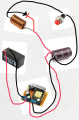
Actually i am thinking to make it very simple just add a diode as you demonstrate before this will suppress the back emf and all electronic components in circuit will be protected

But iam worry this diode slow down the speed of kick

1661958197293.png
 

ThePanMan

Joined Mar 13, 2020
922
iam worry this diode slow down the speed of kick
The diode will not slow anything down. But I think you're going to need a much larger push button switch. That tiny thing will either burn out or weld its contacts together the first time you use it.

As the magnetic field breaks down the voltage will rise quickly. All but 0.6 volts will be conducted through the diode.
The selonoid will be powered for few seconds
The solenoid will be powered for only a moment. Depending on the size of the capacitor and the amount of current the kicker solenoid draws, after the initial kick, the solenoid should be doing virtually nothing. You only need milliseconds of a pulse. If the cap is too large then there's a chance that when you release the button too much current will still be flowing.

Somewhere you asked about an alternative switching system. I'm a bit old school and an SCR comes to mind. When the gate is triggered it will remain ON until the current drops low enough to shut it off. That's an avenue worth considering.
 
Last edited:

BobTPH

Joined Jun 5, 2013
11,546
Either I am missing something or everyone else is.

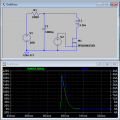
Here s how I think the circuit is working. The boost converter charges a capacitor to 200V. Then the switch is thrown discharging the capacitor very quickly through the coil. The current starts out very high giving the kick, then declines to zero quickly. There is no back EMF unless the switch interrupts the current flow.

Here is my simulation. Notice no flyback diode, because one is not needed.

1662080622749.png

The MOSFET is turned on at 0.49 seconds and then off at 0.5 seconds. The current ramps up quickly to 40A. The voltage across the inductor never goes higher then the 200V supplied because the current decays exponentially over about 10 ms.
 

DickCappels

Joined Aug 21, 2008
10,661
Marcodavid (thread starter) wrote:
"I am planning to make a kicker solenoid for a medical device (sorry can not reveal more about it)"

There will be a lot of energy available for that kicker. Thread locked pending discussion among moderators. We value your life and those upon whom you might experiment.

Edit: Since Marcodavid is unwilling to discuss details of the use of this device, we have decided to leave this thread locked. If Marcodavid changes his mind, he may contact moderation by using the Report button below. The initial question had been answered.
 
Last edited:
Status
Not open for further replies.
Top