I really recommend using a socket for the IC, and soldering the wires to the socket. Also, use thin enough wire either #26 0r #28, to avoid breaking pins off of the socket.
I'm actually getting very interested in the prototype PCB path. It looks pretty cheap.. At least the upfront costs I'm seeing. I can get a set of variations built and take some measurements.
I found (commercial link removed by moderator) and will give that a shot.
Out of curiosity, why would the moderator remove a link? We have links in many of the posts here to many different things and they are often very helpful.
Out of curiosity, why would the moderator remove a link? We have links in many of the posts here to many different things and they are often very helpful.
Circuit boards do offer advantages BUT they are difficult to modify if you want to change a connection. They are great if you need to make a bunch of copies. But creating a layout takes more than an inexpensive autorouter if you want a really good layout. And as for "cheap", that is relative.
Breakout boards like the ones show in the post above are super helpful in this case. If you insist on just using wires, use a small gauge wire. Using something like 30awg wire will help avoid the solder joints from breaking so easily.
I was thinking of laying out 4 or 5 designs on a PCB and trying a few all at once. The thing about a notch is the result will vary according to the "roll of the dice" in tolerances and component selection. Or so I'm told.
I need to hit 1kHz dead on. Or as close as possible. The advantage I have is I can tune the signal generator to match a frequency... but accuracy is preferred. I'm avoiding using pots as I'm told they're inherently noisy and unstable.
Work in progress..
The shameful thing here is the circuit I'm building is dead simple and there's probably no excuse for not just soldering this together in 10 minutes. However, I've managed to burn myself and nearly burn an XLR cable in half. This is really not my strength and I know when to admit that
I'll stick to C++.
But designing a PCB isn't something I thought I'd have an opportunity to do and I'm sure getting my own PCB in the mail will put a smile on my face... Once I figure out why this PCB designer is throwing errors...
If you are contemplating laying out a PCB there are some things you ought to know.
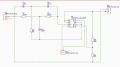
Firstly, P1 in your schematic drawing is a terrible way to indicate a pair of op-amp circuits.
Secondly, 8k, 15.9k, 99k are not standard values.
With regards a proper PCB layout, you are missing important decoupling capacitors on your V+ and V- power supply rails. This is mandatory. For your application, there would be a total of four (or more) decoupling capacitors, two from each rail to GND,
one 100nF and one 10μF (16V) in parallel.
To add to the above:
* Use 1% or better parts if you need accuracy. Have digikey and/or mouser open as you're making your design to be sure the values you are trying to use are available. You may have to change your design a bit to use parts that are actually available
* If you think it needs to be tunable due to part tolerances, add a pot at some point in your design so you can calibrate it to compensate for less than perfect parts
* Someone mentioned an expensive auto-router above for making your own PCB. No one I know, or myself, have ever used an auto-router for an actual board. In my personal experience, you get a much better result routing by hand.
* READ THE DATASHEETS for your parts, they often have recommendations for decoupling caps, footprints and layout and the devil is always in the details.
* The location for decoupling caps can be critical. Put them as close a possible to the pins for the parts that need the decoupling. Traces and wires act as antennas, if you put the caps far away from the part that needs the decoupling, the traces in-between can pick up the noise and significantly reduce their effectiveness.
* You can make quite a lot of mods to a real/custom PCB, it's actually very common for a first rev board. Have fun with it, you will make mistakes but learn a ton!
Thanks for the tips. It's my first circuit schematic. Sounds like it's looking OK overall.
Noted on the decoupling caps. This will be powered by a 9V battery initially at H1.
The resister values are the tricky part here. I've indicated the ideal measurements but I realize they don't actually exist on the shelf. I'll need to fudge these in assembly. I'm expecting to get 5 or so duplicate circuits on a PCB and then build 5 variations with different resisters. Finally, I'll select the one that fits the curve best.
If the best notch ends up 970Hz or 1088Hz I'll simply adjust the tone generator to match. I'm not expecting to be dead on at 1000Hz... I don't feel that's a reasonable expectation.
It doesn't matter what is powering your circuit. You still need decoupling capacitors. This is not an option.
It is not just to protect the circuit from the power supply. It is to protect the circuit from itself.
Thanks for the tips. It's my first circuit schematic. Sounds like it's looking OK overall.
Noted on the decoupling caps. This will be powered by a 9V battery initially at H1.
The resister values are the tricky part here. I've indicated the ideal measurements but I realize they don't actually exist on the shelf. I'll need to fudge these in assembly. I'm expecting to get 5 or so duplicate circuits on a PCB and then build 5 variations with different resisters. Finally, I'll select the one that fits the curve best.
If the best notch ends up 970Hz or 1088Hz I'll simply adjust the tone generator to match. I'm not expecting to be dead on at 1000Hz... I don't feel that's a reasonable expectation.

 Facebook
 Google
 GitHub
 Linkedin