Solar Voltage regulator (No battery)

Thread Starter

Joshua Axford

Joined Feb 23, 2016
5
Trying to build a circuit to regulate a solar panel output voltage to 12VDC, to directly drive a 3.04Amp load (bank or ventilation fans). No battery is required as the load only needs to operate when the sun is out.

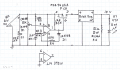
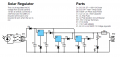
This is the circuit I have designed although I am not sure if it will handle the current and I'm not sure if I really needs all the caps as it's a pure DC input.

Any advice and observations would be greatly appreciated.
Solar regulator.png
 

wayneh

Joined Sep 9, 2010
18,085
What are the specs on your panel? There's a possibility you don't need a regulator at all if the fans can take the full output.

If you care about efficiency, there are chips that can accept a wide range of input voltages and efficiently put out your target voltage.
 

Thread Starter

Joshua Axford

Joined Feb 23, 2016
5

#12

Joined Nov 30, 2010
18,224
wayneh is right. There are several ways to do this from, "You don't need a regulator" to high efficiency and fast switching.
The first thing to do is see if you are going to answer questions or just log off and never be heard from again.
Now we have a conversation.
 

Thread Starter

Joshua Axford

Joined Feb 23, 2016
5
What are the specs on your panel? There's a possibility you don't need a regulator at all if the fans can take the full output.

If you care about efficiency, there are chips that can accept a wide range of input voltages and efficiently put out your target voltage.
Panel specs are 80W max, Voc 21.6V, Isc 5.18A, VmaxPeak 17.6V, ImaxPeak 4.55A.

My concern was the effects of over voltage and under voltage on the load. I think, not that I've tested it, that an under voltage may not be enough to turn the fan motors but burn out trying. And an over voltage may cause a short circuit as the fans are only rated at 12V. I'm sure the fans will run for a while but over and under voltage will shorten the life of the fans.

Please tell me if you don't think this is something i should worry about.
 

#12

Joined Nov 30, 2010
18,224
A 12V fan can get pretty irritated with 17v to 21V. Let's see if I can find a fast switcher for this...

How are you at soldering surface mount components?
 

Thread Starter

Joshua Axford

Joined Feb 23, 2016
5
Here's a page of fast switchers (high efficiency) and a calculator page.
If it blows your hat off, you can do the LM338 that I pointed to first.
http://www.mouser.com/Semiconductor...tching-Regulators/_/N-6j76f?P=1z0wd8nZ1z0wbdj
http://www.ti.com/ww/en/simple_switcher/index.html
I'm going to need time to digest this. I had no idea what a fast switcher was until I googled it after your previous post.

I just had a look at the datasheet and yeah, it blew my hat off. The LM338 seems like a simpler circuit and only just above my pay grade but I think I'll have a good look at the fast switcher and see if I can work it out.

Thanks for your comments. I'll be back (probably on the weekend) once I've had a good read and rethink.
 

#12

Joined Nov 30, 2010
18,224
I'll have a good look at the fast switcher and see if I can work it out.
The Simple Switcher website even sells circuit boards you can use...if you're feeling adventurous.
But the fact remains, you have plenty of solar panel to run 3 amps of fans.
You don't need to get fancy unless you want to go exploring.
 

ErnieM

Joined Apr 24, 2011
8,415
Panel specs are 80W max, Voc 21.6V, Isc 5.18A, VmaxPeak 17.6V, ImaxPeak 4.55A.

My concern was the effects of over voltage and under voltage on the load. I think, not that I've tested it, that an under voltage may not be enough to turn the fan motors but burn out trying. And an over voltage may cause a short circuit as the fans are only rated at 12V. I'm sure the fans will run for a while but over and under voltage will shorten the life of the fans.

Please tell me if you don't think this is something i should worry about.
Yes, you should worry about both over and undervoltage.

Over voltage is solved by your series regulator. Undervoltage is a trickier problem you have every day at dawn.

As the sun comes up the panel starts to produce a low Level of power. Not enough to run the fan but enough to force some current, which essentially shorts out the panel thru the motor. As the sun rises the panel just produces more current into this short and the motor never turns. the panel should be fine, and the motor may be good too as the power is low due to the shorted voltage. Still, it is not a good thing.

Even manually switching on the fan in full sun may do something similar as a motor needs more current to start up than it needs to run.

I have not done any of this, but have seen some designs on the web to add a capacitor to supply the momentary starting current, thought the designs I have seen were not very good.

As far as your posted design goes yes keep those caps as the regulator may well need them to run stable and not oscillate. Also check the min input voltage of the regulators, getting 12v out with 12v in is not all that common unless you use a LDO type regulator.

Edit to add: the LM1085 is not a very good LDO, it needs 1.5 volts across at full load, so with the diode you need over 14 volts from the panel to get the full 12 volts out.
 
Last edited:

Thread Starter

Joshua Axford

Joined Feb 23, 2016
5
Yes, you should worry about both over and undervoltage.

Over voltage is solved by your series regulator. Undervoltage is a trickier problem you have every day at dawn.

As the sun comes up the panel starts to produce a low Level of power. Not enough to run the fan but enough to force some current, which essentially shorts out the panel thru the motor. As the sun rises the panel just produces more current into this short and the motor never turns. the panel should be fine, and the motor may be good too as the power is low due to the shorted voltage. Still, it is not a good thing.

Even manually switching on the fan in full sun may do something similar as a motor needs more current to start up than it needs to run.

I have not done any of this, but have seen some designs on the web to add a capacitor to supply the momentary starting current, thought the designs I have seen were not very good.

As far as your posted design goes yes keep those caps as the regulator may well need them to run stable and not oscillate. Also check the min input voltage of the regulators, getting 12v out with 12v in is not all that common unless you use a LDO type regulator.

Edit to add: the LM1085 is not a very good LDO, it needs 1.5 volts across at full load, so with the diode you need over 14 volts from the panel to get the full 12 volts out.
I think I experienced this when I was testing the panel with half load, close to sunset. I was thinking I may have to look at a way of switching it on only when the panel voltage is above a set threshold. I haven't investigated how to do this yet.

You make a good point about using a motor start cap to help with the start up current spike.

I'm now looking at using a fast switcher as per #12's comments above, as it seems to be able to do the job so much better. I'm going back to the drawing board with all this information.

Thanks Ernie
 

wayneh

Joined Sep 9, 2010
18,085
Another approach is a current shunt to offload excess power when the voltage rises above a set point. It's very simple and does nothing below the set point. (It would use less than a couple milliamps across a zener.) It won't solve the motor startup issue, and it won't do what a switcher can do, to power the fans at low panel voltage. But maybe those aren't important in your application.
 

#12

Joined Nov 30, 2010
18,224
Right now, this is a matter of, "if". If the motor overheats during a low voltage stall, you should make an "if" switch.
"If the voltage is too low, don't try to start."
The drawing in post #13 does that job. (Not that I inspected every part in it.)
But, Bernard is known here, so it's probably good.;)
 

Bernard

Joined Aug 7, 2008
5,784
On eBay I found a buck convertor rated a 5 A, it is either constant current or constant voltage & less than US $ 3.00, might work for your application.
My memory slipped, it was not for a pump, that one was around 15 A, but can find no record of it.
#13 was tested on a breadboard, but do not remember intended load. Today , with same SP, connected several different 12 V brushless fans. On stall they lightly sing & 1.7 W one would draw the SP down to 4 V stalled ,with kick start V would climb to 7 V.
 

Bernard

Joined Aug 7, 2008
5,784
How large is C1 ? On trial with different fans & caps. I came up with 200 uF/ W, or 7200 uF.
Provision needs to be made for current inrush on start, maybe a FET to temp. bypass buck convertor or use a bigger convertor ?
 
Top