Solar Panels Specification Optmisation advice

Thread Starter

DJ_AA

Joined Aug 6, 2021
490
Hi All

I am using the following solar panel Renogy 30 Watt 12 Volt Monocrystalline Solar Panel Off Grid 12V for Motorhome, Garden, Caravan, Camper, Yacht or Boat : Amazon.co.uk: Business, Industry & Science with my battery charger LTC4162 for a 12.6V battery.


My question is related to solar technology, and I would like to gain a better understanding.

I am continuously monitoring the Vin voltage, battery voltage, input current, and battery charge current.

It works well, but since the LTC4162 is an MPPT charger, I expected that I would still get some charge even with a little sunlight.

Now, looking at the specifications:

Specifications:

  • Max Power at STC: 30W
  • Open Circuit Voltage: 22.9V
  • Optimum Operating Voltage: 19.5V
  • Short Circuit Current: 1.70A
  • Optimum Operating Current: 1.60A
  • Dimensions: 570 x 340 x 25mm / 22.4 x 13.4 x 1 in
  • Weight: 2.8 kg / 6.2 lbs
I have a couple of questions:

1.Why do they mention 12V when the panel operates at much higher voltages

2.The optimum operating voltage is specified as 19.5V. Does this mean the panel needs to reach 19.5V before it produces any current, or does it mean that at 19.5V, the panel provides the maximum output of 1.6A, with the current decreasing at lower voltages?

The reason I ask is that if I use a bench power supply set to 14V, I can charge my battery. However, when the solar panel is connected, my battery voltage doesn't start to increase until the solar panel reaches about 18V. Does this seem correct?
 

Ian0

Joined Aug 7, 2020
13,113
Hi All

I am using the following solar panel Renogy 30 Watt 12 Volt Monocrystalline Solar Panel Off Grid 12V for Motorhome, Garden, Caravan, Camper, Yacht or Boat : Amazon.co.uk: Business, Industry & Science with my battery charger LTC4162 for a 12.6V battery.


My question is related to solar technology, and I would like to gain a better understanding.

I am continuously monitoring the Vin voltage, battery voltage, input current, and battery charge current.

It works well, but since the LTC4162 is an MPPT charger, I expected that I would still get some charge even with a little sunlight.

Now, looking at the specifications:

Specifications:

  • Max Power at STC: 30W
  • Open Circuit Voltage: 22.9V
  • Optimum Operating Voltage: 19.5V
  • Short Circuit Current: 1.70A
  • Optimum Operating Current: 1.60A
  • Dimensions: 570 x 340 x 25mm / 22.4 x 13.4 x 1 in
  • Weight: 2.8 kg / 6.2 lbs
I have a couple of questions:

1.Why do they mention 12V when the panel operates at much higher voltages

2.The optimum operating voltage is specified as 19.5V. Does this mean the panel needs to reach 19.5V before it produces any current, or does it mean that at 19.5V, the panel provides the maximum output of 1.6A, with the current decreasing at lower voltages?

The reason I ask is that if I use a bench power supply set to 14V, I can charge my battery. However, when the solar panel is connected, my battery voltage doesn't start to increase until the solar panel reaches about 18V. Does this seem correct?
1. because you can use it to charge a 12V battery.
2. below the optimum voltage the panel operates like a constant current source with a current of 1.70A (at 1000W/m^2)
above the optimum voltage the current falls rapidly and becomes zero at the open circuit voltage.
it follows that the maximum output power occurs at the optimum voltage.
 

Ian0

Joined Aug 7, 2020
13,113
That point (MPP) is very dependent on the light. It changes constantly.
On the contrary, the voltage hardly changes with light intensity, but it changes about 0.3%/K with temperature.
If you look at battery charger ICs such as BQ24650, they implement a regulated input voltage, the voltage of which is adjusted by a thermistor.
 

wayneh

Joined Sep 9, 2010
18,096
FWIW, every solar battery system I've examined used a panel with an open-circuit voltage roughly double the battery nominal voltage. This system is yet another example of that rule-of-thumb.
 

nsaspook

Joined Aug 27, 2009
16,273
For a 12v panel (designed for 12v systems with normal Open Circuit Voltage of about 22V) and 12v battery LA bank charging, MPPT is often not very useful at the lower end (30W here is very optimistic) of panel and total system power for lead-acid batteries that will self-regulate low level charging. A cheap PWM controller, will in effect, act as a direct connection from the panel and battery until the max battery charging voltage set point is reached and then the PWM runs for voltage regulation as the battery nears full charge. If the panel VMP (Voltage Maximum Power) is close to the battery, PWM is just fine and at times, better in low light/power conditions.
 

Thread Starter

DJ_AA

Joined Aug 6, 2021
490
So, if the open circuit is 22V, I presume that is when either no current is being drawn or the solar panel's output is in low sunlight.
 

wayneh

Joined Sep 9, 2010
18,096
So, if the open circuit is 22V, I presume that is when either no current is being drawn or the solar panel's output is in low sunlight.
The OC voltage will be quoted for full sunshine, no load. The voltage drops in low light.
 

ronsimpson

Joined Oct 7, 2019
4,662
At full light.
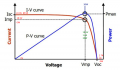
The left side is 22.9V, 0A, 0W
The right side is 0V, 1.7A, 0W
The best spot is 19.5V, 1.6A, 30W
1727624054159.png
This panel charges a car battery well. The car battery is not 12V when charging but 14.5V. For a car battery you don't need a charging circuit. The 1.5A is low enough to not damage the battery. The 12 to 15V is close to the 19.5 sweet spot.
 

Ian0

Joined Aug 7, 2020
13,113
The 1.5A is low enough to not damage the battery.
I wouldn't be too sure about that. It depends on how long you leave it on charge. Keeping the battery at 14.4V for extended periods of time will require it to be topped up with distilled water if it is a flooded battery.

Plot a vertical line on the graph at 14.4V, and you will see that the current is closer to Isc than the 1.6A at Pmax.
 

Ian0

Joined Aug 7, 2020
13,113
If you drive 12000 miles a year at an average of 40 mph, that's 300 hours of battery charging. So less than a fortnight's charging in a year. That's not going to dry out a battery, but I've seen flooded batteries used on permanent float-charge applications and even at 13.6V, they don't last long without maintenance.
A solar charger is not as bad as permanent float charge because it can only possibly charge for 6 months in the year, although here it could charge for 16 hours a day in June and July.
 
Top