SMPS set to output 12.81V (it is laptop 20V power supply), but it fluctuates between 12.2V and 12.8V at idle.

Thread Starter

AntoniGibon

Joined Feb 19, 2025
8
I have an SMPS set to output 12.81V (it is laptop 20V power supply), but it fluctuates between 12.2V and 12.8V at idle, which is around 6%. It stabilizes at 12.81V under a load, I tested it on 1.5A. Is this kind of fluctuation acceptable for an SMPS on idle, and could it potentially damage the unit over time when idle?
 

Thread Starter

AntoniGibon

Joined Feb 19, 2025
8
This originally was a small 20V 2A power supply, and this is stable on 20V. It was very easy to modify for 12.8V and it fluctuates only when idle on 12.8V and not much, just like I say around 6%.

It stops on load of 1.5A, I used a power resistor to test it on a bit higher load. Ill try today to test the range of 500Ω -10K resistors , it would be very good if it does the job at 5k-10k.
Thanks for adding up and I hope it would cause no problems when swinging slightly on idle. This was my concern, the SMSP's controller is a DAP018A, if that is adding up some info to the topic.
 

ronsimpson

Joined Oct 7, 2019
4,645
but it fluctuates between 12.2V and 12.8V at idle,
At idle the supply probably can make 12.8V very easy with only a couple of very short cycles. It realizes that it must go to 0% duty cycle or the voltage will go above 12.8V. So the supply (more or less) shuts down and coasts for a while. By 12.2V the supply wakes up and cycles a couple more time until the voltage is too high. Then shuts down again.

Some supplies do cycle skipping. Say your supply can make 5% to 50% duty cycle. It cannot make very short cycles of less than 5%. So at light load it will do 0%, 5%, 0%, 5%...... At 1/2 that load it will make a 5% then three 0%. Maybe at zero load it makes a 5% and skips 100 cycles or 1000 cycles.

In either option, (shutdown vs cycle skipping) you will see about the same unstable voltage.
 

Thread Starter

AntoniGibon

Joined Feb 19, 2025
8
At idle the supply probably can make 12.8V very easy with only a couple of very short cycles. It realizes that it must go to 0% duty cycle or the voltage will go above 12.8V. So the supply (more or less) shuts down and coasts for a while. By 12.2V the supply wakes up and cycles a couple more time until the voltage is too high. Then shuts down again.

Some supplies do cycle skipping. Say your supply can make 5% to 50% duty cycle. It cannot make very short cycles of less than 5%. So at light load it will do 0%, 5%, 0%, 5%...... At 1/2 that load it will make a 5% then three 0%. Maybe at zero load it makes a 5% and skips 100 cycles or 1000 cycles.

In either option, (shutdown vs cycle skipping) you will see about the same unstable voltage.
This seems to be what exactly is happening, similarly is behaving another SMPS that I also modified, it is a different architecture based on 6754MR and AP4310.

In the datasheet of DAP018A it says:
"Foldback / skip Frequency foldback / skip cycle adjustment By connecting a resistor to ground, it becomes possible to re-
duce the level at which frequency foldback occurs."
also mentioned R value in the datasheet is 100K

It makes me curious why at the factory 20V the SMPSs do not fluctuate but when it is adjusted to 12V it does?
 

ronsimpson

Joined Oct 7, 2019
4,645
It makes me curious why at the factory 20V the SMPSs do not fluctuate but when it is adjusted to 12V it does?
A good power supply, at the factory, is modified by you, and you wonder why it does not work the way you want.
Many power supplies have a minimum load current to operate within specs. In most cases, no load voltage regulation is not specified.
Put a one-watt load resistor on it.
This is like taking your car, (built to idle at 500RPM) modifying it then complaining because you want it to run at zero Rounds Per Minute.
Sorry I have not had my coffee yet. RonS.
 

Thread Starter

AntoniGibon

Joined Feb 19, 2025
8
A good power supply, at the factory, is modified by you, and you wonder why it does not work the way you want.
Many power supplies have a minimum load current to operate within specs. In most cases, no load voltage regulation is not specified.
Put a one-watt load resistor on it.
This is like taking your car, (built to idle at 500RPM) modifying it then complaining because you want it to run at zero Rounds Per Minute.
Sorry I have not had my coffee yet. RonS.
Well, you misunderstood the topic and reasons why I ask the question. I've learned the Ohm's law only in June 2024, then I went through the universe of integrals, derivatives and trigonometry to understand a bit better what the electronics is, so apologise my curiosity - it is my fast track of learning and I cannot stop it. Apologise to spoil this way your first coffee.

I saw a really beautiful cars and motorbikes where modification was done better than the factory, but this is not what we do here.

What I rather look for is to understand a bit better the architecture of the SMPS, and I guess the best is the way of reading, understanding, experimenting and if in doubts - ask those who knows!
 

MisterBill2

Joined Jan 23, 2018
27,159
So I present the question: Why is that no-load variation a problem?? It is not affecting the operation of a load.
Next, consider that to be regulated, there must be a feedback loop and a "perfectly stable Loop" will be a seriously difficult challenge. Besides that, most of engineering is a string of compromises, since most efforts lack infinite resources and infinite time.
 

crutschow

Joined Mar 14, 2008
38,314
Changing the voltage setting, may have affected the feedback loop compensation, making it less stable.
If you want it stable for a zero load (why?) then you would need to determine how to adjust that compensation.

If you want to know more about that compensation, look up SMPS feedback compensation for some articles on that.
 

Thread Starter

AntoniGibon

Joined Feb 19, 2025
8
Thank you both MisterBill2 and crutschow. This is exactly what I wanted to know, and I was expecting also to learn extra from extended thoughts in answers. I have a dozen of 20V good quality chargers, it would wasting of resources to not adopt them to needs if only because they are 20V.
Crutschow, I do not need it stable at idle but my question was if this is rather normal behaviour and can be accepted, especially as on expected load it is stable like a stone, even small load like a LED with 14mA keeps it fine. So your thoughts and link are good, very good answer!

MisterBill2 says: "there must be a feedback loop and a "perfectly stable Loop" will be a seriously difficult challenge.". perhaps doable to some extent, maybe another months of concluding and grasping knowledge to get a little bit closer to the point.
This chargers are about a decade old now but as long as I see soldered clean Rubycon's caps I want to use them and they look really good for any project as a base!
 

crutschow

Joined Mar 14, 2008
38,314
If you want to check the power supply stability you can do that with a step load change using a transistor to switch in a load resistor, and observe the output voltage with an oscilloscope.
If the step current change introduces only a small under/overshoot in output voltage with no more than a cycle or so of ringing, then the loop is likely acceptably stable.
 
Last edited:

Thread Starter

AntoniGibon

Joined Feb 19, 2025
8
If you want to check the power supply stability you can do that with a step load change using a transistor to switch in a load resistor, and observe the output voltage with an oscilloscope.
If the step current change introduces only a small under/overshoot in output voltage with no more than a cycle or so of ringing, then the loop is likely acceptably stable.
Thank you for the guide!

Any suggested frequency of PWM should be considered? Does it make any difference for how long should I test the PS?
 

crutschow

Joined Mar 14, 2008
38,314
Any suggested frequency of PWM should be considered?
Don't understand that question. :confused:
The PWM frequency is determined by the design of the power supply.
It's not pertinent to the transient test I suggested.
Does it make any difference for how long should I test the PS?
The transient test is just a momentary test that takes a few ms to view with the oscilloscope.
 

MisterBill2

Joined Jan 23, 2018
27,159
Consider also that a switcher supply designed and optimized for a specific computer will probably perform best at some speific load current, although it's performance will be adequate over a wider range.
 

Thread Starter

AntoniGibon

Joined Feb 19, 2025
8
Don't understand that question. :confused:
The PWM frequency is determined by the design of the power supply.
It's not pertinent to the transient test I suggested.
The transient test is just a momentary test that takes a few ms to view with the oscilloscope.
You're right, before I will ask more questions I will dig in to the literature, so please be patient as perhaps I will have more questions in this matter for a short little while before the next rabbit hole!
 

crutschow

Joined Mar 14, 2008
38,314
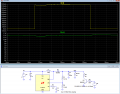
Below is the LTspice sim of a transient test for a typical SMPS:

Note the change in the output (green trace) when a load of 240mA (yellow trace) is suddenly applied at 10ms and removed at 30ms by transistor Q1.
The small voltage change with no significant under/overshoot shows that the loop is well compensated.

R4 can be connected by a switch in a real test.

1740098413332.png
 

MisterBill2

Joined Jan 23, 2018
27,159
REaly, the PWM frequency does limit the power response ability in that the supply can't respond before the next pulse. But usually that is not at all an issue.
 

crutschow

Joined Mar 14, 2008
38,314
REaly, the PWM frequency does limit the power response ability in that the supply can't respond before the next pulse. But usually that is not at all an issue.
Yes, it's not.
The PWM frequency is typically well above the loop response time as determined by the feedback loop compensation and the output LC time-constant.
That's why the loop analysis is normally done by configuring the PWM modulator as a linear gain block and ignoring the PWM frequency.
 
Top