sinus generator Hartley-sim is OK but real circuit :pulses but no sinus

Thread Starter

patpin

Joined Sep 15, 2012
405
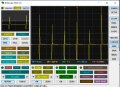
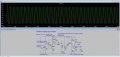
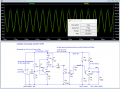
Hello This is the sim and the waveform I could sim was a nice sinus. On real PCB the oscillation are no sinuses but pulses.
Th signal was taken at the "OUT". Voltages indicated on the bitscope screen are to be multiplied by 10. (becomes 5V/div)
Also the frequency is 61KHZ instead of 400Khz.
Any ideas?

PS The L1-L2 was made of (0.6mm diam wire) windings on a paper center of about 8mm as described in the .ASC , without a core and on each other. Inserting an iron core diminished the amplitude by 1/3.
 

Attachments

Last edited:

crutschow

Joined Mar 14, 2008
38,503
At you certain the real circuit is wired exactly as the simulation with the identical component values and the correct transformer polarities?
 

Thread Starter

patpin

Joined Sep 15, 2012
405
Another question: Q2 is taking 16mA on SIM; in real PCB the BC337-25 is taking an average 93mA (DVV) an is heating up to 93°C. Why such a discrepancy SIM/real?
 

crutschow

Joined Mar 14, 2008
38,503
My simulation shows an average Q2 current of 51mA when oscillating (below).
Don't know why that's different from your sim.

The difference from the real circuit is probably due to tolerances of the real devices compared to those in the sim.

To reduce the current, increase the value of the emitter resistor, R9.

upload_2018-6-9_10-58-8.png
 

Thread Starter

patpin

Joined Sep 15, 2012
405
Thanks!; I had changed some other params in between. Q2 Ice will indeed be lower with higher R9.
That problem is as for now solved. But what temperature can a BC337-25 safely handle. The outside temperature of the PCB box can go to 100°C. Are heatsinks still functional in that case?
 

crutschow

Joined Mar 14, 2008
38,503
But what temperature can a BC337-25 safely handle.
From the datasheet:
upload_2018-6-9_14-43-24.png
Thus at 100°C the device can dissipate 625mW - (75 x 5mW) = 250mW maximum (where the junction temperature reaches 150°C).

Adding a heatsink will help even at 100°C, depending upon the thermal resistance of the heatsink.
 

crutschow

Joined Mar 14, 2008
38,503
You can measure it in LTspice by holding the ALT button and move the cursor over the transistor, then left click.
That will plot the instantaneous power.
To get the average power, hold the CTRL button and left click the power plot title.

Otherwise it's basically the average collector current times the average collector-emitter voltage.
 
Last edited:

Thread Starter

patpin

Joined Sep 15, 2012
405
Thanks for yr help. What do you think of the termal stability of the whole circuit. Is there a way to predict the frequency and amplitude change at Q2 between -20°C and 100°C. Can one simulate such events?
And a second question: Can one heatsink a TO92 package as the BC337
 
Last edited:
Top