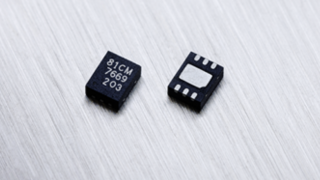
My guess is that the TS does not want a circuit that consists of a discrete component flipflop, which is a reasonable request. But will the TS accept a circuit using a CMOS or TTL IC??
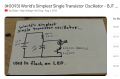
Transistors will be damaged by excessive current causing excessive heat, or by excess voltage causing a junction breakdown, leading to excess current. So there is no reason why the relaxation circuit shown would cause damage unless some limitation is exceeded.
Avalanche breakdown is a characteristic of semiconductors, but even in a controlled current and controlled voltage environment, there could be a lifetime difference between a part that just does it and a part that is designed specifically to do it. Hmmm . . .
One of the problems with a DIAC is that the ones I'm familiar with all are intended for higher voltage circuits, not little battery-and-LED stuff.
A potential problem for the two-transistor switch circuit is that 100% of the load current goes through a transistor's base. I know many small-signal transistors are rated for up to 50 mA base current, but that makes me nervous.
However, an SCR can operate down in the 3 V range and above, and is purpose-built for load current switching. An SCR should do what you want. You can get longer turn-on delays with smaller capacitors if you put a zener diode in series with the gate.
What is the intended operating voltage of the circuit?
But wait. That solves the turn-on and load current problems, but what turns off the LEDs? In the original DIAC circuit, charge is accumulated in the 1 uF cap over many AC cycles until the voltage increases enough for the DIAC to fire. After that, the LED is lit only for the remainder of that specific AC half-cycle. The DIAC opens up and the load is turned off when the incoming AC waveform goes through the next zero-crossing. If you simply pulse the power to the new circuit at a fixed freq, then the LEDs will turn on in the same pattern with every new cycle, and stay on until the power is removed again. That sorta-kinda meets your requirements, but it will not at all look like the video.
Working through this, it looks like you need to keep just about everything in the original circuit, including that power to the circuit is cycling constantly like AC in the original circuit. So, scaling all of the other components appropriately, replace the DIAC with an SCR plus a zener diode.
" Obviously I need to ditch the rectifier " No. The rectifier (or its function) is critical to the circuit's operation. A simple DC source will not do what you want.
Maybe one of the LTSpice wizards around here can model this.
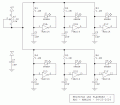
There's a potentiometer which adjusts overall flash frequency ("Master Rate" in the schematic), and each LED has its own resistor which is added to the Master Rate to control its individual flash frequency.
You could always use a simple 555 circuit along with a USB power cube.
the square wave from this 555 circuit will not be 50% duty cycle but duty cycle can be adjusted with extra components.
LEDs, 555s, Flashers, and Light Chasers
Wendy's Index
I can elaborate on this real quick: As shown in post #1 the device has a variable resistor (1M pot) labeled "Master Rate" which is shared by all 5 LEDs. Between the pot and each capacitor is a permanent resistor labeled "Rate 1" with a different value for each LED. Together the pot and resistor control how fast the capacitor charges which controls the frequency of each LED flash. The circuit is exactly the same for each LED unit, except for the "Rate 1" resistor. (I didn't design the device, I purchased it pre-built. The schematic is exactly what's on the circuit board for the first LED.)
I think this should convert well to low voltage (with different value resistors/capacitors) as long as I can replace the DIAC. I've been looking at the ideas presented in the replies and I hope to try as many of them out as I can soon.
The original circuit is five quasi-independent relaxation oscillators. What you want can be done with one 555 per LED.
Or . . . one CMOS Schmitt trigger hex inverter gets you six independent oscillators easily. If you use the LED as the feedback element, and connect all of the timing resistors together . . .
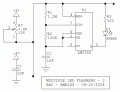
OK, a first pass *concept* schematic that replicates the approach of the #1 schematic. 74AC series logic is rated for continuous operation at 6 V, and has an extra-beefy (for CMOS) output stage for brighter flashes. The approach is the same as in #1 - the LED discharges the timing capacitor when a threshold voltage is reached during charge-up. In this case, it is approx. 3.5 V.
As in #1, R1 through R6 are to be different for each stage. You also can vary C1 through C6. I kept the initial values in #1, but my guess is that C1-6 will have to increase because the AC series hysteresis is much less than that of a DIAC. You will get better performance out of ceramic caps, but if you have to go with electrolytics, keep C7 a ceramic.
As in #1, you might have to add a resistor in series with each LED to protect the LED, gate output stage, or both; maybe 33 ohms or more.
There is a chance that this circuit will not work, because the input voltage never goes low enough to cross the lower threshold of the input stage, because the voltage drop across the LED (Vf) is too large. If so, there are options. One is to change to a CMOS family that will run on 9 V. Another is to rework the circuit so the LED is connected to Vcc, and a feedback resistor or signal diode is added to each stage. I'll mess with that tomorrow.
Any standard battery voltage from 3 volts to 12 would be fine, preferably something which can be substituted with a common inexpensive wall charger like those used to charge phones. Thanks for your schematic, I'm hoping to place an order this weekend for parts to experiment with. I'll need to answer your other questions tonight after I get home.
EDIT- sorry no time tonight, important things came up. Will reply soon!
If it doesn't actually damage the transistor over hours and days it might be fine, but there seems to be plenty of other solutions available and I'd rather have a long-term reliable solution. (FWIW, I did build that circuit and left it running for three days and it seemed fine, but again there are so many more robust solutions given in this thread.)
Here is an oscillator section based on a 555. For the timing resistor values involved, best to go with the CMOS version. Lotsa parts and pins, but it will run on anything from 1.5 V (which is too low for the LED) to 15 V.
If it doesn't actually damage the transistor over hours and days it might be fine, but there seems to be plenty of other solutions available and I'd rather have a long-term reliable solution.
In my experience, the Cappels circuit operation is marginal at 10-11 V, and its performance is very dependent on the specific transistor, and varies with temperature, from part-to-part, etc. At 12 V and above I've had no problems.
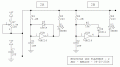
Based on version 1, here are two different fixes for more reliable operation. In 2A, the feedback diode is changed to a small-signal type. This reduces the threshold for oscillation from 2 V to 0.6 V, which is much better. However, it actually increases the stress on the AC14 output stage because now it is sinking both the timing capacitor charge and the LED current.
Next up is 2B, which fixes everything but runs up the body count. Now the output stage current can be set to any desired value with R4. The circuit is shown with a very short flash time. This can be extended by increasing R5, but note that increasing R5 decreases the oscillation voltage margin. Life is choice.
Body count: Each of the three approaches has a different number of total connected pins for six stages plus device decoupling (not counting the pot or LEDs, which are a constant for all versions).
1: 40
2B: 76
3: 108 (This one requires one decoupling cap per 555.)
I've decided to start with the schematics provided by Wendy and the AnalogKid, and I may as well try out all of them. I need to order a few parts but I'm sure one of these will get me close to what I want, and maybe I'll try some other ideas later if I get adventurous! Thanks everyone, I'll come back and post my results when I get my order all set!

 Facebook
 Google
 GitHub
 Linkedin