Simple PC audio amplifier circuit

Thread Starter

tjohnson

Joined Dec 23, 2014
611
One of my PCs doesn't have built-in speakers, so I would like to make a simple speaker circuit so that I can listen to things on it without having to use headphones. I'm not trying to make anything fancy, not even a stereo amplifier, but just a bare bones circuit that produces reasonably decent sound quality.

I've found several circuit schematics online that show how to do this sort of thing, but I'm struggling to put something together that works. This looks like it should work:
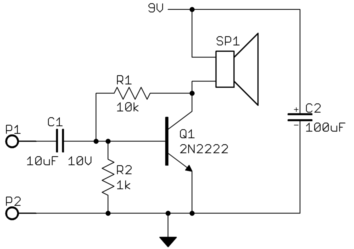
but my problem is that assuming P1 and P2 are the input audio signals, where should the 9V battery be connected? I see where one terminal should be connected at the top of the schematic, but what about the other terminal?

Or, is there a different circuit that you would recommend for this purpose?
 

Thread Starter

tjohnson

Joined Dec 23, 2014
611
Hello,

Why not use a circuit with a LM380 or LM386?

Bertus
I know that would be the easiest way to do it, but I don't have any ICs right now, so I'd prefer to use transistors instead of having to buy an IC.
 
Last edited:

bertus

Joined Apr 5, 2008
22,923
Hello,

What is the impedance of the intended speaker?
For the given circuit I would use a speaker of 32 Ohms or higher.

Bertus
 

Thread Starter

tjohnson

Joined Dec 23, 2014
611
Hello,

What is the impedance of the intended speaker?
For the given circuit I would use a speaker of 32 Ohms or higher.

Bertus
It says 8Ω, 0.25W on it. I ripped it out of an old toy, so I don't have any other specs for it.
 

Thread Starter

tjohnson

Joined Dec 23, 2014
611
Hello,

0.25 watt is not very much.
Do you have any opamps available?

Bertus
No, the only active components I have are some NPN transistors. Would this speaker work in the schematic in post #1? I suppose it's not as simple as just plugging a breadboard circuit into my computer's headphones jack?
 

bertus

Joined Apr 5, 2008
22,923
Hello,

The circuit you are showing is a class A amplifier.
There will be a DC current through the speaker and the transistor would need good cooling.

Better look for a class AB amplifier.

Bertus
 

Thread Starter

tjohnson

Joined Dec 23, 2014
611
Hello,

The circuit you are showing is a class A amplifier.
There will be a DC current through the speaker and the transistor would need good cooling.

Better look for a class AB amplifier.

Bertus
Hmm, it looks like that would require using a PNP transistor as well as NPNs, which I don't have: http://hackaweek.com/hacks/?p=332. This doesn't seem as simple as I originally thought it would be.
 

Thread Starter

tjohnson

Joined Dec 23, 2014
611
Hello,

That is a preamp circuit for an electret microphone.
That will not give any power at all.

Bertus
OK, thank you for the explanation.

Basically, I wanted to build a circuit to amplify the audio output coming out of my PC's headphone jack to make it as loud as if it was coming out of a speaker. It seems that the best way to do this is to either use an IC in the circuit, or just buy some speakers. It would be neat if there was a program that could amplify sounds being played on a PC by several hundred percent, but I'm not aware of one.
 

bertus

Joined Apr 5, 2008
22,923
Hello,

Are you using a separate sound card?
There are some soundcards that will have jumpers on them to select if the outpout has line voltage or should be connected to a speaker.

Bertus
 

Thread Starter

tjohnson

Joined Dec 23, 2014
611
Hello,

Are you using a separate sound card?
There are some soundcards that will have jumpers on them to select if the outpout has line voltage or should be connected to a speaker.

Bertus
I don't know if I understand your question exactly. I suppose the answer would be No, since I never bought a separate sound card, and am using the one that has been in the PC ever since I've had it.
 

Thread Starter

tjohnson

Joined Dec 23, 2014
611
After an hour or so of experimenting with this circuit, I actually got the speaker to work, but only for a few minutes. After I tried to use it in another PC it stopped working. The transistor became burning hot, and the circuit started to smell fried, so I assume there must be a short in the circuit somewhere. The transistor I used is a 2N2222 and the resistors are ½ watt, so I wouldn't think they would have blown. The 10μF capacitor in the schematic has a max voltage rating of 10V, so since the one I used is rated at 35V it should also be fine. Could it be problematic that the 100μF capacitor has a max rating of only 15V, or what else might be causing the circuit to short?
 
Last edited:
Top