Facebook
 Google
 GitHub
 Linkedin

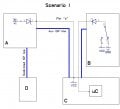
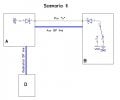
Hi. I'm trying to conceptualize how to connect 2 or more of three "devices", A B and C, utilizing an identical cable between any two pairs, when the requirements of one particular pin - let's call it Pin X - are different depending on the pair (the rest serve identical purposes regardless of the pairing, and so can be ignored).
A is always in the equation. It may be connected as A to B, or A to C, or daisy chained as A to B, B to C (B has two headers) but never A to C, C to B.
On A, Pin X is connected to the output of a 5v regulator. When connected to B (on header 1), that wire provides power to B... so that's straight forward.
On B, Pin X (on header 2) is a uC input... expecting a signal from C. That too is straight forward. (to be clear, Pin X on header 1 is completely independent from Pin X on header 2)
So I have no problem with A to B or A to B to C. My issue is with A to C.
On C, Pin X is connected to either ground or C's VCC by way of a switch. So when connected with B, that sends a high or low to B's uC. But when connected to A... I want it completely ignored. I don't want A's +5v output frying anything and I don't want C's potential connection to ground shorting anything!
Possible?
I'd draw a schematic, but honestly I don't even know how to represent it graphically. If I did, I probably wouldn't be having an issue conceptualizing it
I'm wondering if its as simple as having a diode on both A and C? I suppose my biggest concern is what happens when C's switch has its Pin X connected to ground and A's +5v is connected to it.
I know my thoughts are a bit of a mess here. I hope someone can figure out what I'm trying to say, and throw it back to me in a language that triggers my brain into seeing the problem more clearly I'm betting its either "impossible" or "simple" lol
Thanks
- Steven
A is always in the equation. It may be connected as A to B, or A to C, or daisy chained as A to B, B to C (B has two headers) but never A to C, C to B.
On A, Pin X is connected to the output of a 5v regulator. When connected to B (on header 1), that wire provides power to B... so that's straight forward.
On B, Pin X (on header 2) is a uC input... expecting a signal from C. That too is straight forward. (to be clear, Pin X on header 1 is completely independent from Pin X on header 2)
So I have no problem with A to B or A to B to C. My issue is with A to C.
On C, Pin X is connected to either ground or C's VCC by way of a switch. So when connected with B, that sends a high or low to B's uC. But when connected to A... I want it completely ignored. I don't want A's +5v output frying anything and I don't want C's potential connection to ground shorting anything!
Possible?
I'd draw a schematic, but honestly I don't even know how to represent it graphically. If I did, I probably wouldn't be having an issue conceptualizing it
I'm wondering if its as simple as having a diode on both A and C? I suppose my biggest concern is what happens when C's switch has its Pin X connected to ground and A's +5v is connected to it.
I know my thoughts are a bit of a mess here. I hope someone can figure out what I'm trying to say, and throw it back to me in a language that triggers my brain into seeing the problem more clearly
I'm betting its either "impossible" or "simple" lolThanks
- Steven