Signals and Systems help

Thread Starter

helloeveryone

Joined Apr 8, 2011
64
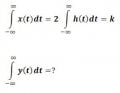
Hello, I was wondering if someone could explain how to solve the following problem step by step. x(t) is the input into the system, h(t) is the system's impulse response, and y(t) is the system's output.
 

Attachments

DerStrom8

Joined Feb 20, 2011
2,390
So what's your question?

If you're expecting us to hand you the answers on a silver platter, you've come to the wrong place. however, if you show us your work so far, we might be able to point you in the right direction.
 

Thread Starter

helloeveryone

Joined Apr 8, 2011
64
So what's your question?

If you're expecting us to hand you the answers on a silver platter, you've come to the wrong place. however, if you show us your work so far, we might be able to point you in the right direction.
What I know:
As I stated, x(t) = input, h(t) = impulse response, y(t) = output, that was not given I figured it out on my own. We are not told what kind of system it is, I'm assuming it is a Linear Time-Invariant system, or LTI system.
So, if I understand correctly, 2 times the input response is equal to the input which is equal to k. Then the output must be "something" k. If I were to give it a guess it would be that the output is y(t) = 2k. But that is just a guess, I have no idea where to even start or how I would even know if my answer was correct. So my first question is where do I start?
 

Thread Starter

helloeveryone

Joined Apr 8, 2011
64
Normally to find y(t) you have to convolve x(t) with h(t).
Hmm, I know how to convolve two continuous time signals. How does one convolve the integrals of signals? Is the first step to derive the x(t) integral , h(t) integral, and the constant k with respect to t? Maybe take the derivative of the y(t) integral as well? But, taking the derivative of everything yields 0, doesn't it? So y(t)=0?
 
Last edited:

MrAl

Joined Jun 17, 2014
13,702
Hi,

I like to see some background info for questions like this but what it looks like this might be is the two integrals are integrals of impulses, because the integral of an impulse is a constant, and they are both equal to constants.
If they are impulses then there are simplifications which you should think about as that would simplify the third integral.
If you have any more background info that might help too.
 

Thread Starter

helloeveryone

Joined Apr 8, 2011
64
Sorry, I don't have any background information.

How would I apply the Laplace transform method? Could you at least setup the problem for me?
 
Top