Should I Use Project Enclosures?

Thread Starter

MCU88

Joined Mar 12, 2015
358
Should I Use Project Enclosures?

When you do projects do you usually put them in an box? I am working on an CMOS 4000 IC tester at the moment, which uses an PIC 16F877a MCU, an LCD, a ZIF socket, a push button and not much else. I cannot decide whether or not to house the board in an case, or just present the project as an circuit board.

What is your opinion?
 

DickCappels

Joined Aug 21, 2008
10,661
With test equipment on un-mounted PC boards there is a great risk of something on the board accidentally getting in contact with stuff on the bench. These days I put every benchtop instrument in a box.
 

Thread Starter

MCU88

Joined Mar 12, 2015
358
With test equipment on un-mounted PC boards there is a great risk of something on the board accidentally getting in contact with stuff on the bench. These days I put every benchtop instrument in a box.
I agree. And I personally prefer things neatly packaged up. But downsides of projects enclosures could be...
  • Cost and availability
  • The look and feel is no longer abstract
  • Does the target audience find circuit boards impressive to look at?
  • Added complexity to the engineering of the project
 

OBW0549

Joined Mar 2, 2015
3,566
Despite the risk of shorting something and letting the "Magic Smoke" out, I usually build things as un-enclosed boards, except when a) high voltage is involved or b) I need shielding to keep interference away from low-level analog signals.
 

jpanhalt

Joined Jan 18, 2008
11,087
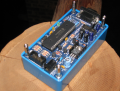
The board can serve as the top of the box/enclosure. For example, take a Hammond 1591 series box. Make the board to a size that will fit inside the lips of the box and screw it to the posts. That eliminates most of the downsides you mention. Those boxes are not expensive, and knock-offs are even cheaper. Some from China are about $0.99 each with free postage.

John

Capture1.PNG
 
Last edited:

MaxHeadRoom

Joined Jul 18, 2013
30,562
For small projects especially around the shop, I use some fairly rugged plastic containers from the $1 Store, they have a hinged snap/ latch type retainers around the edge for the cover/lid.
Max.
 

Brownout

Joined Jan 10, 2012
2,390
For small projects especially around the shop, I use some fairly rugged plastic containers from the $1 Store, they have a hinged snap/ latch type retainers around the edge for the cover/lid.
Max.
Use the clear ones, so you can gaze at all those beautiful electronics.
 

DickCappels

Joined Aug 21, 2008
10,661
At times all that is needed is something to protect the underside of the board and possibly some to which controls can be mounted. It is important for me because I have a three dimensional workbench. 1 meter long x 1 meter wide x 20 cm of past projects thick. :)
 

atferrari

Joined Jan 6, 2004
5,001
The board can serve as the top of the box/enclosure. For example, take a Hammond 1591 series box. Make the board to a size that will fit inside the lips of the box and screw it to the posts. That eliminates most of the downsides you mention. Those boxes are not expensive, and knock-offs are even cheaper. Some from China are about $0.99 each with free postage.

John

View attachment 82747
Could you show one or two more pictures John? Gracias.
 

#12

Joined Nov 30, 2010
18,224
Hacking around with an idea is fine for the top of the work bench, but I box everything I want to keep.
A metronome, a DB meter, a battery charger, a preamp in the 12db to 24db range...
If you want it to survive for 20 years, protect it.
 

jpanhalt

Joined Jan 18, 2008
11,087
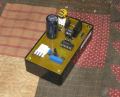
Happy to oblige. Here's something I built many years ago based on Ronald Dekker's Inductor Test Bench (http://www.dos4ever.com/flyback/flyback.html#ind2). That IC near the center that seems supported by wires is exactly that. I changed the mosfet driver and had to adapt to the different pin layout of the new chip. The toroid with the yellow wire is the device under test. The small connector is to my o'scope. The other connector is for a hefty power supply. The current can get pretty impressive.

upload_2015-3-28_20-16-46.png

Incidentally, I was able to talk CoilCraft into selling me a calibrated inductor to study core saturation. I had read about saturation, but wanted to see it. The calibration was very close. Gave me an appreciation for Mag Amps too.

BTW, the previous picture was of a device Bill at Blueroomelectronics designed. It is called a Inchworm. If you look closely, you may see the Maple Leaf on the board. That is something I am not likely to do to anything I design. ;)

The project I am working on right now is similar to the first picture I posted, but I bought the matching clear cover to put over it for protection from the weather. The clear cover allows me to see what is going on (e.g., flashing LED's on a XBee) and the only penetration is for a combined on/off switch and charge plug.

John
 
Top