Shielding low voltage signals

Thread Starter

ricn

Joined Sep 6, 2017
3
I am recording data from sensors outputting a low voltage signal (mV) but have been getting noise that I'd like to minimize. I've noticed the noise only appears when an infrared heating lamp near the sensors is set to anything less than max output. The lamp runs on 3 phase 480Vac and output level is set by phase angle controlled solid state relays. Due to space constraints, sensor wires cross over the lamp's power supply cable.

Is there a way for me shield the signal wires to reduce the noise level on the sensors? If so, what material would be best for this. Thanks!
 

philba

Joined Aug 17, 2017
959
Are you using shielded cables for the sensors? Reroute the sensor wires away from the heater, controller and power lines. Move the sensors if possible. Amplify the signal at the sensors?
 
Crossing is better than parallel. Separation distance also helps.

Standard is twisted pair shielded cable. Foil shield is fine. There is a drain wire which should be insulated with clear heat shrink and so should the ends.

Shielding reduces RFI
Twisting reduces EMI

The shield should ONLY be connected at one end, preferable the source.

Ground loops I won't even discuss.

This is the "first order" solution.
 

BR-549

Joined Sep 22, 2013
4,931
You haven't mentioned what kind of sensor we're talking about. Have you verified that the noise in coming in thru cable and not the sensor itself?
 

shteii01

Joined Feb 19, 2010
4,644
You could simply put a piece of metal between the cables where they are crossing. See if that helps.
If not.
Then you need shielded cables.
At work for 480 VAC 3 phase we use shielded cable, what we call VFD cable. However, we use it to connect motor to VFD.

Generally speaking it is easier to run sensor cable when compared to motor cable because sensor cable is smaller in diameter. So. If you need to replace one cable, definitely replace sensor cable.
 

DickCappels

Joined Aug 21, 2008
10,661
Failing all else move the dimmer to as close to the lamp as possible and then put an EMI filter on the input to the lamp. That last step would probably only be helpful if you are experiencing interference at radio frequencies.
 

OBW0549

Joined Mar 2, 2015
3,566
In addition to shielding, keep in mind the possible benefits of filtering: for best results, you may need to pass the incoming signal from your sensor through a low-pass filter to limit the bandwidth to only what is needed for your application. Filtering can get rid of a LOT of noise.
 

Thread Starter

ricn

Joined Sep 6, 2017
3
I appreciate all the feedback. The sensors are thermopiles measuring heat flux and the signals are DC voltage that representing the temperature and flux level. The odd thing is that it's only noisy when the SSRs are reducing the output below max. Not sure if that is an indicator of what type of interference is being created.
 

DickCappels

Joined Aug 21, 2008
10,661
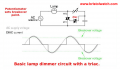
The lamps are probably being controlled by a phase controlled triac, which will switch power to the lose sometime during each half AC cycle thus controlling the average voltage applied to the lamps. This results in a high rate of voltage change vs time, which readily capacitively couples into other circuits.

upload_2017-9-8_4-23-40.png

I have a soldering iron on my bench that has a similar triac controller, and I often have to switch it off during the measurement of low level signals.
 
Top