Servo Help

Thread Starter

Icanmakeit67

Joined Sep 23, 2018
210
I recently was challenged to creat a counting seven segment display (single digit, 0-to-9 &repeat) but non traditional. I asked what do you mean? I was told surprise us. Soooo….i want to do a mechanical version using servos and plastic segment that will be swung up into place forming the segment on a digit.
I want to use 7 micro servos with arms connected to digit segments that are all up to form a zero then start swinging there segment down not quit 45 degrees but fully out of the way until needed for their segment and then swing up. I really don’t want to use programming. Is there a way to use say a CD4026 to instead of lighting an LED, trigger the rotation of a servo a fixed number of degrees(maybe 40) up for say a fixed time and then down for next number group of servos? I’m looking for a mechanical feel and look so it’s ok for several parts to make it all work. I have built 4026 counters so it’s really the non programming way to make all the servos work. Ideas? Thank You
 

BobTPH

Joined Jun 5, 2013
11,463
It would actually be much simpler to have 10 servos, each of which rotates the entire digit into view. Or, you could use solenoids to do same with some mechanical linkage.

Edited to add: Or better yet, one servo and a disk with all 10 digits on it.
 

Jerry-Hat-Trick

Joined Aug 31, 2022
777
I once built a seriously large 7 segment display with each segment being a length of plastic water pipe mounted so it could rotate on a central axis, one half circle painted red, and a magnet inside such that an electromagnet behind rotated the segment by 180 degrees according to the polarity of the coil.
 

KeithWalker

Joined Jul 10, 2017
3,603
You can
change position of a R/C servo by sending it pulses that vary between 1 and 2 mS long. The pulses should repeat about every 18 mS. It usually takes several pulses to move the servo arm through 90 degrees. If the pulses stop, it will remain in its last position if there is not much load on it.
I hope that helps.
 

Thread Starter

Icanmakeit67

Joined Sep 23, 2018
210
I once built a seriously large 7 segment display with each segment being a length of plastic water pipe mounted so it could rotate on a central axis, one half circle painted red, and a magnet inside such that an electromagnet behind rotated the segment by 180 degrees according to the polarity of the coil.
The more I look into it the less likely of it happening. Programming to turn a servo or possibly a stepper motor seems the best but I wanted a mechanical solution. Someone suggested an idea I already had namely solenoids and linkage. That’s a possibility. I want a retro feel to it not so much electronic/s. Still thinking on it.
 

Jerry-Hat-Trick

Joined Aug 31, 2022
777
The more I look into it the less likely of it happening. Programming to turn a servo or possibly a stepper motor seems the best but I wanted a mechanical solution. Someone suggested an idea I already had namely solenoids and linkage. That’s a possibility. I want a retro feel to it not so much electronic/s. Still thinking on it.
Fair enough, but maybe I didn't make clear how simple my approach was. I used the guts of a solenoid, just the coil and a mild steel bolt through it (and a nut) so as to make an electromagnet. Inside the plastic pipe I glued a magnet with the North/South poles facing diametrically outward. With the electromagnet behind the pipe, in line with the magnet, if the pipe is mounted so it can spin on its axis it will turn to align itself with the bolt, either way around, and it will stay there until the coil is driven with the right polarity to push the magnet away. Not only does it work when activated, the segments stay where they are when power is off.

Maybe you want it to be totally mechanical, no electronics at all? stepper motors,, solenoids and linkages do sound a bit more complicated. How is the digit being selected?
 

Thread Starter

Icanmakeit67

Joined Sep 23, 2018
210
Fair enough, but maybe I didn't make clear how simple my approach was. I used the guts of a solenoid, just the coil and a mild steel bolt through it (and a nut) so as to make an electromagnet. Inside the plastic pipe I glued a magnet with the North/South poles facing diametrically outward. With the electromagnet behind the pipe, in line with the magnet, if the pipe is mounted so it can spin on its axis it will turn to align itself with the bolt, either way around, and it will stay there until the coil is driven with the right polarity to push the magnet away. Not only does it work when activated, the segments stay where they are when power is off.

Maybe you want it to be totally mechanical, no electronics at all? stepper motors,, solenoids and linkages do sound a bit more complicated. How is the digit being selected?
Well I have built several different kings of example counters and among them a version of 555 clock,CD4026 that drives 7 transistors that can handle larger loads to make individual segments up to 20 LEDs. I can adjust the transistors for even larger loads. This method could drive a relay or dc solenoid… you get the picture.
 

BobTPH

Joined Jun 5, 2013
11,463
Edited to add: Or better yet, one servo and a disk with all 10 digits on it.
I think this can be implemented with one ‘555 and one CD4017 as the only chips. The ‘4017 would select different resistors for the charge cycle if a ‘555 astable. Diodes needed so the outputs that are low would not interfere.

The simple circuit I am imagining would have 1-2 ms pulse width but 16-18 off time. Don’t know if a servo would work with that variable period or not. If not, another ‘555 could be trigerred as a monostable instead.
 

Thread Starter

Icanmakeit67

Joined Sep 23, 2018
210
I think this can be implemented with one ‘555 and one CD4017 as the only chips. The ‘4017 would select different resistors for the charge cycle if a ‘555 astable. Diodes needed so the outputs that are low would not interfere.

The simple circuit I am imagining would have 1-2 ms pulse width but 16-18 off time. Don’t know if a servo would work with that variable period or not. If not, another ‘555 could be trigerred as a monostable instead.
Interesting. I’d like to see your idea
 

Ian0

Joined Aug 7, 2020
13,097
Two 555s, one to generate each of the two pulse widths required for the two servo positions, then a set of multiplexers (4053) to select which pulse is sent to each servo based on the output of the 4026
 

Thread Starter

Icanmakeit67

Joined Sep 23, 2018
210
Two 555s, one to generate each of the two pulse widths required for the two servo positions, then a set of multiplexers (4053) to select which pulse is sent to each servo based on the output of the 4026
That sounds great but admittedly I’m not at that level for the design. I am always grateful for the wealth of ideas on this forum.
 

ronsimpson

Joined Oct 7, 2019
4,647
A million years ago (+/- a little) I worked for a company that used a million of these. Really a million)
1711134341217.png
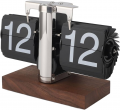
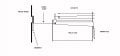
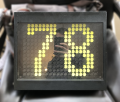
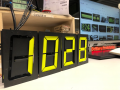
Here is a picture of flip bars.
1711134192649.png
We did not use servos, but I have seen people that did. If you need more info I have it. RonS.
 

MisterBill2

Joined Jan 23, 2018
27,186
OK, you fooled me into thinking actual servo system, not hobby RC servos.
For each segment of the display use a cylindrical piece, with stops so that only rotates part of a turn, showing either blank or color. Then use the very cheap hobby class DC motors to drive them one way or the other. The drive scheme will be simple and the voltage will be quite low to avoid burning the motor up.
 

MisterBill2

Joined Jan 23, 2018
27,186
Back about 1971 or 72, I had a digital clock that created the digits by manipulating segments in different directions. It wore out and failed after a few months, there was no hope of repair because the metal had worn away. A better scheme could be done with segment gears and cams, costing as much as a whole trainload of electronic digital clocks.
 
Top