Sense voltage while isolating MCU ADC port

ericgibbs

Joined Jan 29, 2010
21,455
Hi G,
This TI PDF is more helpful.
The input impedance requirements for an MCU ADC input are is that it less than 5k for some models, 10k for others.

I would suggest you consider on using an OPA input filter and conditioner for the ADC input, in order to get the maximum resolution from the ADC conversion.

Limiting it to 200 to 300 is IMO under utilizing the ADC resolution.

E

Added: An ADC link.. @Goxeman
https://deepbluembedded.com/stm32-adc-tutorial-complete-guide-with-examples/
 

Attachments

Last edited:

Ian0

Joined Aug 7, 2020
13,158
But be careful you don’t spoil it with a poor choice of op-amp.
The LSB of a 12 bit A/D on 3.3V is 800uV. Some op-amps will introduce an offset error that is greater than that, and look out for errors caused by op-amp input bias currents.
 

Thread Starter

Goxeman

Joined Feb 28, 2017
176
I think that I will be fine without the op amp that would introduce other variables.

Going back to the topic of the Figure 17 from ST. I am curious, what is C1 going doing? Blocking a frequency?
 

Ian0

Joined Aug 7, 2020
13,158
I think that I will be fine without the op amp that would introduce other variables.

Going back to the topic of the Figure 17 from ST. I am curious, what is C1 going doing? Blocking a frequency?
It’s an AC coupled input. I assume it is for audio.
 

Thread Starter

Goxeman

Joined Feb 28, 2017
176
Two contradictory points.
1. Increasing the resistances in the potential divider reduces the possible fault current that would go through the processor protection diode.
2. The ADC needs a low source impedance if it is to sample quickly.
A capacitor across the lower resistor would ensure the low source impedance, but would limit the frequency you can measure.
If the voltage you are measuring doesn't change much, then that isn't a problem, and a bit of filtering would help remove all sorts of interference and noise.
Hi Ian,

Would you use the capactitor close to the node point of the resistor divider or close to the ADC pin of the MCU?
 

Ian0

Joined Aug 7, 2020
13,158
Hi Ian,

Would you use the capactitor close to the node point of the resistor divider or close to the ADC pin of the MCU?
If you‘re thinking of pcb layout, then close to the device will have a small advantage. You have to charge the ADC’s sample and hold capacitor before it can take an accurate reading. It’s <10pF but it still takes time and current to do it.
 

ericgibbs

Joined Jan 29, 2010
21,455
hi G,
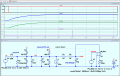
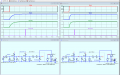
For reference only, a typical MCU ADC

With and without the 100p, note the delayed sampling time.
As I asked earlier, exactly what voltages will you be sampling in order to determine what parameters?
E

EG57_ 997.png
 

Thread Starter

Goxeman

Joined Feb 28, 2017
176
hi G,
For reference only, a typical MCU ADC

With and without the 100p, note the delayed sampling time.
As I asked earlier, exactly what voltages will you be sampling in order to determine what parameters?
E

View attachment 299073
The output of the resistor divider will be between 0,5 and 3,3
I don’t mind having a bit of delay in sampling as this is only for readings
 

Thread Starter

Goxeman

Joined Feb 28, 2017
176
Hi guys,

I am back with my project and reading about different things I though that output impedance fo the voltage divider would be very high for the ADC dont you think? I read a bit about it and I have found in a couple of places that impedance to the ADC should be no more than 10K
 

ericgibbs

Joined Jan 29, 2010
21,455
Hi G,
Check out this option for an OPA.
E
Sorry to say, I did a full working simulation a week ago, but you did not want to use an OPA, so I deleted it.:(
Please post your OPA circuit and will will run it in simulation.
 

Attachments

Ian0

Joined Aug 7, 2020
13,158
The impedance restriction is to ensure that the sample and hold capacitance is charged quickly enough. The capacitance is about 10pF. 100nF capacitor across the input holds 10,000 times the charge required by the sample and hold capacitance, so that will suffice and there is no need for an op-amp.
 
Top