Scroll with Tracking output LEDs and input IR sensors

Thread Starter

q12x

Joined Sep 25, 2015
2,227
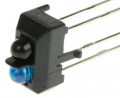
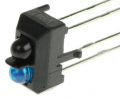
I have 10pcs of these TCRT5000 (Infrared LED emitter + phototransistor): https://www.vishay.com/docs/83760/tcrt5000.pdf
I will call them IR for short.
1717992468813.png
I want to make a cct with these 10 IR's to function like this: - When I sweep my finger over them dispose in line, one after another, some 10 output LEDs will light up a single LED but retain the last position (LED on) of the last finger sweep over the last IR. For ex, if I sweep to 7th IR, the output will have all LEDs off, except LED 7 on. When Im not touching the IR's anymore, the output will still retain the last position. Like a memory.
I already tried this cct using simple steel wires:
part1 - /https://youtu.be/z2p-qGrjdeA (9:52)
part2 - /https://youtu.be/e_u4PA-61m8 (19:39)
but I encounter some problems and the cct was glitchy. A UK friend of mine liked the idea and send me these IR's while he tried it's own cct design in his side. He reach a stage of the cct but he didnt manage to finalize it as my original problem to be solved.
I liked his idea using these IR's and I already received them from some time now. His idea of using IR's gives me the impression to be a bit more solid and stable than my steel wires version that was influenced by 50Hz radio interference or electrostatic, or something, because it was buggy like I present it in my movies.
So.... Im after the logic cct that will do all that.
Thank you for playing.
 
Last edited:

MisterBill2

Joined Jan 23, 2018
27,164
With steel wires, these could be a good guitar pickup. Possibly that is the actual intention. They can work very well, but are subject to interference from external illumination.
 

dl324

Joined Mar 30, 2015
18,218
I want to make a cct with these 10 IR's to function like this: - When I sweep my finger over them dispose in line, one after another, some 10 output LEDs will light up a single LED but retain the last position (LED on) of the last finger sweep over the last IR. For ex, if I sweep to 7th IR, the output will have all LEDs off, except LED 7 on. When Im not touching the IR's anymore, the output will still retain the last position. Like a memory.
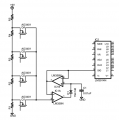
You could use the IR emitter/detectors to apply a voltage from a voltage divider to a peak detector and have the peak detector drive an LM3914 operating in dot mode.

EDIT: attach schematic fragment
1719504604621.png
Notes:
o R5 selected to keep LM358 input/output far enough away from the supply (~2V).
o C1 low leakage (e.g. polystyrene)
 
Last edited:

Thread Starter

q12x

Joined Sep 25, 2015
2,227
The AO3401 could be replaced with IRF4905 (overkill, but you just need the functionality).
Your AO3401 is in fact the phototransistor in the TCRT5000 package. (Infrared LED emitter + phototransistor). 1719575018411.png
...or you probably thought to link the phototransistor to the gate of that AO3401, maybe? My 1st version is better, more direct.
 

dl324

Joined Mar 30, 2015
18,218
My 1st version is better, more direct.
If not working reliably can be considered better. The circuit I proposed will work. And you're correct, your IR detectors are used to turn the MOSFETs (which are being used as analog switches) on.
 

Thread Starter

q12x

Joined Sep 25, 2015
2,227
Not better. but simpler I had to say.
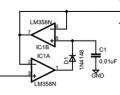
Very interesting xxx peak detector made from those 2 opamps!
1719590512960.png
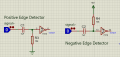
My solution is with the classical and my favorite IC 7414 which I have 1Gate IC SMD for use.
1719590474817.png
I dont think a peak detector will work if IC is not Schmitt trigered.... does LM358 has it internally and I dont know about it?
 
Last edited:

dl324

Joined Mar 30, 2015
18,218
Not better. but simpler I had to say.
Simpler is never better if it doesn't work.
I dont think a peak detector will work if IC is not Schmitt trigered.... does LM358 has it internally and I dont know about it?
A peak detector will not work if the input has hysteresis. An edge detector is not the same as a peak detector.

An edge detector is useful in digital circuits. A peak detector is an analog circuit. IC1B is a buffer that avoids loading the output of the peak detector.

You can analyze the circuit using the zero differential input theorem.

When a voltage is applied to the non-inverting input of IC1B IC1A, the opamp will try to make the same voltage appear on the inverting input. To do that, the output of IC1A needs to be a diode drop above its non-inverting input. That will put the voltage on the non-inverting input of IC1A on the non-inverting input of IC1B. That will cause the output and inverting input of IC1B to be the same voltage as the non-inverting input of IC1A. The amount of time that the circuit can hold the peak depends on capacitor leakage and current coming out of the non-inverting input of IC1B (because the input is a PNP Darlington).
 
Last edited:

Thread Starter

q12x

Joined Sep 25, 2015
2,227
An edge detector is not the same as a peak detector.
I confused the 2. I thought is the same thing but with different names. It turns out your peak detector is mostly used for sinusoidal wave forms, while my edge detector is mainly for square waves. To be sincere, I never used or feel the need to use a peak detector until your cct. Very...interesting !
In my mind, both of the detector ccts will do the same job. No? They should.
 

dl324

Joined Mar 30, 2015
18,218
In my mind, both of the detector ccts will do the same job. No? They should.
They don't and shouldn't.

An edge detector is used to detect edges. A peak detector is used to detect a peak voltage. The input to a peak detector doesn't have to be a sinusoidal waveform.
 
Top