Because the failures happen at widely different times, it is most likely that the system is running close to maximum ratings, and that heat buildup is reducing the lifetime of the different parts, so that the assorted transients have a destructive effect. Or it may just be that running at max uses up the component lifetime faster than is convenient, and that the system failures are started by a single component passing the end of life point. Highly stressed electronic parts do eventually fail. That is the motivation to reduce the highly stressed operating time.
It may be that at some point the vehicle encounters a small hill while already at a high temperature, and so an event that would not bother a cooler instance suddenly is a bit too much.
Your experience already shows that this does not happen very often.
Of course, improving the cooling of the FETs and the rest of the control system may also help. That might include adding heat sink capacity somehow, or even adding a fan.
I have been trying that route and end up chasing my tail with various failures. First the controller then the motor, now the controller again, what next a battery fire? this is a toy and not a commuter vehicle (thank God) The design works fine for speed and power, just not reliably, that is my issue. Buying endless parts is not going to solve my problem, when the over all design has a flaw in it. I am not alone with this problem, making and selling these parts is an enterprise of it's own. I want to control the current to save the motor, controller and battery from self destruction. using the battery or the controller as a limiting resistor only creates smoke and fire! The design must be safe and reliable.
The statment there about it being a toy is kind of key. Is this being used as a toy? They, even though the are made to look like an ATV aren't made to be used off of a sidewalk type of surface, not off road. If this is used off road it probably is the motor back feeding the controller when going down slope, unless made for that it isn't a good thing for the controller. Your controller is most probably what is called a "1Q" type of control, they don't like any back feed. Google, "Quadrant motor control" for more information on what I mean.
You had a reference to 4QD in another post, they are or were one of the top makers of motor controllers. I would try and find one of there products.
And I'm sorry but what you said about controlling current to save things is not real world. If I was having this much problem I'd put a gasoline motor in it.
The statment there about it being a toy is kind of key. Is this being used as a toy? They, even though the are made to look like an ATV aren't made to be used off of a sidewalk type of surface, not off road. If this is used off road it probably is the motor back feeding the controller when going down slope, unless made for that it isn't a good thing for the controller. Your controller is most probably what is called a "1Q" type of control, they don't like any back feed. Google, "Quadrant motor control" for more information on what I mean.
You had a reference to 4QD in another post, they are or were one of the top makers of motor controllers. I would try and find one of there products.
And I'm sorry but what you said about controlling current to save things is not real world. If I was having this much problem I'd put a gasoline motor in it.
I presume that if it is used "off sidewalk" that the overload is going UP the hills with an already hot set of transistors. The reverse power,(voltage feedback) will happen every time the speed command is quickly reduced.
I think the best approach is make the speed controller as beefy as possible, order one of those 800w deals for $10, then your speed controller should not be the weak link. What will kill the motor will be heat, so if you think the motor is a weak point then attach a thermal cutoff to it (Thermal Cutoffs on DigiKey)., or for over current just use a resettable circuit breaker. No need to be complicated.
Yes it is a toy and used as one in my back yard, the girls even towed it with our larger Razor 500 DLX (not good idea) when the battery ran out! The yard is flat with no major resistance. Gas motor is not an option because we have very narrow yards (side 10 foot easement) and at my property line there is an elementary school. I'm going to rebuild the controller and add filtering near the motor. If it burns up again I will look into a 4QD or another model. I'm not sure if controlling the current will help, it seems the sensitivity of the Mosfets in this environment is what is causing the failures. The controller is mounted inside (no access) an all metal case bolted to the frame of the ATV, taping a thermocouple to it I might learn how hot it gets.
I ordered an ammeter with shunt and a dual thermocouple meter. Then I will know more accurately what is going on. I guess asking for help without properly knowing the question I will never get a direct solution. But with everyone's help here, eventually I'll get there! literally!
The statment there about it being a toy is kind of key. Is this being used as a toy? They, even though the are made to look like an ATV aren't made to be used off of a sidewalk type of surface, not off road. If this is used off road it probably is the motor back feeding the controller when going down slope, unless made for that it isn't a good thing for the controller. Your controller is most probably what is called a "1Q" type of control, they don't like any back feed. Google, "Quadrant motor control" for more information on what I mean.
You had a reference to 4QD in another post, they are or were one of the top makers of motor controllers. I would try and find one of there products.
And I'm sorry but what you said about controlling current to save things is not real world. If I was having this much problem I'd put a gasoline motor in it.
Your Razor comment gave me an idea. When my son was young we had 2 Razor electric motorcycles. I could put him on the "gas tank" and I would sit on the back and ride us around the back yard in soft grass. That poor thing worked so hard, but it took the abuse and never missed a beat. My point is, take a look at the Razor design and see what they did, and try to replicate that. It was model MX500, this one: https://www.razor.com/products/electric-rides/mx500-dirt-rocket/
For the very worst case you could set it up the same way as my nephew's tractor. It has two motors and they are either in series for low speed or in parallel for the higher speed. The foot pedal control is an on/off switch. So every start is like popping the clutch on a car with the engine reved up. That is about as simple a system as can be. The high/low selection is a parent operated switch, so it stays in one or the other modes. So there you have another option.
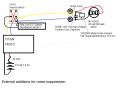
I think the controllers and their design and production are OK. But the motor, rerverse switch, reverse contactor or other RFI sources that can trigger a Latch condition that causes the Mosfet to self destruct. Obviously the designer can't assume the environment these controllers are used in but they should recommend noise suppression on the brushed motor that these are sold to drive. A full explanation of RFI and it's effect on Mosfet controllers:
I think the controllers and their design and production are OK. But the motor, rerverse switch, reverse contactor or other RFI sources that can trigger a Latch condition that causes the Mosfet to self destruct. Obviously the designer can't assume the environment these controllers are used in but they should recommend noise suppression on the brushed motor that these are sold to drive. A full explanation of RFI and it's effect on Mosfet controllers:
Yes it does! I added a dpdt switch to reverse polarity. I think by putting a snubber across the contacts and maybe a 100NF 1KV 104 High Voltage Ceramic Disc Capacitor as well, any noise will be reduced to the gates of the Mosfet. I had a free replacement controller 350 watt provided by the maker of the ATV (XPro ATV). It lasted about an hour of use, another landfill item. I guess the reverse switch is killing the controllers. She does come to a full stop before reversing though, but that has not been enough to stop the destruction of the assorted controllers I've used. I am waiting for the suppression parts on order
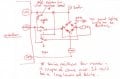
The bridge rectifier around the motor directs spikes to the battery, even when the FWD/REV switch is instantaneously open during switching. Ideally, high speed diodes should be used, but a "normal" bridge is better than none.
As an added precaution, a series resistor can be added when in reverse. This resistor can be a length of cable, or even an open wind coil of steel fencing wire as it will have a bit of resistance, and be high power.
Yes it does! I added a dpdt switch to reverse polarity. I think by putting a snubber across the contacts and maybe a 100NF 1KV 104 High Voltage Ceramic Disc Capacitor as well, any noise will be reduced to the gates of the Mosfet. I had a free replacement controller 350 watt provided by the maker of the ATV (XPro ATV). It lasted about an hour of use, another landfill item. I guess the reverse switch is killing the controllers. She does come to a full stop before reversing though, but that has not been enough to stop the destruction of the assorted controllers I've used. I am waiting for the suppression parts on order
OK, in a much earlier post I thought that I saw a comment about no reverse. But it may be just no reverse in the controller.
The solution s called a "hesitation switch", which must be paused at off and will not go immediately from forward to reverse. But at the very least, have the reversing switch be one with an off position in the middle. Consider that if the two sections do not shift at exactly the same time it will cause a short circuit until the second section shifts. And consider also that reversing at speed will certainly cause a very high current burst to reverse the motor and the vehicle.
The bridge rectifier around the motor directs spikes to the battery, even when the FWD/REV switch is instantaneously open during switching. Ideally, high speed diodes should be used, but a "normal" bridge is better than none.
As an added precaution, a series resistor can be added when in reverse. This resistor can be a length of cable, or even an open wind coil of steel fencing wire as it will have a bit of resistance, and be high power.
Consider the effect of operating that reverse switch while the motor is running full speed in one direction. Consider that a PM motor such as this one will also function very well as a generator.
This means that such a reversal applies the full voltage backward into the controller for a while. That equates to 48 volts into a dead short circuit for that time. That may tend to cause some of the problems.
So one more time I recommend having that reverse switch be a "hesitation" type of switch. Such switches enforce a momentary pause at an off position prior to allowing operation in the opposite direction.
The switch is very stiff and she has to come to a full stop before changing direction. it also has to pass through an open (middle) position to get to the other direction. I do not believe switching under power is the source of my burning Mosfet problem
Consider the effect of operating that reverse switch while the motor is running full speed in one direction. Consider that a PM motor such as this one will also function very well as a generator.
This means that such a reversal applies the full voltage backward into the controller for a while. That equates to 48 volts into a dead short circuit for that time. That may tend to cause some of the problems.
So one more time I recommend having that reverse switch be a "hesitation" type of switch. Such switches enforce a momentary pause at an off position prior to allowing operation in the opposite direction.

 Facebook
 Google
 GitHub
 Linkedin