Saturating a Transistor for a Single LED

Thread Starter

ELECTRONERD

Joined May 26, 2009
1,147
Hey,

I am in dire need of help, I am so frustrated! Here is what I need: I am trying to saturate a 2N3904 transistor so that it will turn a single LED on and off. It is similar to the following circuit:
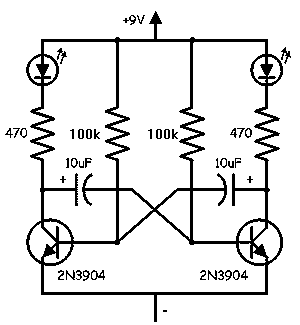

Except that I only want one LED to turn on and off. I realize that while one transistor is off, the other is on. Thus, it keeps the LED's alternating as well. The 470Ω resistors determine the current to the LED and the 100K sets the saturation current. I want to be able to calculate what resistors I need and how long I want the LED to be on and off. I DO NOT want to use a 555 timer but ONLY transistors; I want to be able to do this myself.

If you look at Figure 2 at the last page of the 2N3904 specs (http://www.fairchildsemi.com/ds/2N/2N3904.pdf), it shows the storage and fall time of the transistor, so I know that a single LED can accomplish this. I also see a 4pF cap between the collector and emitter I suppose this determines the time that it is on and off so I could use a higher value cap to make the duration longer. I'm not sure though, so PLEASE help me!

Thanks in advance!
 

Audioguru

Joined Dec 20, 2007
11,248
If the LEDs are 2.0V red ones then their current is (9V - 2V)/470 ohms= 14.9mA.
The datasheet for the 2N3904 transistor shows it saturating well with a base current that is 1/10th the collector current.
Then the base current should be 1.49mA.
The base resistor should be (9V - 0.7V)/1.49mA= 5571 ohms. Use 5.6k. The 100k is far too high.
 

Jony130

Joined Feb 17, 2009
5,600
If the LEDs are 2.0V red ones then their current is (9V - 2V)/470 ohms= 14.9mA.
The datasheet for the 2N3904 transistor shows it saturating well with a base current that is 1/10th the collector current.
Then the base current should be 1.49mA.
The base resistor should be (9V - 0.7V)/1.49mA= 5571 ohms. Use 5.6k. The 100k is far too high.
But if use Rb=10KΩ transistor will be in saturation or not ?

PS.
Sure, but, couldn't a single transistor do the job? I'm sure it can!
Yes, whit the negistor
http://www.cappels.org/dproj/simplest_LED_flasher/Simplest_LED_Flasher_Circuit.html
 
Last edited:

Wendy

Joined Mar 24, 2008
23,852
A UJT is also a transistor of a sort, a specialized unit if you will. As beenthere suggested, it would do the job with the transistor, a capacitor, one or two resistors, and a LED.

I don't think you'll be able to do it with a BJT though.
 

Thread Starter

ELECTRONERD

Joined May 26, 2009
1,147
If the LEDs are 2.0V red ones then their current is (9V - 2V)/470 ohms= 14.9mA.
The datasheet for the 2N3904 transistor shows it saturating well with a base current that is 1/10th the collector current.
Then the base current should be 1.49mA.
The base resistor should be (9V - 0.7V)/1.49mA= 5571 ohms. Use 5.6k. The 100k is far too high.
But will 5.6k saturate the transistor? I thought I would use a resistor at the base to saturate the transistor and the resistor at the collector will determine the current for the LED. I could have a 10mA LED by the way, instead of using some 20mA ones that I have.
 

Audioguru

Joined Dec 20, 2007
11,248
A 100k base resistor in that multivibrator circuit might saturate a few 2N3904 transistors if you have a bucket full of them.
10k will saturate most 2N3904 transistors in a bucket full.
5.6k will saturate all transistors if they are made by a well known manufacturer.
Use 5.6k if you want every circuit you make to work properly.

Most ordinary LEDs have a maximum current rating of 30mA. They are tested and spec'd with a current of 20mA. You can operate them at 10mA or 5mA if you want.
 

hobbyist

Joined Aug 10, 2008
892
According to my NRI course manuals,

IB > (IC / Beta. min.)

They go on to say that to ensure saturation, with modern , (general purpose transistors),

IB > (IC / 10) is a good starting point.
 

Jony130

Joined Feb 17, 2009
5,600
A 100k base resistor in that multivibrator circuit might saturate a few 2N3904 transistors if you have a bucket full of them.
Well, to be more precise, in this multivibrator circuit the 2N3904 will be in saturation, because the base current that saturate the 2N3904 will be coming from the Vcc-->LED-->470--->10uF (10 uF -capacitor charging current).
And you have to remember that statistically mostly 2N3904 will have Hfe much higher then minimum from datasheet.
Most 2N3904 will have Hfe that is show in a graph "typical Current Gain".

PS. I know I pick on
 

daroc26

Joined Apr 4, 2009
30
Hi Electronerd,

I'm working on the same circuit, however my goal is to make both LED's flash.

Can anyone tell me how to make this circuit work with +3v? How can I calculate the resistors I would need if using +3v instead of +9v?

All week I've been struggling with changing the resistor values, but no luck.

Thank you!
 

Thread Starter

ELECTRONERD

Joined May 26, 2009
1,147
Well, I suppose I'll have to use two transistors to make this work. One to turn the LED on and the other to turn it off. I saw that one circuit without the base connected to anything, but how does that work? If anyone has any more saturation calculations I'd be glad to know.
 

Ron H

Joined Apr 14, 2005
7,063
Well, to be more precise, in this multivibrator circuit the 2N3904 will be in saturation, because the base current that saturate the 2N3904 will be coming from the Vcc-->LED-->470--->10uF (10 uF -capacitor charging current).
And you have to remember that statistically mostly 2N3904 will have Hfe much higher then minimum from datasheet.
Most 2N3904 will have Hfe that is show in a graph "typical Current Gain".

PS. I know I pick on
Yeah, but if the base resistor is too high to keep the transistor in saturation after the cap is charged, then the timing will be a function of beta, and the LED current will be reduced, and also a function of beta - not generally desirable.
 
Top