Safety relay help.

Thread Starter

maintenancemetaloffice

Joined Oct 23, 2024
4
Good morning,

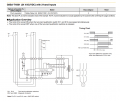
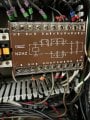
I am looking for some assistance with a safety relay. The image attached shows a relay we currently have which is pretty old now. It is intermittently sticking and I wish to replace this. Unfortunately an exact replacement is no longer available so I am wondering what I can replace this with which will be suitable? I have not got a wealth of experience with this, so I wonder if anyone is able to assist. I am leaning towards this being a 2 channel(?) relay. It runs on 24V AC.

Thank you in advance.
NZHZ2.jpg
 

nsaspook

Joined Aug 27, 2009
16,275
Last edited:

be80be

Joined Jul 5, 2008
2,394
There is not much to that all it is is a relay with two terminal blocks may even have replaceable relay we had some older equipment that was that way.

But you really need to see more then the picture you posted like what is K1 and K2 and what is S1 and S2 your problem could be any one of those

S1 and S2 Estops K1 and K2 stop and start most likely any of those can cause problems with the whole ball of wax.
 

Thread Starter

maintenancemetaloffice

Joined Oct 23, 2024
4
It will be a lot more likely to receive useful advice if you provide more information, both about the device and about the application.
My apologies.
This relay is controlling a bending sequence function on a powered press machine. Unfortunately it is a uniquely designed piece of equipment by a long departed predecessor.
Essentially upon pressing the start button, the machine applies a fold to a piece of sheet steel. Once the first bend is completed, it moves along via a pneumatic cylinder to the next position. Here it is supposed to operate the second fold, however this relay sticks. Tapping it ever so slightly initiates the second bend and completion of the sequence.
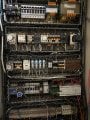
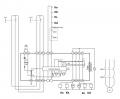
Inspecting the internals of this relay shows a row of three internal relays, of which two are blackened and have seen better days. An external inspection has ruled out possible repair owing to the internal relays connected to the circuit board being obsolete. I have attached another image showing the entire cabinet.
 

Attachments

MisterBill2

Joined Jan 23, 2018
27,358
What does the "safety relay" do?
Is it different from a normal relay?
Based only on the price difference from a "standard industrial relay", certainly a "safety relay" is quite different. They perform the same functions as we designed into equipment, but evidently somehow are better by some standard.

My guess is that a "safety relay" integrates that interlocking protection scheme into a separate package so that unknowing individuals will not so easily defeat the safety interlocking arrangement.
(That is the sort of thing that happens when unknowing folks replace fully aware folks)
 

panic mode

Joined Oct 10, 2011
4,945
That seem to be a very common two-hand anti tie down safty controller (aka "safety relay").

A1/A2 is power
two buttons are wired to 11+12+14 and 21+22+24

safety outputs are 33/34 (NO contact) and 41-42 (NC contact)\.those can drive small load or external safety relays/contactors (contact expansion).
when using contact expansion, those external relays/contactors are to be monitored.
monitoring is done by circuit 31/32.
when contact expansion relays are driven by NO (33/34) which is most of the cases. one would string NC contacts of those relays here into monitored loop.
if expansion relays are drived by NC contact (41/42), then one of normally open contact of each of those expansion relays is stringed into monitored loop.

so... if looking for replacement, just google "two hand anti tie down safety relay". there are tons of products like this on the marked from Omron, ABB, Keyence, Pilz, Schmersal, Banner, Murr, etc.

btw, relays used for contact expansion must also be safety rated. only then monitoring has meaning.
 
Last edited:

panic mode

Joined Oct 10, 2011
4,945
Based only on the price difference from a "standard industrial relay", certainly a "safety relay" is quite different. They perform the same functions as we designed into equipment, but evidently somehow are better by some standard.

My guess is that a "safety relay" integrates that interlocking protection scheme into a separate package so that unknowing individuals will not so easily defeat the safety interlocking arrangement.
(That is the sort of thing that happens when unknowing folks replace fully aware folks)
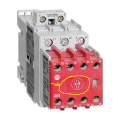
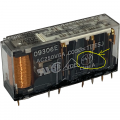
that is correct. the difference is how they handle FAILURE... any failure.

for example relay may have one or more of the contacts stuck (welded for example). let's say that was a NO contact,
when relay is de-energized that contact will remain closed (since welded). other contacts may or may not return to their normal state. there are no guarantees. that is behavior of normal relays.

safety relays can suffer the same fate. but...

safety relay construction, tests and certification GURANATEE that in such case ALL contacts would remain in same state (in this case "energized" position because one or more NO contact are welded). if there are NC contacts, they too would have to remain in the "energized" state which means they would HAVE TO stay open.

this "same state" guarantee is key and prerequisite for monitoring,

monitoring is used to check if relay is working as expected. in most cases monitoring check means evaluation of de-energized state, this is why NC contacts are added into monitoring loop.

to identify safety devices there are special symbols. for relays,
that would be this:

1729774777606.png

or this
1729774885427.png
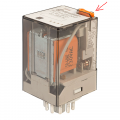
another characteristics of safety relays is that any override feature is removed (for obvious reasons).
so this is obviously not a safety product:
1729782271982.png

and here is an example of them in use:
1729775286281.png
 
Last edited:

Thread Starter

maintenancemetaloffice

Joined Oct 23, 2024
4
That seem to be a very common two-hand anti tie down safty controller (aka "safety relay").

A1/A2 is power
two buttons are wired to 11+12+12 and 21+22+24

safety outputs are 33/34 (NO contact) and 41-42 (NC contact)\.those can drive small load or external safety relays/contactors (contact expansion).
when using contact expansion, those external relays/contactors are to be monitored.
monitoring is done by circuit 31/32.
when contact expansion relays are driven by NO (33/34) which is most of the cases. one would string NC contacts of those relays here into monitored loop.
if expansion relays are drived by NC contact (41/42), then on of normally open ocntact of each of those expansion relays is stringed into monitored loop.

so... if looking for replacement, just google "two hand anti tie down safety relay". there are tons of products like this on the marked from Omron, ABB, Keyence, Pilz, Schmersal, Banner, Murr, etc.

btw, relays used for contact expansion must also be safety rated. only then monitoring has meaning.
Thank you very much for your help and information on this.
If I may ask one further question. The existing NZHZ box has inputs from 11, 12 and 14 (along with 21, 22 and 24). When looking at alternatives, I cannot see a suitable unit that allows for a similar configuration. I.E. out of 11 and allowing two channels returning into 12 and 14. I apologies if this is me being naïve. I can see that on replacements you have inputs (out via S11 and back in via S12, and the same on S21 and S22) but how do I configure the missing connections, (14 and 24)?
Again, sorry if I have not explained myself too well.
Kind regards
 

panic mode

Joined Oct 10, 2011
4,945
btw. common pitfall is to not use monitoring. even though everything appears to be working correctly, this degrades rated circuit performance (safety category) dramatically - for example if one is using KM1/km2 but simply placing jumper across T31/T32 instead of monitoring their NC contacts would drop safety category from 4 (highest) to just 1 (the lowest one). and probably nobody would know until someone loses limb or gets killed. guess who is going to jail when that happens.

also often one needs additional contacts. this requires further contacts expansion. then those additional relays would need to be monitored too.

and since each relay is only one channel, for redundancy circuits (categories 3 and 4) one would have to always combine contacts from channel1 and channel2. internal contacts of the safety controller are already redundant. but external circuitry would need to be redundant too (see NO contacts of KM1 and KM2 powering motor).

but.... redundant does not mean using two or more contacts of same relay. they need to be from different relays (one from channel1 and other from channel2). so to get one redundant NO contact, one could use series connection of one NO from Ka and one on from Kc.
1729776911283.png
 
Last edited:

panic mode

Joined Oct 10, 2011
4,945
Thank you very much for your help and information on this.
If I may ask one further question. The existing NZHZ box has inputs from 11, 12 and 14 (along with 21, 22 and 24). When looking at alternatives, I cannot see a suitable unit that allows for a similar configuration. I.E. out of 11 and allowing two channels returning into 12 and 14. I apologies if this is me being naïve. I can see that on replacements you have inputs (out via S11 and back in via S12, and the same on S21 and S22) but how do I configure the missing connections, (14 and 24)?
Again, sorry if I have not explained myself too well.
Kind regards
button for one hand is wired to NZHZ contacts 11,12,14.
connection to terminal 14 is not missing, it is REQUIRED.

button for the other hand is wired to NZHZ contacts 21,22,24.
connection to terminal 24 is not missing, it is REQUIRED.

each button needs two contacts, one NO and one NC. do not mix them up...

example schematics that i posted is for an old Omron TH relay. i only chose that one because it is a rather nice example of what i wrote (plus it shows some notes and timing diagram which may be useful for understanding operation). but if you want to use that one (or any other), you need to look at the FUNCTION of each terminal and cross reference connections because they may be looking similar but they are not exactly the same (check order):

NZHZ / G9SA
A1/A1 // positive supply
A2/A2 // negative supply
31/T31 // monitoring
32/T32 // monitoring
11/T12 // button 1, common
12/T11 // button 1, NC
14/T13 // button 1, NO
21/T22 // button2, common
22/T21 // button2, NC
24/T23 // button2, NO
33/33
34/34
41/41
42/42
 
Last edited:

panic mode

Joined Oct 10, 2011
4,945
btw G9S is great but it is an older product. it is very common and still available but i am not sure if this is just an old stock or if they are still made. personally i would consider something that did not sit on shelf for a while. and new products are more compact saving panel space (and shelf space for spares). plus, many have removable terminal blocks so in case of a failure, replacement is a snap - no risk of losing wire and spending time trying to figure out where it should go. just my $0.02
 

MaxHeadRoom

Joined Jul 18, 2013
30,605
What does the "safety relay" do?
Is it different from a normal relay?
The term "Safety Relay" has been slow entering N,A terminology and usage.
In most of Europe it has been mandatory for a while. There has been talk of making them mandatory in N.A.
It essentially replaces the typical control relay used in the E-stop circuit at the end of E-Stop string where a series of sensors L.S's etc are all NANDed together..
It posses special features such as force guided contacts, they come in several varieties that include time delays and other features that may be required.
IOW, you cannot use a simple relay or contactor in its place.

1729782853770.png
 
Last edited:

panic mode

Joined Oct 10, 2011
4,945
The term "Safety Relay" has been slow entering N,A terminology and usage.
In most of Europe it has been mandatory for a while. There has been talk of making them mandatory in N.A.
what is supposed to be mandatory? the term itself?

because safety devices (including relays) are already part of NA safety requirements, imposed through safety standards and that was the case for quite some time. but standards (documents) tend to use more abstract language to avoid bias when it comes to products and technology on the market. this also means that standard does not have to be rewritten when new type of device is introduced - in standards all that matters is the performance level.

and the term "safety relay" is so entrenched in the language that other products designed to replace them are also frequently called "safety relays", although they are obviously more complex products that contain functional equivalent of several safety relays. the terms sticks even when no relay is present inside it. most of the devices on the market today use solid state for everything - including outputs (OSSD) rather than safety relays. so what is the point to mandate terms now when the products that name derives from are becoming obsolete?

i find it rather archaic to use term "safety relay" for those more complex products like ones discussed above. it is same as using "wheels" to refer to a car. car is much more than just a set of wheels. and "wheels" is not even accurate description of the product such as car. so why would anyone think it is a good idea to mandate terms? where is demand for such mandates?
 
Last edited:

MaxHeadRoom

Joined Jul 18, 2013
30,605
The Safety Relay in this context is a relay specifically designed to replace the old traditional method of a ordinary contactor/relay at the end of the E-Stop string.
They come with various different options, immediate force guided contact disconnect coupled with time delay etc for time delay outputs to cover the different classes of E-stop under NFPA79, for example.
I did not come up with, or decide on the devices name. ;) As I mentioned, it is a well known term for its usage other than N.A.
Here is 2 YouTube videos that show the difference's using a small one..
 
Last edited:

panic mode

Joined Oct 10, 2011
4,945
i know, i've been using them on many of 800+ projects over the years (automotive, nuclear and chemical plants etc.). i am using them less and less as project complexity is increasing and working with discrete devices like this is very limiting. they are only good for really small things, so they get replaced by safety PLCs. even for small jobs there are programmable controllers.

btw the linked videos are by Tim Wilbur, he is the guy in the red shirt on the right and does automation as well as offering training. He is a long time member at MrPLC.com, young guy must be a tech working for him.
but i did not watch the videos, i dragged the time index begin to end to preview content in a jiffy. but no circuit was ever shown and for me that is a deal breaker.;)

and about the circuit, there is just couple of wires so clearly this is the most elementary one can make, obviously done just for the sake of video ad. there is no external relay monitoring, EStop button has two contacts but they are powered from +24V instead of from safety relay so there is no diagnostic pulses, no cross channel monitoring... tsk tsk :D
 
Last edited:

MisterBill2

Joined Jan 23, 2018
27,358
I have done that "Two-Hand, Anti-Tie down, anti repeat with AB series 700N relays for a whole lot of years. I know there was a time delay as well so the second button had to operate within about 3 seconds, I think. That was before the term "safety relay" was ever used.
The real pain is at least one country far away where that was not nearly enough protection. Enclosures were interlocked, AND hard plastic shields over all power wiring above 24 volts. AND padlock provisions provided on all electrical equipment enclosures.
My take was that the factories were full of drunks bent on self destruction.
We came out far ahead by not quoting, explaining that the equipment was outside our area of competence and we would not want to deliver inadequate quality.
 

nsaspook

Joined Aug 27, 2009
16,275
...
The real pain is at least one country far away where that was not nearly enough protection. Enclosures were interlocked, AND hard plastic shields over all power wiring above 24 volts. AND padlock provisions provided on all electrical equipment enclosures.
My take was that the factories were full of drunks bent on self destruction.
...
Sometimes there is a monster behind those enclosures that needs to be tamed with that safety equipment and more.

1729815247724.png
 

MrAl

Joined Jun 17, 2014
13,686
what is supposed to be mandatory? the term itself?

because safety devices (including relays) are already part of NA safety requirements, imposed through safety standards and that was the case for quite some time. but standards (documents) tend to use more abstract language to avoid bias when it comes to products and technology on the market. this also means that standard does not have to be rewritten when new type of device is introduced - in standards all that matters is the performance level.

and the term "safety relay" is so entrenched in the language that other products designed to replace them are also frequently called "safety relays", although they are obviously more complex products that contain functional equivalent of several safety relays. the terms sticks even when no relay is present inside it. most of the devices on the market today use solid state for everything - including outputs (OSSD) rather than safety relays. so what is the point to mandate terms now when the products that name derives from are becoming obsolete?

i find it rather archaic to use term "safety relay" for those more complex products like ones discussed above. it is same as using "wheels" to refer to a car. car is much more than just a set of wheels. and "wheels" is not even accurate description of the product such as car. so why would anyone think it is a good idea to mandate terms? where is demand for such mandates?
Hi,

Interesting, I ran into this with an old Volvo. The fuel relay was not just a relay, but a relay plus circuit that monitored the engine. If the engine shut down, the fuel relay would open up, thus preventing a gas fed fire in the event of an accident.
The components on the circuit board were tried and proved electrical components.

Thus some relays have to be better than others.
 
Top