RS Rechargeable Soldering Iron 545-008 power req?

Thread Starter

Themusicman

Joined Apr 2, 2017
48
Hi All

I wonder can anyone advise me on this please...

I have what was an excellent RS Rechargeable Soldering Iron - part number 545-008, but I am unable to locate the accompanying power supply unit for it. So, I look on the RS www site and it is there, but at a whopping £36!!! So, as I have many high power rated PSU's hanging around here I thought I'd simply rig up my own PSU for it.

So... I look on the RS www site and I see there is a separate datasheet for both the iron and the supply unit. However, nothing is given as the DC out supply - which leqds me to wonder what exactly I'd be paying £36 for!

Can anyone advise what the power supply to this device might be please? Does it have an in-built unit that accepts 240V AC, or is it powered by a high wattage 24/12V DC power unit?

Hope someone can advise please. Thanks.

Link to power supply unit: http://uk.rs-online.com/web/p/soldering-station-accessories/3375212/
Link to Rechargeable Soldering Iron: http://uk.rs-online.com/web/p/soldering-irons/0545008/
 

dl324

Joined Mar 30, 2015
18,289
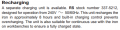
The charging unit charges while avoiding overcharging. Without knowing battery specs, would recommend buying the commercial charger.
upload_2017-4-3_8-6-36.png
 

Thread Starter

Themusicman

Joined Apr 2, 2017
48
They do a 12V car adapter charger, i had one of these years ago and it had two D type soldered Nicads, total voltage was 3V, so i put 5V in, and it charged up ok,.

If you're unsure, open it up and check the voltage or, take the element off and power it up with a voltmeter across the element terminals..

https://uk.rs-online.com/mobile/p/soldering-station-accessories/0547515/
Hi Dave

That's just it - I can't power it up as it is flat - hence wondering what I need to use to power it up with i.e. a DC or AC supply. I am not sure if the unit itself has some form of AC-DC unit inside, or if it takes DC PSU.

It really is a bugger to take apart too, no screws that I can see at least!
 

Dodgydave

Joined Jun 22, 2012
11,395
It's DC 5V,@500mA, and it has a polarised socket, hence reason to open it up, there was a screw under the sticker on the side on mine,you should be able to read the open circuit voltage if you remove the element and turn it on.

Mine was made in 2010, so they could have changed the batteries to nimhi or lithium-ion.
 

Thread Starter

Themusicman

Joined Apr 2, 2017
48
They do a 12V car adapter charger, i had one of these years ago and it had two D type soldered Nicads, total voltage was 3V, so i put 5V in, and it charged up ok,.

If you're unsure, open it up and check the voltage or, take the element off and power it up with a voltmeter across the element terminals..

https://uk.rs-online.com/mobile/p/soldering-station-accessories/0547515/
Hi Dave

So I have managed to get it apart - no screws, just some awkward little things you push in to allow the top to be removed, and then with some effective push pull manouvering the whole thing slides out.

Apologies about not quite knowing how to check the polarity here, but how do I actually do this? I have a 5V PSU - if I connect the +ve and -ve across the element terminals how do I then check the polarity - because given my limited understanding here if I placed a voltmeter across the same terminals as I am powering up then wouldn't I simply measure the supply voltage and polarity from the 5V power supply?

Thanks for your advice here, much appreciated.
 

LesJones

Joined Jan 8, 2017
4,511
You will need to trace out the internal wiring to the battery. You should be able to identify the positive terminal of the battery so you should be able to work out the positive terminal on the connector. There will probably be a resistor and possibly a diode between the battery and the connector. You will also need to identify the cell type, size and number of cells. From the cell size you should be able to find its capacity on the internet. From this information you should be able to get an idea of the charge voltage required. I would base your calculations on the cahrging current being one tenth of the AH capacity of the cells.

Les.
 

Thread Starter

Themusicman

Joined Apr 2, 2017
48
You will need to trace out the internal wiring to the battery. You should be able to identify the positive terminal of the battery so you should be able to work out the positive terminal on the connector. There will probably be a resistor and possibly a diode between the battery and the connector. You will also need to identify the cell type, size and number of cells. From the cell size you should be able to find its capacity on the internet. From this information you should be able to get an idea of the charge voltage required. I would base your calculations on the cahrging current being one tenth of the AH capacity of the cells.

Les.
Les - thank you so very much for replying so quickly, this is a huge help as I am today trying to get this soldering iron working.

Yes, there is a little circuit tucked away, and I did spot a resistor or two but didn't look closely so will check. There's also an LED 'On' indicator.

The batteries are short chunky things, I'll measure them and do some research to see if I can work out their capacity and to find suitable replacements.

Once I have done this, I will try to power it up by connecting my 5V power supply (1.5A) +ve to the +ve battery terminal and -ve to -ve. Will post results if you're interested.

Thanks again!
 

Thread Starter

Themusicman

Joined Apr 2, 2017
48
Les / Dave

The circuit is a tad difficult to trace out as the mini pcb is well hidden, but... there is one side of the (2) batteries which is connected directly to one of the elements.

Am I safe to assume this is -ve?

Also... it is connected to the 'flat' side of the battery (the other end of the battery is hidden and clamped in behind some switch mechanism)
 

LesJones

Joined Jan 8, 2017
4,511
I dont know what type of cells are in the unit and I am confused by your description. You use the terms "flat side" and "other end" I had thought the cells would be cylindrical with the positive end being insulated from the casing. Posting a picture would be helpful.

Les.
 

Thread Starter

Themusicman

Joined Apr 2, 2017
48
I dont know what type of cells are in the unit and I am confused by your description. You use the terms "flat side" and "other end" I had thought the cells would be cylindrical with the positive end being insulated from the casing. Posting a picture would be helpful.

Les.
Sure Les - two images here - quick iPhone ones.

Yes you are right, the batteries are cylindrical and connected in series. By 'flat side' of the battery I meant the usual flat side associated with the -ve terminal of cylindrical AA/AAA's (+ve side has the bumb on the end!).

First pic is the entire insides of the iron, second pic is a closer one of the mini PCB and LED.

The blue cable (was originally white but I renewed as I snapped it as I initially pulled the insides out from the casing) is the cable that is connected directly to one of the sides of the element, the other side of the element goes to the 'white plastic thing' which then comes out and joins the mini PCB circuit from within which there is a connection to the other side of the heating element.


LesJones

Joined Jan 8, 2017
4,511
It looks like the confusion was caused by using the worde side instead of end. The smoothe end will be negative. I would suggest limiting the charging current initialy to about 100 mA using a resistor in series with the 5 vollt power supply.

Les.
 

LesJones

Joined Jan 8, 2017
4,511
The charging connection is not designed to operate the heating element. It is only to charge the battery. Did you get any voltage across the battery when connected to the charging supply and what current was it drawing from the charging supply ?

Les.
 
Top