RPN Calculators

Thread Starter

Futurist

Joined Apr 8, 2025
789
Did - does - anyone here ever prefer using RPN calculators like those that HP made? I never took to it myself, I used mainly TI and Commodore calculators years ago when I was using calculators routinely.

I also note that the built-in calculator on Windows is not RPN.

I never understood the attraction - perhaps someone can explain...
 

wayneh

Joined Sep 9, 2010
18,119
Yes, my favorite calculator over the last 5 decades was my HP11C. The financial version HP12C was handy too, depending on what you were doing. Rugged, nice display, great layout.

Once you get used to RPN, which takes all of a few minutes, it becomes clearly more efficient. Anything else feels like a dumbed-down toy. The snotty nerds that looked down on anyone not using RPN had a point.

In the Apple world, the phone or laptop calculators can both be switched into RPN mode. I'm comfortable either way but don't use calculators all that much. I became mostly a spreadsheet jockey in the 80's and never looked back.
 

Papabravo

Joined Feb 24, 2006
22,084
The whole point of RPN is that the order of operations is never ambiguous and does not require the use of parentheses and associated rules like PEMDAS to resolve ambiguity.
 

crutschow

Joined Mar 14, 2008
38,543
I never understood the attraction
Your question is interesting since, I remember when I first read about the how the first pocket scientific calculator, the HP35 functioned, I immediately thought, "this is how calculators should operate".
For a complex series of calculations, RPN is much easier for me than algebraic notation which requires the use of parentheses for complex equations.
With RPN there is never any pending operations. It immediately executes the function so you always know where you are in the calculation.
And since there is no parenthesis or equal sign, the number of RPN keystrokes is almost always less then with Algebraic.
I aways have to think twice about how to do a complex calculation with an algebraic calculator so only use them in rare circumstances.
The calculator I now use is a virtual HP-42s calculator on both my computer and phone that completely mimics the appearance and operation of the real device.

And note that simple Algebraic machines use RPN operation for the transcendental function keys, so you have to mentally keep track of that also, when executing a long function.
 

Thread Starter

Futurist

Joined Apr 8, 2025
789
Your question is interesting since, I remember when I first read about the how the first pocket scientific calculator, the HP35 functioned, I immediately thought, "this is how calculators should operate".
For a complex series of calculations, RPN is much easier for me than algebraic notation which requires the use of parentheses for complex equations.
With RPN there is never any pending operations. It immediately executes the function so you always know where you are in the calculation.
And since there is no parenthesis or equal sign, the number of RPN keystrokes is almost always less then with Algebraic.
I aways have to think twice about how to do a complex calculation with an algebraic calculator so only use them in rare circumstances.
The calculator I now use is a virtual HP-42s calculator on both my computer and phone that completely mimics the appearance and operation of the real device.

And note that simple Algebraic machines use RPN operation for the transcendental function keys, so you have to mentally keep track of that also, when executing a long function.
Yes, I've heard this from a lot of people who've used HP calculators. But what puzzles me is that almost any non trivial formula will have parentheses, it's standard notation in mathematics and schools and colleges. I know of no science book for example that expresses equations in RPN notation.

So if entering a formula that when written down will have parentheses, it's a simple matter of transcription more or less.

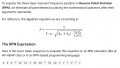
Look, I asked AI:

1782057697712.png

I just can't see anything appealing here and it worries me that doing that translation in one's head might lead to an error that goes unnoticed.

As someone who's built programming language compilers I am aware that the RPN form is what actually gets generated by the compiler, but as for day to day human use, I can't fathom the appeal!
 

crutschow

Joined Mar 14, 2008
38,543
I just can't see anything appealing here
So you could enter that equation without error, in an algebraic calculator that had only a numeric display to show the results (which is the display that early RPN and algebraic calculators had).

But if you can't fathom the appeal of RPN, no sweat.
There are many of us who used calculators every day (or used to) for engineering work, do. :)
 
Last edited:

Thread Starter

Futurist

Joined Apr 8, 2025
789
So you could enter that equation without error, in an algebraic calculator that had only a numeric display to show the results (which is the display that early RPN and algebraic calculators had).

But if you can't fathom the appeal of RPN, no sweat.
There are many of us who used calculators every day (or used to) for engineering work do. :)
I always admired people who use RPN, guess I'm jealous!
 

SamR

Joined Mar 19, 2019
5,497
The new HP models have RPN as a throwback option but are now CAS (computer algebraic system). I've worn the key markings off of a TI-30 but upgraded to the TI-36XPro solar powered for daily use even though I also have a TI-83 Plus and TI nSpire CX II CAS gathering dust in a drawer. That cheap one does almost all I ever need on a daily usage basis. As well as using Microsoft Mathematics on the PC for more complex equations. RPN was great in its days of having only LED digits displayed. But LCD does so much more now...
 

Jon Chandler

Joined Jun 12, 2008
1,614
So on an RPN calculator to do this: 23.7 / 19.2 I would actually enter what?
Let's look at a more complex problem:

(23.7 + 42) / (13.5 × 7.3)

23.7, enter, 42, +,
(this takes care of the numerator)

13.5, enter, 7.3, ×,
(this takes care of the denominator)

/
(this does the final division)

The steps yield:
65.7 (numerator)

98.55 (denominator)

0.66666667 (final division)

To me, this breaks the problem into logical steps without having to store or write down intermediate results.
 

Thread Starter

Futurist

Joined Apr 8, 2025
789
Let's look at a more complex problem:

(23.7 + 42) / (13.5 × 7.3)

23.7, enter, 42, +,
(this takes care of the numerator)

13.5, enter, 7.3, ×,
(this takes care of the denominator)

/
(this does the final division)

The steps yield:
65.7 (numerator)

98.55 (denominator)

0.66666667 (final division)

To me, this breaks the problem into logical steps without having to store or write down intermediate results.
Yes, I see. That's exactly how a programming language does it, translates the original expression into the latter (operator precedence parsing) RPN is a natural fit for stack based execution.

My first programmable was the TI57, so I never dealt with RPN, but had college mates with HP's very impressive build quality too.
 

WBahn

Joined Mar 31, 2012
32,933
Did - does - anyone here ever prefer using RPN calculators like those that HP made? I never took to it myself, I used mainly TI and Commodore calculators years ago when I was using calculators routinely.

I also note that the built-in calculator on Windows is not RPN.

I never understood the attraction - perhaps someone can explain...
RPN takes some getting used to, but after an amazingly short time it becomes very natural. You can do quite complicated calculations and do the conversion from infix (the way we normally write expressions, complete with all the parens) to postfix (which is what RPN is) in your head as you proceed.

My first intro to RPN was a Physics I test my freshman year in college. I had two Sharp scientific calculators and the batteries were dead in my normal one and I didn't have time to walk down to the drugstore to get more, so I went to get my backup and it's display was completely black from having been set on the dash of my car on a hot day. So my roommate loaned me his HC-41CV and gave me a brief tutorial on how to use it. When the prof was handing out the exam, I told him that this was my first time using an HP calculator, to which we replied, "We'll take that into account." It was a good thing, I got a 96% on the exam even though I didn't get a single numerically correct answer on the entire exam! But since I had set everything up correctly and it was just the evaluation of the final expression, the penalty was low, especially since I included ROM (rough order of magnitude) estimates for each answer.
 

Thread Starter

Futurist

Joined Apr 8, 2025
789
RPN takes some getting used to, but after an amazingly short time it becomes very natural. You can do quite complicated calculations and do the conversion from infix (the way we normally write expressions, complete with all the parens) to postfix (which is what RPN is) in your head as you proceed.

My first intro to RPN was a Physics I test my freshman year in college. I had two Sharp scientific calculators and the batteries were dead in my normal one and I didn't have time to walk down to the drugstore to get more, so I went to get my backup and it's display was completely black from having been set on the dash of my car on a hot day. So my roommate loaned me his HC-41CV and gave me a brief tutorial on how to use it. When the prof was handing out the exam, I told him that this was my first time using an HP calculator, to which we replied, "We'll take that into account." It was a good thing, I got a 96% on the exam even though I didn't get a single numerically correct answer on the entire exam! But since I had set everything up correctly and it was just the evaluation of the final expression, the penalty was low, especially since I included ROM (rough order of magnitude) estimates for each answer.
I tend to regard people who are fluent in RPN in a similar way to how I regard people who are fluent in Regex, I always sigh and reach for a book.

The Prof seems like a decent guy.
 

boostbuck

Joined Oct 5, 2017
1,051
I learned RPN on my HP35 fifty years ago and just loved it. And still do. I can't bear trying to calculate on a standard calculator - it seems so clumsy.
 

dl324

Joined Mar 30, 2015
18,376
My first HP calculator was an HP41C. SN is lower than 100 because it was a life test unit that a tech sold me in the late 1970's. It no longer works because I wore it as a costume prop in the early 1980's and some people threw me in a hot tub. That still pains me because I have a magnetic strip reader and many programs - both commercial and self-written.

I bought an HP12C, HP10BII and HP20S from Goodwill for $11 (3 different trips). The latter 2 are algebraic.
 
Top