Facebook
 Google
 GitHub
 Linkedin

I am stuck at this issue with square waves.
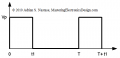
The signal illustrated on the picture is measured:
- 4,0 V for a digital multimeter set to DC mode -- (so DC offset, I presume)
- 8,0 V for the TRMS
I must find the Vpeak.
Now, I am quite lost. With square waves, you normally expect Vpeak to be equal = RMS/sqrt(2) for the pulse duty factor 50%, but it's clearly not 50% here. Also, the only values given are DC offset and the TRMS (AC + DC offset). The answer given is 16 Volts, but I don't know where it could come from. Am I to understand the peak value is twice as high as TRMS? Then how do I explain it? and why the DC offset is given then?
Please help.
Thank you
The signal illustrated on the picture is measured:
- 4,0 V for a digital multimeter set to DC mode -- (so DC offset, I presume)
- 8,0 V for the TRMS
I must find the Vpeak.
Now, I am quite lost. With square waves, you normally expect Vpeak to be equal = RMS/sqrt(2) for the pulse duty factor 50%, but it's clearly not 50% here. Also, the only values given are DC offset and the TRMS (AC + DC offset). The answer given is 16 Volts, but I don't know where it could come from. Am I to understand the peak value is twice as high as TRMS? Then how do I explain it? and why the DC offset is given then?
Please help.
Thank you