How can I create a short (0.5us) electrical pulse (50mV amplitude)?

Thread Starter

Milfod

Joined Feb 10, 2025
5
I'm working on a charged particle detector consisting of a plastic scintillator and a SiPM to create an electrical signal and I'm using an arduino with an ADC to detect these pulses.
I'd like to create a circuit which can emulate the pulse from the detector at home while I leave the detector in the lab, while I develop the arduino oscilloscope.
Ideally, I'd like to create two pulses as I described in the title, with 1-2 microseconds between them and be able to vary that time.
It's easy enough to make a periodic signal with these properties but what's a good way to create just one or two pulses?
Thank you.
 

ronsimpson

Joined Oct 7, 2019
4,647
What is your budget?
When does it need to be done?
What are you driving? 50 ohm load?
amazon signal generator or look at this list. DDS signal generator
I have AGB signal generators in my lab that are $20,000 on one and $100 on the other. I am not recommending anyone but just saying spend 100 to 200 and get a signal generator. In you case I would go for 50 to 60mhz not the 20mhz version.
In the ARB mode you get to draw the wave form you want. You can just makeup a waveform with 2000 points in it.
You can have the two channels talk to each other. Example burst mode or modulation mode.
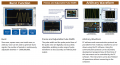
Here is a picture of three of the advanced modes.
1739205777582.png
 

MrChips

Joined Oct 2, 2009
34,628
The simple way is to use an RC differentiator.

1739206199118.png

Simply, the RC circuit creates the derivative of the input.
If R is a pull-down resistor to ground, the negative portion of the pulse will be ignored by the pulse detector circuit.
Likewise, if R is a pull-up resistor to +Vcc, the upper portion of the pulse will be above the input threshold and the negative going part of the pulse will be detected.

If desired, the signal can be clamped to GND or +Vcc with clamping diodes.

For two pulses in succession, use two monostable multivibrator circuits.
 

Thread Starter

Milfod

Joined Feb 10, 2025
5
Thank you, I hadn't realised arbitrary waveform generators could be so cheap!!
What I'm more interested in, is a very simple way to get a short pulse, using basic components. I feel like this is a fundamental type of circuit but I don't have a background in electronics only physics, which is stunting me in regards to this problem.
 

Thread Starter

Milfod

Joined Feb 10, 2025
5
This is perfect thank you!
The simple way is to use an RC differentiator.

View attachment 342327

Simply, the RC circuit creates the derivative of the input.
If R is a pull-down resistor to ground, the negative portion of the pulse will be ignored by the pulse detector circuit.
Likewise, if R is a pull-up resistor to +Vcc, the upper portion of the pulse will be above the input threshold and the negative going part of the pulse will be detected.

If desired, the signal can be clamped to GND or +Vcc with clamping diodes.

For two pulses in succession, use two monostable multivibrator circuits.
This is perfect thank you!
 

crutschow

Joined Mar 14, 2008
38,316
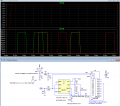
Here's the LTspice sim of a circuit that uses a 555 timer configured as a one-shot to generate the 0.5µs square pulse, driving a CD4017 counter to determine the number of pulses:
The circuit is triggered by push-button Spb.

The number of pulses is determined by which U2 counter's output is connected to D1 (giving the option of 1 through 9 pulses).

The pulse width is determine by the value of R2.

The time between pulses is varied by potentiometer U3.
This is shown for 0% (green trace), 50% (yellow trace) and 100% (red trace) of the pot wiper position.

1739294915333.png
 
Last edited:

Thread Starter

Milfod

Joined Feb 10, 2025
5
Here's the LTspice sim of a circuit that uses a 555 timer configured as a one-shot to generate the 0.5µs square pulse, driving a CD4017 counter to determine the number of pulses:
The circuit is triggered by push-button SPB.

The number of pulses is determined by which U2 counter's output is connected to D1.

The pulse width is determine by the value of R2.

The time between pulses is varied by potentiometer U3.
This is shown for 0% (green trace), 50% (yellow trace) and 100% (red trace) of the pot wiper position.

View attachment 342329
Thank you! I'd been trying to think of a way to simply use a 555, literally never heard of these counters.

On a side note. My only knowledge of electronics is from a GCSE I did when I was 15, and various RPi and arduino projects relevant to my degree, which wasn't much. Is there a good free online course to study this type of thing more comprehensively?

Thanks all for responding so quickly!
 

Thread Starter

Milfod

Joined Feb 10, 2025
5
Here's the LTspice sim of a circuit that uses a 555 timer configured as a one-shot to generate the 0.5µs square pulse, driving a CD4017 counter to determine the number of pulses:
The circuit is triggered by push-button Spb.

The number of pulses is determined by which U2 counter's output is connected to D1 (giving the option of 1 through 9 pulses).

The pulse width is determine by the value of R2.

The time between pulses is varied by potentiometer U3.
This is shown for 0% (green trace), 50% (yellow trace) and 100% (red trace) of the pot wiper position.

View attachment 342376
Thank you for your help. The three connections at the top-left of the CD4017, do these represent the reset, clock, and clock inhibit pins? Or is the not-and gate a separate component?
Thank you
 

crutschow

Joined Mar 14, 2008
38,316
The three connections at the top-left of the CD4017, do these represent the reset, clock, and clock inhibit pins?
Yes, they are intrinsic to the CD4017.
I am using the clock inhibit pin as an inverted clock input (count advances on the clock/pulse falling edge) to avoid glitches in the output.
 
Last edited:
Top