Consider a linear regulator having input 50 mVpp ripples at 1 MHz which is coming from DCDC converter. What the linear regulator will do with the ripples. Pass it ? Removes the ripples with output de-caps ?
Hi,Consider a linear regulator having input 50 mVpp ripples at 1 MHz which is coming from DCDC converter. What the linear regulator will do with the ripples. Pass it ? Removes the ripples with output de-caps ?

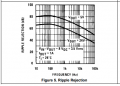
I was also thinking of this graph, power supply rejection ratio vs frequency. This shows that the power supply rejection ratio decreases with increase in frequency.With out knowing what linear regulator ..................
Ripple rejection for LM7805 and 7824. Extend the graph to the right to 1mhz, you can get an idea of rejection. (Cin 0.22uf Cout 0.1uf)
View attachment 325720
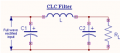
You need to add a CLC filter in the input. The L can be a bead. Choose values that will give good rejection in the 100khz to 10mhz range.
Offhand it seems that the 1MHz signals would be hard to pass but it really depends on the regulator.I just have asked a general question. Let's suppose a linear regulator has ripples at the input. The frequency of ripples are 10 kHz and 1 MHz. The power supply rejection ratio of the linear regulator is a function of frequency. Does this means that the linear regulator suppress the ripples more at 10 kHz then ripples at 1 MHz.
As with any other system where the power source was not battery-smooth DC, an inline filter would be the first step. At 1 MHz it would not require much inductance to reduce the ripple. And then shunt capacitors to reduce the remaining high frequency signal. Not a whole lot different from input filtering for electronics in an ICE car today.I just have asked a general question. Let's suppose a linear regulator has ripples at the input. The frequency of ripples are 10 kHz and 1 MHz. The power supply rejection ratio of the linear regulator is a function of frequency. Does this means that the linear regulator suppress the ripples more at 10 kHz then ripples at 1 MHz.
That's not categorically true -- nor is it even true for that particular graph. Notice that it improves slightly from 10 Hz to 100 Hz before it peaks and then starts dropping off. Be very careful about extrapolating the behavior of a typical curve for a specific part to draw general conclusions about an entire class of circuits. The manufacture is merely presenting data for THEIR design for THAT part. It may well be that the reason that the ripple rejection peaks midway between 10 Hz and 100 Hz is that the designers of that regulator assumed that the part would frequently be used in circuits powered by 50 Hz or 60 Hz mains sources. Also, the curve is not just for that part, but (probably) for that part combined with specific external components and also under specific operating conditions.I was also thinking of this graph, power supply rejection ratio vs frequency. This shows that the power supply rejection ratio decreases with increase in frequency.
Filtering, like most other parts of designs, is usually a compromise. Much of engineering is the art of compromise, in fact. Perfect designs are often possible but seldom practical. And even less frequently required. A measuring system must provide better than the required certainty and repeatability, but not infinite resolution and exactness. And a power supply, besides being able to supply adequate power and stability, needs only to not add noise to a circuit above it's intrinsic noise level. The sole exception is top-end audiophile equipment, which must impart zero noise or distortion no matter what the cost.That's not categorically true -- nor is it even true for that particular graph. Notice that it improves slightly from 10 Hz to 100 Hz before it peaks and then starts dropping off. Be very careful about extrapolating the behavior of a typical curve for a specific part to draw general conclusions about an entire class of circuits. The manufacture is merely presenting data for THEIR design for THAT part. It may well be that the reason that the ripple rejection peaks midway between 10 Hz and 100 Hz is that the designers of that regulator assumed that the part would frequently be used in circuits powered by 50 Hz or 60 Hz mains sources. Also, the curve is not just for that part, but (probably) for that part combined with specific external components and also under specific operating conditions.
One general statement that is often true of many, if not most, circuits is that many of their performance parameters show a band-like characteristic -- they peak (either at a high or a low) at some frequency and get worse in both directions from there. This is usually because they are designed to operate optimally within some frequency range and performance outside that range is whatever it is, which usually means it gets worse. At higher frequencies, in particular, intentional capacitances get overshadowed by parasitic inductances and vice-versa.
C1 can be the output capacitors if the DC-DC converter. I would add a cap right at L.You need to add a CLC filter in the input. The L can be a bead. Choose values that will give good rejection in the 100khz to 10mhz range.


Hello again,My point in #9 was that if the error amplifier in the linear regulator is by default not responding to fast changes present at the input then we can say that higher frequencies in the input will not be pass by the linear regulator ?
If the linear regulator can not do anything with the ripples at 1 MHz (this is the switching frequency of the DC-DC converter whos output is connected to the input of the linear regulator). What is the best way to remove ripples. Adding filter at the input of linear regulator or adding filter at the output of the linear regulator ? What kind of filter ? Common mode chock, EMI filter or just a low pass first order filter ?
I have seen common mode chock used at the input of the DC-DC converter. I am not sure if that also worth for linear regulators.