Reverse recovery current of a diode?

Thread Starter

johnyradio

Joined Oct 26, 2012
615
What is reverse recovery current of a diode (and how does it affect Mosfet switching)?

I believe reverse recovery current of the diode means a brief overshoot of current when current direction through the diode is reversed.

Meaning, when current reverses direction, before the diode settles at zero V, there's a brief overshoot... no undershoot... not sure if it's undershoot or overshoot.... ?
 
Last edited:

crutschow

Joined Mar 14, 2008
38,435
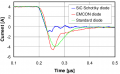
Junction diodes have reverse recovery current (charge) in varying degrees depending their design (fast recover types have less).
Schottky diodes inherently do not exhibit that.
 

DickCappels

Joined Aug 21, 2008
10,661
But there is also capacitance across the diode might affect the operation of some circuits. This is different than separate from clearing charge carriers that is the recovery current.
 

Thread Starter

johnyradio

Joined Oct 26, 2012
615
place schottky diodes (externally) in parallel with the body diode, so that the body diode never conducts, and therefore never exhibits reverse recovery problems.
That seems like such an easy way to get soft switching. Why do anything else? Am i wrong?
 

Thread Starter

johnyradio

Joined Oct 26, 2012
615
Isn't a parallel schottky a much simpler solution than a more complicated soft switching circuit?

Or is a parallel schottky the typical soft switching circuit?
 

Thread Starter

johnyradio

Joined Oct 26, 2012
615
I think hard switching is the result of undershoot, due to diode recovery.

I believe, when you open a Mosfet, it's body diode has to expel, in reverse direction, electrons that built up in the diode during forward current. That causes a brief surge of current in the reverse direction, going below zero (undershoot), before settling back at zero.

When a power diode is quickly reverse biased while it is conducting a high forward current (hard switching), a finite amount of time is required to clear it of charge carriers so that it can block the reverse voltage.
https://www.eeweb.com/reverse-recovery-charge-current-and-time/
When a MOSFET is used as a simple switch, a reverse bias is never applied across the drain and the source, and therefore the body diode does not conduct. However, in resonant power supplies and inverter circuits, current can flow through the body diode during freewheeling and synchronous rectification operation. During this process, a large recovery current flows through the diode in the reverse direction. This current causes a large reverse recovery loss.
https://toshiba.semicon-storage.com/info/application_note_en_20180901_AKX00076.pdf
1682670518549.png

----

Mitigation
I think there are a few ways to mitigate it.


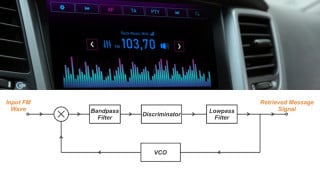
Zero Voltage Switching - I think this means, you adjust the phase shift of your square wave until the square wave's phase is in sync with with phase of the resonant oscillation, such that the square wave exerts the least effort to flip the switches. When they're out of sync, it's called "stress". It's kinda like swinging your legs on the swing at just the right instant for maximum momentum with minimum effort, so that pumping your legs in the direction of swinging, to add power to the swing. If your legs pump at the wrong moment, you won't get as much lift. Zero Current Switching is a variant (and maybe a better fit for the swing analogy). A PLL can be used to achieve phase sync.

1682670619409.png


Use a GaN, or possibly a SiC device - GaN mosfets have little to no undershoot.


I'm not sure if dead time helps, I thiink dead time is to prevent forward current and reverse current mosfets turning on at the same time.

1682670716078.png


Parallel Schottky? - @Ian0 I haven't seen any articles that say you can mitigate diode reverse recovery current with a parallel Schottky.
 
Last edited:

crutschow

Joined Mar 14, 2008
38,435
You are talking in generalities.
So what is the exact application of a MOSFET that you are concerned about reverse recovery current?
 

crutschow

Joined Mar 14, 2008
38,435
My original question, above, is a general question.
Well, you were introducing specific applications into the discussion, so that wasn't clear.

For example, you mentioned the reverse diode conduction during synchronous rectification, but that only occurs during the short time the reverse voltage is applied before the MOSFET is turned on.
As soon as the MOSFET turns on, the diode conduction stops, and and recovery charge is absorbed by the low resistance of the MOSFET on channel, which is in parallel with the diode, so the reverse charge is never seen externally.
 

Thread Starter

johnyradio

Joined Oct 26, 2012
615
Some circuits place Schottky diodes (externally) in parallel with the body diode, so that the body diode never conducts, and therefore never exhibits reverse recovery problems.
You're right!

In 11 minutes, Sam lays out four methods of achieving soft switching, starting with parallel Schottky's.

"What can you do in order to alleviate this problem? One thing is to put a fast diode in parallel to the slow body diode. For this remedy to work the voltage drop on this fast diode should be smaller than the voltage drop on the body diode. The current will go through the diode which has the smallest voltage drop. A Schottky diode would have a lower drop. However Schottky diodes are limited to about 100 volts"
So why don't mosfets use Schottky's for their body diode?

Turns out some do.
"you can today buy an assembly in which the diode is already inside the casing so from outside looks like a regular MOSFET but inside there is already Schottky diode"
 
Last edited:
Top