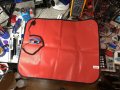
By the way, I do work on static control bags if I have to handle boards that are at risk and I am not soldering. I have a lot of larger ones, and I am grounded, so...
The mat is good when I have to sort parts or deal with things like RAM, but it’s inconvenient. You can see how it dominates the bench. This is a nice new one that replaces my previously pock-marked and solder burned one.
It will eventually take on the patina of work, but for now, it’s pretty.
IE No burn scars on the table top from solder drips etc. Plus I like the resilient and soft surface texture as it helps reduce dropped parts scatter. The color is easy on the eyes and helps to find parts. I use the S-130 35x25 cm mat, but thinking I may get a slightly larger one that actually is ESD. I wash/wipe it from time to time to get rid of coffee stains and such.
I haven't seen on your workbenches any ESD protection, mats etc. I am not talking of NASA prerequisites, i.e. antistatic workbenches. Just an antistatic mat.
I only use my mat when it'll make a difference. My mat is larger than my workspace, so I'm more likely to ground myself before manipulating static sensitive parts, or use anti-static tweezers.
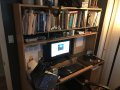
For the moment, I am constrained to setting up my bench on a 4' x 30" table. I've been trying to maximize the use of the space. I just added a dual arm with metal shelves to hold scope, AWG, and multimeter, and while it isn't rock solid, it works very well. The addition of a small cart with drawers makes it pretty usable.
I feel your pain. So much so that I'm actually building a new shelving system to manage parts in a compact way nobody has done. It will let me store parts cabinets in a fraction of their current space while still being easily accessible.
I offer this- use a table for soldering- do soldering at a 'station' that is solely for that. Do electronics design/breadboarding at another table/station where your scope and signal equipment is, and keep the 2 areas separate (one can be in front and one behind you). Use cardboard from any boxes you receive as the 'blotter' for your solder work- makes disposal easy and saves your table surface.
I separate space this way because I find that when I'm soldering, I need space for clamps, solder, suckers, my iron, venting, and various tools (pliers, cutters, snippers, etc), as well as documents/imagery if I've done the project before so I can lay images out and make sure I'm placing components correctly, etc. And none of the soldering stuff (95% of it) will be necessary in the space that I breadboard, program, design, or conduct experiments in. It would just clutter the space I need for doing those tasks. IMHO
It also solves another problem- I *HATE* getting tools out and putting them away frequently. If you do it enough, you don't want to do whatever it is you're trying to accomplish to begin with. I mean, I don't mind using tools and putting them away to a pegboard or other thing. But if you have to unplug, wrap, store in a container, and then reverse that process for 20 different items every single time you spend what little time you have to work on something- it becomes too much of a hassle IMHO. Set up work areas, and use them, leave tools out at each place that you use all the time, and you will spend more time making progress, not wishing you were.
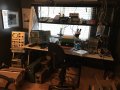
I have an entire room ~10'x 10' dedicated to my electronics, oscilloscopes, studies, and research. When we bought the house we had every intention of turning one room into a workspace for me. I insisted I was on the top floor with access to outdoor light... I hate dingy basements with no/minimal natural light. I painted the walls dark grey because it helps me think - I don't know why - I just enjoy work environments more if they have dark walls, and soft lighting. I did go out and buy a proper ESD lab bench at one point. $200 used. My father-in-law found a high boy chair at goodwill. Stereo microscope is a must. Easy access to all the cables, wires and tools. Plenty of room to work... dedicated work space in the house.
I also have an office desk with a computer that doubles as a second bench for firmware development. I've considered combining the two desks, but I haven't come up with a good way to get the two areas working together. It's a bit of a pain if I have a FW and HW issue, but it's generally one or the other and not both.
The only think I haven't done well so far is coming up with a good way to organize parts with the exception that I generally only buy the number of parts I need. It's a lot cheaper for me to have Digikey, Mouser, etc. store parts than myself. The exception is some common parts that I use a lot of... resistors, 0.1uF caps, different diodes, a couple transistors, etc. I might buy a few extras if I think I may damage the parts also... power resistors, high power transistors, etc. I do wish I had better organization of what I do have though.
I also like having decent, but not great, sound quality music and quick access to reference material. I also have a whiteboard so I can keep the technical details on the wall and available for easy reference - not pictured for IP purposes.

 Facebook
 Google
 GitHub
 Linkedin