Facebook
 Google
 GitHub
 Linkedin

Hi everyone.
I should measure respiratory rate using a bandage that varies in resistance if it is stretched or not. It's tied around the chest and its length vary and change its resistance: let's assume that R increases when you inhale (rib cage widening) and decreases when you exhale (rib cage narrowing).
I converted this resistance variation into the range [0 .. 3V], filtered the signal and then gave it as input to a microcontroller.
My ideas for detecting respiration rate are these two below, I kindly ask you to tell me the pros/cons of both (especially the first one):
I should measure respiratory rate using a bandage that varies in resistance if it is stretched or not. It's tied around the chest and its length vary and change its resistance: let's assume that R increases when you inhale (rib cage widening) and decreases when you exhale (rib cage narrowing).
I converted this resistance variation into the range [0 .. 3V], filtered the signal and then gave it as input to a microcontroller.
My ideas for detecting respiration rate are these two below, I kindly ask you to tell me the pros/cons of both (especially the first one):
(1)
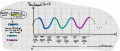
As explained in the figure, I calculate the respiratory rate like this: 1 breath ≈ 1 period ... so "respiratory rate" = number of periods(breaths) per minute(2)
I run the FFT of this signal (Vadc) and choose as "respiratory frequency" the frequency at which the peak (the maximum amplitude) of the FFT is located. I am still not very convinced about this solution because I honestly do not fully understand it yet, however, it seems to me to be a good approach.