Resonance and impedance matching

Status
Not open for further replies.

Thread Starter

The Electrician

Joined Oct 9, 2007
2,986
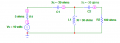
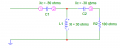
Finally, we have this circuit:

Series Res 5.png

We have a 10 volt source with an impedance of 5 ohms driving through some reactances to a 180 ohm load. Can you calculate the voltage across the 180 ohm resistor, the voltage at node 4?
 
Last edited:
Thread Starter

The Electrician

Joined Oct 9, 2007
2,986
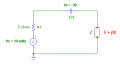
While you're doing the calculations in post #21, a related calculation I'll ask you to do is this.

Calculate the impedance looking into the circuit from the side driven by the voltage source:

Series Res 7.png
 

Thread Starter

The Electrician

Joined Oct 9, 2007
2,986
(180-30j)//(0+30j)
0+5400j+0-900j²/180 as j²=-1
5400j+900/180
30j+5

5+30j-30j
5Ohm ,right?
Yes, this is correct. This result shows us the impedance matching in action. We have a 180 ohm load at R2, but the voltage source sees a 5 ohm load. Since the voltage source has a 5 ohm internal impedance, and it sees a 5 ohm load, we are getting maximum power transfer our of the voltage source. But the voltage across a 180 ohm load would need to be higher than 10 volts to be equal to the power out of the source. Where does that higher voltage come from? It comes from the voltage rise that the series resonant circuit in post #1 provided.
 

RRITESH KAKKAR

Joined Jun 29, 2010
2,829
This result shows us the impedance matching in action. We have a 180 ohm load at R2, but the voltage source sees a 5 ohm load. Since the voltage source has a 5 ohm internal impedance, and it sees a 5 ohm load, we are getting maximum power transfer our of the voltage source. But the voltage across a 180 ohm load would need to be higher than 10 volts to be equal to the power out of the source. Where does that higher voltage come from? It comes from the voltage rise that the series resonant circuit in post #1 provided.
How the source see 5ohm internal Resistance?
we get higher voltage at 180ohm ie. 360V
to be equal to the power out of the source.
what this mean?
Do we will get shock from it?
 

RRITESH KAKKAR

Joined Jun 29, 2010
2,829
transformation ratio
Volts per Turn. A transformer with a primary winding of 1000 turns and a secondary winding of 100 turns has a turns ratio of 1000:100 or 10:1. Therefore 100 volts applied to the primary will produce a secondary voltage of 10 volts.
 

Thread Starter

The Electrician

Joined Oct 9, 2007
2,986
How the source see 5ohm internal Resistance?
The source doesn't "see" a 5 ohm internal impedance. The internal impedance of the source IS 5 ohms. That is why we want a load of 5 ohms, because that will match the internal impedance of the source. We want our real source (Vs plus R1) to "see" a load of 5 ohms. The load the source sees is the circuit of post #22.

The Vs source has zero ohms internal impedance because it is an ideal source. A real source will have an internal impedance, and the resistor R1 is used to represent the internal impedance of a real source. So for this problem, we use Vs plus R1 to represent our real source, which therefore has an internal impedance of 5 ohms.

To get maximum power transfer out of our source (which has 5 ohms internal impedance), we want it to be driving a 5 ohm load.

The load which our source is driving is the circuit in post #22 which has an impedance of 5 ohms as you calculated in post #27. The reactive components have made the 180 ohm resistor "look like" 5 ohms at the left end of the circuit in post #22.

If we had just connected the 180 ohm resistor directly to our source, we would have a mismatch. We would have a source with 5 ohms internal impedance driving a load with 180 ohms impedance.

But by connecting C1, L1 and C2 between our source and the 180 ohm load, we have transformed the 180 ohm load impedance into a 5 ohm impedance, which matches our source impedance.
 

Thread Starter

The Electrician

Joined Oct 9, 2007
2,986
The C and L will cancel as it is in balance.
So, 10V/5=2Amp current
V=2*180=360V
No, this is not correct. You correctly calculated the current in the circuit of post #1 as 2 amps, but that is not the current in the circuit of post #21. You need to analyze the full circuit of post #21.

This can be done is several ways. You could use the simple technique of just combining series and parallel circuits, followed by a voltage divider calculation.

Xc2 and R2 are in series. Calculate the series combination of Xc2 and R2 in parallel with Xl1; call that equivalent impedance Z. Now that impedance Z is in series with Xc1 and R1 and Vs; calculate the current (call it I1) in that series circuit. Since that is a series circuit, the current in R1, Xc1 and Z will all be the same. Because we now know the current in Z, we can calculate the voltage across Z as I1*Z.

If the voltage across Z is I1*Z, that is also the voltage across the series combination of Xc2 and R2. Xc2 and R2 form a voltage divider, so we can calculate the voltage across R2 using the voltage divider rule.

We could also use the more elegant method of mesh analysis. There are only 2 different meshes in the circuit of post #21. Do you know how to do a mesh analysis?

See if you can calculate the voltage across R2 in post #21.
 
Last edited:

RRITESH KAKKAR

Joined Jun 29, 2010
2,829


In this circuit which mesh calculation kvl and kcl?
(180-30j ) // (0+30j)
0+5400j+0-900j²
5400j+900/180
30j+5

so, (5+30j) // (5-30j)
25-150j+150j-900j²
25+900/10
2.5+90
92.5ohm
so, total current is 10/92.5=0.108mA
after this voltage divider at 3 node
10*(5+30j)/(5+30j)+(5-30j)
50+300j/ 10
5+30j
 

Thread Starter

The Electrician

Joined Oct 9, 2007
2,986
I didn't realize this was a competition?:confused:
AFAIK it's not a competition.

You were and are free to contribute to the thread on 'homework'
I stopped contributing over there because it seemed to me that RRITESH was being confused by multiple suggestions from multiple posters. My contributions were mostly not directed at helping RRITESH solve the impedance matching problem anyway. I did want to offer suggestions toward the solution of that problem, and I started a new thread so I could offer a different line of instruction with continuity rather than as interjections to your line of instruction.

Inasmuch as this is a continuation of the 'line of instruction' I began with Rritesh some weeks ago --
It is my intention that this thread NOT be a continuation of your "line of instruction"; it is different. It concerns the same topic, but is not a continuation of your "line of instruction".

I cannot, in all good conscience, abandon the discussion
There's no reason for you to abandon the discussion, which, AFAIK, is still in progess over at the other thread.
 
Last edited:

Thread Starter

The Electrician

Joined Oct 9, 2007
2,986


In this circuit which mesh calculation kvl and kcl?
(180-30j ) // (0+30j)
0+5400j+0-900j²
5400j+900/180
30j+5
OK, so this value becomes Z, a temporary impedance. The circuit is now like this:

Series Res 8.png

The rest of the calculation below is wrong, because you have calculated Z in parallel with 5-30j. You must calculate Z in series with Xc1 and R1. Then calculate the current in Z. After that you can calculate the voltage across R2 by using the voltage divider rule since Xc2 and R2 are a voltage divider acting on the voltage across Z.

If you want to do a mesh calculation, you would use KVL.

so, (5+30j) // (5-30j)
25-150j+150j-900j²
25+900/10
2.5+90
92.5ohm
so, total current is 10/92.5=0.108mA
after this voltage divider at 3 node
10*(5+30j)/(5+30j)+(5-30j)
50+300j/ 10
5+30j
 
Status
Not open for further replies.
Top