Resistors, Resistance

MrChips

Joined Oct 2, 2009
35,314
OK you are right! Thanks for the tip! And sorry about that I was rude! Its my fault!
You are not being rude. You simply lack the knowledge and experience.

Learn by doing.

Take your 12V 300mA power supply.
Select various resistors that you may have, and one at a time, connect it across the power supply.
Measure the voltage across the resistor with a voltmeter.
Insert an ammeter in SERIES with the resistor and power supply and measure the current.
Verify that Ohm's Law is obeyed.
Calculate the wattage dissipated by the resistor.
Touch the resistor with your finger and relate the temperature to the calculated wattage.
 

Thread Starter

PaulEngineer

Joined Dec 21, 2016
217
Thanks for the tip! I will try this at home! Today I have learned one thing: "when someone tries to tell you one thing, do not go against to his knowledge! By this way, you will ignore his attempt to explain you all the basic things you need to know! You should have modesty and listen what he says!"
When you said "I trying really hard to be nice" I thought myself: "This person want to explain something important to me! Where is my modest?"
I'm really sorry about that! I will try not do that again! I promise!
 
Last edited:

MrChips

Joined Oct 2, 2009
35,314
Thanks for the tip! I will try this at home! Today I have learned one thing: "when someone tries to tell you one thing, do not go against to his knowledge! By this way, you will ignore his attempt to explain you all the basic things you need to know! You should have modesty and listen what he says!"
Congratulations! You have learned an important lesson today.

Print what you wrote and stick it on your computer.
Read this every time you post a question on AAC.

Thanks for being humble and grateful.
 

Thread Starter

PaulEngineer

Joined Dec 21, 2016
217
But if the resistor will be extremely hot? I think I shouldn't touch my finger on the resistor! I thing the best way is to use the multimeter with temperature calculation or a simple temperature meter! Is it the best way? Or no?
 

MrChips

Joined Oct 2, 2009
35,314
But if the resistor will be extremely hot? I think I shouldn't touch my finger on the resistor! I thing the best way is to use the multimeter with temperature calculation! Is it the best way? Or no?
Go ahead and touch it with your finger. That's the way to learn from experience.

If the resistor is dangerously hot you will smell it and see it smoke even before you put your finger on it.
 

hp1729

Joined Nov 23, 2015
2,304
Hello everyone! I want to ask something! Its weird question but its important for me! I know very well resistance, the Ohm's Law, resistors etc.. So why I ask this question if I know very well some basics? The reason is that resistors doesn't show in the color code, how much voltage or current they can handle until their break down, (of course this value is different for each value of the resistors, I.e. the breakdown voltage isn't the same for the resistor 330 ohm and another one 1K) So how to find how much current or voltage the resistor can handle depending of its impedance value until it will breakdown?
If you have a 2.5 V load drawing 0.2 Amps it has a resistance of 12.6 ohms. If you want to cut that in half brightness add a 12 ohm resistor in series with it. The current will now be 0.1 Amps, The voltage across theresistor will be 1.25 V, so wattage will be 1/8 Watt. You need a 1/4 W, 12 ohm resistor.
 

djsfantasi

Joined Apr 11, 2010
9,237
What people are trying to say is that if your supply is 12V/300mA, the current in that specification is a "rating". Not what is in used in the circuit. What is in the circuit is, basically, defined by the voltage and resistance. You can calculate the current "draw" using ohms law.

Let's use an example. Imagine a circuit consisting of a 100 ohm resistor which is supplied by 10 volts. You can calculate he current "drawn" with Ohm's Law and find that the current "drawn" is 100mA.

Now we use the rating. Is 100mA less than 300mA? Yes, and so the supply will work. the 300mA is only a "rating".
 

Tonyr1084

Joined Sep 24, 2015
9,744
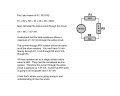
I think I figured out where you're going wrong. It appears to me that you're thinking that if you have a resistor of 40 ohms which at 12 volts gives you 300 mA, that you're going to see that 300 mA across that resistor. Add your light bulb and you're thinking that you're going to see a different current through that light bulb. Both the light bulb and the resistor need to be considered as a single resistance. And yes, someone before me said light bulbs have complex resistances, at start up their resistance is much lower than when it's at full brightness. That being said, lets stick to using pure resistors for the sake of clarification.

Refer to the attached drawing and explanation therein. The power supply may be capable of pushing 1000 amps. (ridiculous, I know, but stick with me) That doesn't mean your power supply is going to "Push" that current through the circuit; the amount of current is going to be dictated by the resistance of the circuit. And as already stated, you must consider all resistors as a single resistance, therefore a single current.

That being said, to address your initial question about voltage and breakdown of a resistor, while complex in itself, the basics can be considered under low voltage situations, such as voltages of 220 volts and lower. Unless you exceed the capacity of the resistor to act like an insulator protecting one end of the resistor from arcing across the body, you really don't need to consider voltage that carefully. Wattage is your best hope at understanding what's going on.

In the circuit below there are three resistors totaling 6KΩ and a 10 volt supply. Total current through the resistors is 1.67 mA. If you multiply the total current by the total voltage you get the total wattage dissipation. In this case, 1.67 mA times 10 volts you're going to get 16.7 milli Watts (16.7 mW). A simple quarter watt resistor (250 mW) will be sufficient to withstand the heat generated.

[edit #2] I'm deleting this paragraph because something in my math is all screwed up. If you read my post before I had this chance to edit it - please disregard my confusion.

Just remember to add all resistances together before you calculate any current. The total current is dependent upon the total resistance and the total voltage.

Hope this helps.

[edit] EVERYBODY WAIT - I SCREWED UP ON MY MATH AGAIN - I THINK.

OK, this is why I hated decimals. Here's an Excel spread sheet with the numbers. Lets see if it attaches:

…V1……R1……R2……R3…...R total…….I total……….W total
····10····1000····2000····3000····6000.00····0.001667········0.016667
····20····1000····2000····3000····6000.00····0.003333········0.066667
····30····1000····2000····3000····6000.00····0.005000········0.150000
··100····1000····2000····3000····6000.00····0.016667········1.666667
1000····1000····2000····3000····6000.00····0.166667····166.666667

After all that fuss (on my part) you can see how the increase in voltage affects the wattage. 10 volts and 6KΩ has a total current of 1.67 mA and 16.7 mW
20 volts increases current to 3.3mA and 66.7 mW.
30 v = 5 mA = 150 mW
100 v = 16.7 mA = 1.67 WATTS
1000 v = 167 mA = 167 Watts.
Double the voltage and you double the current. AND you quadruple the wattage.

You can see at what point a quarter watt resistor (250 mW) will break down.

R Value N Current.png
 
Last edited:

Thread Starter

PaulEngineer

Joined Dec 21, 2016
217
Thank you very much guys! Your tips helps me a lot! But I have a problem with English language! I am from Greece and I don't understand so much English language! Its not my.... let's say (in my country this word translated like "mother language") " mother language". I trying very hard with this syntax and learn the words that I don't know! This language is too difficult (you can see how I speak English! Really I'm not understandable!) But anyway I have to speak with as many English I know! I'm not sure if you understand me with the way how I speak English!
 

Tonyr1084

Joined Sep 24, 2015
9,744
Understand English - or not understand. Do you understand numbers?

I was sure English is not your "Mother language" (Native language), but that is OK. We don't judge others.
 
Top