Resistor getting too hot in a pulse circuit

Thread Starter

captoro

Joined Jun 21, 2009
207
Hello,
happy new year everyone
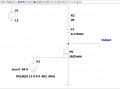
In my circuit attached, the resistor R2 (20 ohm and rated 20 watt). from calculation I get 7.2 watt. but this resistor is getting so hot I cant even touch it. Is it because of the switching ? the resistor it rated more then twice its power dissipation. It's out on the open with a small fan blowing on it.
The output is not connected, just to my scope to view the form wave.
thanks
Ken
 

Attachments

Audioguru again

Joined Oct 21, 2019
6,826
Your simulation has a 1000V power supply and a 2000 ohms resistor.
The Simulation does not show the 60V zener diode in the IRFZ44 conducting then allows the drain to have a flyback voltage of 1000V.

In actual use with a 12V supply and a 20 ohms resistor, the resistor has 48V pulses in it in addition to the 12V pulses in it which will make it hot. Editted
 
Last edited:

BobTPH

Joined Jun 5, 2013
11,463
The total power can be no more than

12^2 / 20

or 7.2W. The fact that some energy is stored in the inductor does not increase that.
 

Thread Starter

captoro

Joined Jun 21, 2009
207
MY bad, the datasheet requires a heatsink above a certain power. and I am above that required spec. So i will adding a heatsink.
thanks for your quick reply
 

dl324

Joined Mar 30, 2015
18,220
In my circuit attached, the resistor R2 (20 ohm and rated 20 watt). from calculation I get 7.2 watt. but this resistor is getting so hot I cant even touch it. Is it because of the switching ? the resistor it rated more then twice its power dissipation.
Your discomfort is meaningless to a resistor. A resistor will easily tolerate 70C, but you'd probably find that a bit warm.
 

MisterBill2

Joined Jan 23, 2018
27,186
Is it possible that this circuit is being used to produce short positive pulses, and that the transistor is normally conducting, and only momentarily switched off? That would result in a lot more heat.
 

DickCappels

Joined Aug 21, 2008
10,661
dl324 summed up the situation succinctly in post #7. Can measure the resistor's temperature and compare it with manufacturer's rating for it?

If its maximum temperature is not exceeded then things should be ok. If you have the resistor mount on a circuitboard you might want to mount it above the board (using spacers would be ideal) to avoid damaging or discoloring the board with the heat.
 
Top