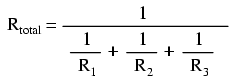
Double check what you wrote. My guess is that you made a simple typo.
Second, the way you write the equation is ambiguous. Is the denominator just R2, or is it (as you entered) R2+R2? The use of parentheses might be called for here.
Double check what you wrote. My guess is that you made a simple typo.
Second, the way you write the equation is ambiguous. Is the denominator just R2, or is it (as you entered) R2+R2? The use of parentheses might be called for here.
Thanks. djsfantasi wrote that I had a typo and also missing parenthesis. I wanted to make sure missing "*" was the typo since I assumed that it was self explanatory in the given context.
Thanks. djsfantasi wrote that I had a typo and also missing parenthesis. I wanted to make sure missing "*" was the typo since I assumed that it was self explanatory in the given context.
I assume that by now you discovered what I saw as a "typo". In post #3, you wrote the equation correctly and unambiguously. You had repeated R2, (R2+R2), instead of (R1+R2). And the parentheses was necessary to clearly show you intended to divide by the sum.
I'd write out what the original mistaken equation implied, but won't for fear it will only confuse things more. Suffice it to say tat your equation in post #3 is correct.

 Facebook
 Google
 GitHub
 Linkedin