Researching Switch type for a fan

shortbus

Joined Sep 30, 2009
10,049
Can you offer a solution?
I guess I don't understand your problem, really. The blower is too powerful? Move too much air or what? Blowers in furnaces are made to force air through the heat exchanger and duct work, just using them in open air they move a lot of air. If you want less air movement from a squirrel cage blower you make the intake opening smaller. Or add some type of baffles to the out put side to increase back pressure.

But lowering the motor voltage on an induction motor is the last thing I'd do, no matter what the expert is telling you.
 

Thread Starter

Tonyr1084

Joined Sep 24, 2015
9,744
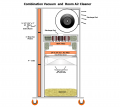
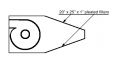
This is what I'm building. The outlet is 11 1/2" by 6". I'll snap a few pic's later this morning when I make it to the shop. Perhaps the air filters will provide sufficient resistance to air flow. But then, if I recall a discussion about vacuum motors; when you block the air intake the motor speed greatly increases because the motor is not moving air - thus, doing no work.
1640790693241.png
 

Thread Starter

Tonyr1084

Joined Sep 24, 2015
9,744
add some type of baffles to the out put side to increase back pressure.
I'll give blocking the output a try and see what happens.

The purpose is to extract saw dust from the air. Until I can upgrade my sawdust collection system I have to wear a mask almost all the time. And every day there's a find settling of dust on everything. The fan in the box with filters is intended to capture most of that dust. The big complaint is the noise. It's not LOUD but it is Loud. Running it on a lower setting also reduces the amount of noise. And there's already enough noise when I'm running the sawdust collector. Hearing protection, eye protection and dust protection, all a problem. Not a Serious problem but a problem nonetheless. Hence, the desire to reduce the motor speed, which will reduce the amount of air flow.

Just had a thought earlier this morning - is there such a thing for PWM for AC circuits? Could one be built using something like an SCR (no - not an SCR, but another similar control component, just can't think of the name of it). - - - [EDIT ] Triac?
 

shortbus

Joined Sep 30, 2009
10,049
And there's already enough noise when I'm running the sawdust collector.
That is why in a real wood shop, one that is a business the dust collector is outside. Over powering something like this by using too big a blower doesn't work too well. And just blowing dust through a filter box and back into the shop doesn't work well. This is one of the reasons dust collectors like this are usually a cyclone type thing.

I'd say, if doing this myself, I'd spend some time looking at ready made dust collectors. The companies making them document the shop size and the motor and impeller wheel sizes. Then try to find a blower that is close in size to what they use. Just because you have a furnace blower available doesn't make it the best for the job. There are surplus places selling these blowers or look at a window air conditioner for smaller blowers. Moving air with a blower is right up there with an air compressor in sound levels.
 

MisterBill2

Joined Jan 23, 2018
27,741
I have installed a speed controller for a 1/2 horsepower "whole house" fan and it worked very well. It provided at least a 2:1 speed reduction and no problem complaints from the homeowner, except that the fan still moved to much air. That motor was a 1750 RPM induction motor belt driving a 24 inch fan blade. The fan turned about 800 RPM with the belt reduction, before the speed control was added. And it was rather noisy.
That controller came from the Grainger catalog a few years ago, at the time the price was about $25. It included an off position as well as a full speed position, and mounted in a single-wide electrical switch box.
 

Thread Starter

Tonyr1084

Joined Sep 24, 2015
9,744
MisterBill2 I would appreciate a link. I can do $25.

shortbus that's why the compressor is downstairs in the garage.

I've looked at a lot of those shop air filtration systems and they're not much more than a blower and filter. Some have electrostatic dust collection, others have charcoal filters to absorb odors. All that may happen one day, but for a start-up - - - I'm just looking to get a little going. Hanging an exterior dust collector means a lot more expense and ductwork. Could easily cost close to $10,000 (US). Then there's the limited space behind the shop; and the noise my neighbors will have to live with. I only have two stations that need dust collection; the table saw and the miter saw. The miter is on a cart that can be wheeled out of position and a plainer can be wheeled in. IT's cart is specific to the planer deck height to match the workbench it will park between. The act of moving one machine out and moving the other in is how I connect a given machine to the dust collection system. Basically a 4" ABS pipe with a blast gate and a box surrounding the miter saw. Move that out and move the planer in and the box becomes a means of redirecting chips into the ductworks for the collector. At present the dust collector is a Harbor Freight single stage unit. The filter bag IS going to be replaced with a canister filter. The collection bag below is going to be replaced by a trash can separator OR a Dust Deputy (cyclone) separator. The canister will only be filtering out the really fine dust. Hence, the shop should stay a whole lot cleaner. And I don't have to clean the filters for the HVAC. During the warmer weather the dust collector can be rolled outside and hosed into the shop. With doors and windows open - dust isn't going to be a problem. But winter months means a closed up shop. Meaning dust becomes an issue. Not only for the HVAC and my lungs but also for the electronics that depend on fans to keep them cool. Lots to be considered here. I'll live with the noise if it means my equipment doesn't clog up with saw dust and overheat.
 

Thread Starter

Tonyr1084

Joined Sep 24, 2015
9,744
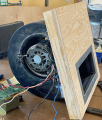
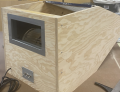
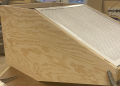
Right now box fans are not on shelves. They will likely be back come March or April. But I already have the materials I'm working with and the project is well under way. Largely speaking I have a few braces to build, a cover and a base and some tabs to hold the filters in place when not in operation. Here are a few photos of my progress thus far:
1640805113610.png
 

Attachments

MisterBill2

Joined Jan 23, 2018
27,741
It looks good. You could have the exhaust discharge out of the garage, maybe even out a roof vent, and not need to deal with whatever got past the filters. Plus you might lose some of the noise. No clue as to how fussy your neighbors might be. That could be the show-stopper for an outside vent.
 

MaxHeadRoom

Joined Jul 18, 2013
30,713
So happens - I have a few 2A autotransformers hanging around with no specific purpose. One experiment I did with that was to power the fan directly through the AT. However, the AT got hot, and I was using the low speed line on the motor.
Can you tell me a little more about hooking up a "Subtracting" transformer (you didn't call it that but I assume you mean opposing voltages detract from overall voltages).
What are you looking at using a variable speed, you apparently already have a 3 speed fan, i.e. 3 windings PSC motor?
 

shortbus

Joined Sep 30, 2009
10,049
that's why the compressor is downstairs in the garage.
Before you burn up your motor you might want to look at this video. It's not the one I was looking for but says and even shows why the 'expert' that keeps making claims about single phase induction motor speed controls work(they don't). If it was a simple as reducing voltage why do they make VFD's to do it? Lowering voltage just lowers the power output and heats up the rotor which then heats the stator. The added slip from the lower voltage also draws more amperage. The video he shows with test instruments what I'm saying, that the speed doesn't change.

None of the commonly used home shop dust collectors use a furnace type filter, they use a filter bag, which is much finer filter, it stops the dust you are still getting. Your furnace blower is way bigger/longer than what a real dust collector uses. It's probably got a impeller that is ~14" long. Where a store bought one is only ~4".

Look at this site - https://thehomewoodworker.com/best-dust-collector-for-workshop-large-and-small/
I have two different dust colectors, one for my sand blaster and one for wood working.

The sandblast one has a universal type motor, like a shop vac. And it has a bag in it hat does the filtering. When you shut it off the bag has a weight at the top that makes the bag collapse into the bottom, a steel drum, This shakes the fine stuff off of the bag and into the drum to be emptied when it gets full.

The wood work one has an induction motor and direct drive. It has 2 bags and like the other one the top one falls and shakes the fine stuff into the bottom one making it easier to empty when full. It's similar to this one but only a 1HP motor many years old now - https://www.harborfreight.com/2-hp-industrial-5-micron-dust-collector-97869.html
 

Thread Starter

Tonyr1084

Joined Sep 24, 2015
9,744
you apparently already have a 3 speed fan, i.e. 3 windings PSC motor
Yeah, that's what I "HAVE". But after all that wiring up of switches and crimping connectors, making the switch mount plate, installing the sides and the filters (only have the top and bottom left to make - tomorrow), after all that, when I put the fan on High it's pretty darn high. When I switch immediately to Low (refer to switch configuration for modes of switching) the motor doesn't change speed at all. At least not that I can discern. So all that work and around $40 (US) for a one speed fan. High, high or high.

Some pic's for the curios: (having issues uploading pic's - bear with me)
1640826689486.png1640826909116.png
 
Last edited:

MisterBill2

Joined Jan 23, 2018
27,741
If there is not much load the motor will not slow much. In many cases the speed change just reduces the torque, meaning that at no load the change is very small. At least with the original blower motor on my furnace, running at the higher speed, the voltage on the low speed connection was about 250 volts. That was way too much for the 120 volt primary of the small transformer that the guy who put in my humidifier connected to, since heating uses the lower speed connection. So the lower speed connection on this style motor just adds a lot more turns, so as to have less torque.
 

Thread Starter

Tonyr1084

Joined Sep 24, 2015
9,744
If there is not much load the motor will not slow much.
Yeah, learned that many years ago. Thing is - and I have to verify this - when starting on low the fan doesn't come up to speed quite as quickly, but it still comes up to about the same speed as when on high. At least to the best of my ability to detect the changes. I even used a playing card and placed it against the blades of the squirrel cage with the hopes of detecting a change in pitch between high and low. There was no change in pitch. None. Not exaggerating. I'm wondering if someone swapped out a bad motor years ago and this motor is too powerful for the heater as it once was.

There's a neighbor with an old furnace outside. Maybe I should chat with him about taking it off his hands. Take that motor out (if I can make it fit) and swap them. Then again, maybe I'll hit the lottery. Nah! They say you can't win if you don't play - but I reply "I can't lose if I don't play."

I'm tired T - I - R - D "Tired". Besides it's dinner time.
 

MaxHeadRoom

Joined Jul 18, 2013
30,713
Yeah, that's what I "HAVE". But after all that wiring up of switches and crimping connectors, making the switch mount plate, installing the sides and the filters (only have the top and bottom left to make - tomorrow), after all that, when I put the fan on High it's pretty darn high. When I switch immediately to Low (refer to switch configuration for modes of switching) the motor doesn't change speed at all. At least not that I can discern. So all that work and around $40 (US) for a one speed fan. High, high or high.
Reduce the area of the outgoing air, it will also reduce the current.
 

MisterBill2

Joined Jan 23, 2018
27,741
Reduce the area of the outgoing air, it will also reduce the current.
Max, that depends on the type of blower configuration. For some varieties it reduces the load, for other styles it increases the back-pressure and increase the load. I have fought with both types, it is still not clear about how to recognize which kind is which.
 

Thread Starter

Tonyr1084

Joined Sep 24, 2015
9,744
Reduce the area of the outgoing air, it will also reduce the current.
I suspect that's the case. Less work being done means less power consumption. But @MisterBill2 said
For some varieties it reduces the load, for other styles it increases the back-pressure and increase the load.
Since I don't "Know" this to be the case - or know it to be NOT the case - I can't speak to or against that argument. Experience is pretty hard to trump. For my purposes, more air flow is better than less, as it will filter the total volume of air in the room more frequently than one with a choked output.

There IS a guy with a furnace sitting in his front yard. I don't know if he wants it - or if he's going to want cash for it. It's definitely smaller. And the way I'm constructing my air filtration system, changing to a smaller fan would be easy enough. But then the amount of air volume filtration will be decreased. There's a trade off.
 

MisterBill2

Joined Jan 23, 2018
27,741
If the smaller furnace has a smaller fan, be sure to rescue whatever controls are associated with it. It might be a newer type with electronic controls for the blower. Or maybe not.
 

Thread Starter

Tonyr1084

Joined Sep 24, 2015
9,744
Judging from the age of the neighborhood and the looks of the small unit - I'd say it's probably a 1960's model. Probably the basic operating system, the fire box gets hot, triggers a switch that turns the blower on. Fire box cools, switch opens and the blower shuts off. IF it's a multi-speed fan then it's likely dependent upon which wire is connected. With Heat and AC, they sometimes utilize a different speed, one for heat and another for AC. These Utah homes didn't come with AC back then. If you have it either you've upgraded or bought a newer home recently built during the land boom. Every farmer's heir is selling property to make quick big bucks and developers are building those cheap cookie cutter homes. The look real nice, but they don't last like the old brick & mortar homes. However, they're probably stronger in earthquakes. We had one here last year and I was in the basement when it hit. I don't recall how many steps it took me to get up stairs, but I'm betting it was around six steps, all the while exclaiming SHIIII - - - (you guessed it), over and over until the shaking stopped.

I grew up in Los Angeles. Earthquakes, scary as they are never shook me up like this minor quake did. But then this is the first brick home I've ever lived in. Knowing how unsound they can be during earthquakes, I was afraid of a collapse. Here's the home security video:
https://www.cnn.com/2020/03/18/us/utah-earthquake/index.html
I'm about 35 miles north of that area. Shaking here wasn't that bad, but still scared me out of the crap.
 
Last edited:
Top