#20 is a little too thick. The boards were designed for #22 solid and 0.025" square headers fit well. I've seen some people advising to not use them because they're too wide (just another old wives' tale). They're not if oriented square to the contact faces; the diameter of #22 wire is 0.0253".
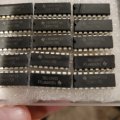
Hate to have to be the one to break it to you, but these devices are packaged improperly. If they aren't outright dead, they could be unreliable.
Any CMOS IC's are static sensitive as are some blue and white LEDs and need to be handled, packaged, and stored properly. CMOS IC's include protection diodes, but they're only tested to a couple thousand volts and aren't intended to provide protection from flagrant abuse.
He'll likely be fine. The chances of the chips being bad are proportional to the chances that a project with nearly 2000 hand-soldered LEDs will be completed.
He'll likely be fine. The chances of the chips being bad are proportional to the chances that a project with nearly 2000 hand-soldered LEDs will be completed.
#20 is a little too thick. The boards were designed for #22 solid and 0.025" square headers fit well. I've seen some people advising to not use them because they're too wide (just another old wives' tale). They're not if oriented square to the contact faces; the diameter of #22 wire is 0.0253".
I check continuity...
View attachment 260375
Hate to have to be the one to break it to you, but these devices are packaged improperly. If they aren't outright dead, they could be unreliable.
Any CMOS IC's are static sensitive as are some blue and white LEDs and need to be handled, packaged, and stored properly. CMOS IC's include protection diodes, but they're only tested to a couple thousand volts and aren't intended to provide protection from flagrant abuse.
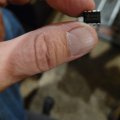
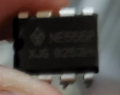
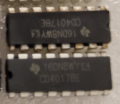
Were we supposed to be able to see the markings? View attachment 260376
Unless TI changed their marking methodology for NE555P, I'd be suspicious of them.
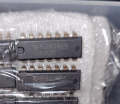
The discoloration on the leads of the top device looks suspicious: View attachment 260377
As a novice, you should buy semiconductors from reputable places so you don't have to add troubleshooting defective components to your projects. If you're lucky, the parts won't work because they've been mishandled, or might even not be what the markings indicate. If you're unlucky, you might get something that sort of works, but was salvaged (either from a board or from factory rejects) and you end up chasing your tail.
Some counterfeiters will put a small number of good parts with their counterfeits so that you have to do 100% functional testing to catch them. They're counting on human nature to let them get away with selling you garbage.
CD4017 from a reputable source in the US are only $0.25 each in quantity 100.
There are some things where lower quality and price are acceptable.
Intel has older technology fabs in China that still produce parts that meet Intel's standards, but they're probably packaged in another country, so you wouldn't know the country of manufacture.
Don't underestimate the strength, the motivation or intelligence of a country that has changed so much in the last 30 years. It is not a 3rd world country.
As a novice, you should buy semiconductors from reputable places so you don't have to add troubleshooting defective components to your projects. If you're lucky, the parts won't work because they've been mishandled, or might even not be what the markings indicate. If you're unlucky, you might get something that sort of works, but was salvaged (either from a board or from factory rejects) and you end up chasing your tail.
Some counterfeiters will put a small number of good parts with their counterfeits so that you have to do 100% functional testing to catch them. They're counting on human nature to let them get away with selling you garbage.
CD4017 from a reputable source in the US are only $0.25 each in quantity 100.
There are some things where lower quality and price are acceptable.
Intel has older technology fabs in China that still produce parts that meet Intel's standards, but they're probably packaged in another country, so you wouldn't know the country of manufacture.
That will impact our ability to be able to help you identify counterfeits.
I suppose I may have to seek an IC tester. Recommendations? Also, would you recommend any good sources for electronic components? I'd like to find diffused LEDs, too. So far no luck. I have searched. A lot.
I always purchased electronic parts locally. One of my designs used a Texas Instruments quad opamp and tens of thousands of a product were made and sold. The ICs were reliable and did not need to be tested.
Not a single finished product failed a very exhaustive test ( but one had the IC mounted backwards and another had a shorted capacitor) and none were ever returned.
There are entire cities "over there" that manufacture only cheap fake electronic parts. Not here in Canada.
I did post a question early on, and never really got an answer that was clear enough to me. Electrolytic capacitors are used in everything. Their values are rated in voltage and µF. I understand why a particular voltage is selected - they have to be rated at or higher than the voltage that will be applied to them. What I don't understand is the selection of a particular µF rating. I know of 10, 22, 33, 47, 100, and values I can't remember up to 4700. I bought a mixed set with a few of the little ones all the way up to the 4700s. Haven't used them. Anyway, I only partially understand, maybe, the general concept. Timer circuits that I have seen just have a 10 µF rating. Why? I guess you don't need much "kick" to drive the circuit? A taser, on the other hand, requires a lot of "kick". There is a lot I don't understand about the capacitor. I can do the math all day long, but when it doesn't apply to something, it doesn't mean a whole lot.
I don't have any recommendations. If you plan on testing static sensitive parts that have been handled improperly, the chances of finding all of the problems is low. ESD can cause damage that could take days, weeks, or years to manifest itself. Determining the failure cause will always involve decapping the device and that's a job best left to professionals. They'd have to look for what caused the failure anyway.
Once you develop good troubleshooting skills, finding defective components in small circuits isn't too difficult; as long as you understand how the circuit and components work.
Any authorized or reputable seller - that would exclude most sellers on Ali Express, eBay, Amazon, and the like. I buy most of my semiconductors from Jameco, Newark, Tayda, and Mouser. If you plan ahead and buy enough parts to amortize shipping charges across more parts
I don't have any recommendations. If you plan on testing static sensitive parts that have been handled improperly, the chances of finding all of the problems is low. ESD can cause damage that could take days, weeks, or years to manifest itself. Determining the failure cause will always involve decapping the device and that's a job best left to professionals. They'd have to look for what caused the failure anyway.
Once you develop good troubleshooting skills, finding defective components in small circuits isn't too difficult; as long as you understand how the circuit and components work.
Any authorized or reputable seller - that would exclude most sellers on Ali Express, eBay, Amazon, and the like. I buy most of my semiconductors from Jameco, Newark, Tayda, and Mouser. If you plan ahead and buy enough parts to amortize shipping charges across more parts
Any of the companies I listed will have many options for diffused LEDs.
You just haven't seen enough circuits. I've used caps ranging from 1uF to 470uF. Electrolytic capacitors typically have a wide tolerance which will affect timing. With large electrolytic capacitors, you also need to factor in leakage current.
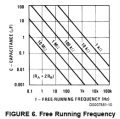
National Semiconductor included this graph in their datasheet:
It only goes up to 100uF, but larger caps can be used.

 Facebook
 Google
 GitHub
 Linkedin