Facebook
 Google
 GitHub
 Linkedin

Hello, i have being working in a design to create a repeating timer with variable time for my aquarium. What i want is an analog timer where i can set a different time spam on T1 and a locked T2. The times can vary from 0-180sec for T1 and 15-30Min to T2.
I want to implement a model of aquaponic´s filtering system in my aquarium to manage some experiments with flow and dirt removal/clogging.
My design so far is based in 3 Cmos: 4020, 4093, 555.
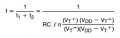
I thought to use a 4093 as a Monostrable timer for T1. 555 for a multivrator to generate a pulse for 4020 which will set T2. In this scenario the Monostable timer can be adjusted with the help of a potentiometer to set T1 independently of T2. One future idea is to change 4020 with 4060 so I could get rid of 555. The problem I am facing with this is that my monostable timer first set does not fully charge the capacitor, so only in the second cycle the T1 timer actually have a steady timing. Also, I am not sure why but in my Proteus simulation the state of my 3rd Nand gate gets grey, leading to a indefinite state in 4020 reset and the start of counting before the end of T1, this occurs only in first cycle.
This can be set very easily with a microcontroller, but for sake of parts and knowledge i want to try to make this with analog. Also, managing analog real-time time set with microcontroller can be tricky with potentiometer, which would lead to a complex case of HMI.
Yes, i have seen thehttp://www.zen22142.zen.co.uk/schematics, but believe me, the ones that could work for me just did not work in my proto board. I am not sure why. For instance,http://www.zen22142.zen.co.uk/ronj/rt7.html, could have made this very simple, but i tried with 4093 and could not make it to work no matter how hard i tried. Also i could not simulate this in Proteus, maybe because the capacitance limit of Proteus.
If you have any ideas on design or directions I would thank you from the bottom of my heart. Seriously, I have spent too much time in this project so far, and it became personal, haha.
I want to implement a model of aquaponic´s filtering system in my aquarium to manage some experiments with flow and dirt removal/clogging.
My design so far is based in 3 Cmos: 4020, 4093, 555.
I thought to use a 4093 as a Monostrable timer for T1. 555 for a multivrator to generate a pulse for 4020 which will set T2. In this scenario the Monostable timer can be adjusted with the help of a potentiometer to set T1 independently of T2. One future idea is to change 4020 with 4060 so I could get rid of 555. The problem I am facing with this is that my monostable timer first set does not fully charge the capacitor, so only in the second cycle the T1 timer actually have a steady timing. Also, I am not sure why but in my Proteus simulation the state of my 3rd Nand gate gets grey, leading to a indefinite state in 4020 reset and the start of counting before the end of T1, this occurs only in first cycle.
This can be set very easily with a microcontroller, but for sake of parts and knowledge i want to try to make this with analog. Also, managing analog real-time time set with microcontroller can be tricky with potentiometer, which would lead to a complex case of HMI.
Yes, i have seen thehttp://www.zen22142.zen.co.uk/schematics, but believe me, the ones that could work for me just did not work in my proto board. I am not sure why. For instance,http://www.zen22142.zen.co.uk/ronj/rt7.html, could have made this very simple, but i tried with 4093 and could not make it to work no matter how hard i tried. Also i could not simulate this in Proteus, maybe because the capacitance limit of Proteus.
If you have any ideas on design or directions I would thank you from the bottom of my heart. Seriously, I have spent too much time in this project so far, and it became personal, haha.
Attachments
-
40.3 KB Views: 20