Relay logic help

boostbuck

Joined Oct 5, 2017
1,043
Quite an explanation, but you still haven't shown a schematic using AC relays as logic elements.
I for one would appreciate it if you can explain why the use of AC relays changes the logic. I always thought (and have always found, in my limited experience) that AC and DC relays behave the same.

In what way do they differ in their logical behaviour?
 

Papabravo

Joined Feb 24, 2006
22,083
Quite an explanation, but you still haven't shown a schematic using AC relays as logic elements.
If each rung in the diagrams above has 110 VAC across it and the coils are designed to hadle that it makes them AC relays does it not? Does it matter if it is 36VAC or 12VDC? No it does not. Do you have something else in mind when you refer to AC relays?
 

panic mode

Joined Oct 10, 2011
4,995
Quite an explanation, but you still haven't shown a schematic using AC relays as logic elements.
i certainly did...

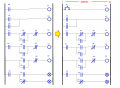
post #21 shows relay ladder diagram. this is used as is - either as a circuit schematic or as a program code. when used as a schematic, power is connected to vertical rails and components are chosen to match that voltage (relay coils, lamps). and this works with any voltage and regardless if AC or DC. this is how you turn it into 120VAC schematics. really only push button symbol changes and voltage is shown. just keep contact type the same (NO). maybe you have not seen schematics like this. or are not familiar with symbols. or is it specific part of the circuit that you have problem with? or you cannot follow it and would prefer something with pictures (like Fritzing?)

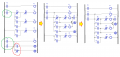
1728573809100.png

it is clear that there are things that confuse you... like AC/DC,voltage, relays, ladder logic, schematics etc. that is ok, forum is here to help clarify things.

everything shown here has been around for a very long time - practically since invention of electricity. and conventions are well established - and were followed. i tried to explain things in depth and draw relations to other technologies (like discrete digital logic) to help you out. i would like to help more but not really sure what else can be said that would let you understand. perhaps try letting us know what specifically you find challenging or why you think that presented may not work.
 
Last edited:

eetech00

Joined Jun 8, 2013
4,705
i certainly did...

post #21 shows relay ladder diagram. this is used as is - either as a circuit schematic or as a program code. when used as a schematic, power is connected to vertical rails and components are chosen to match that voltage (relay coils, lamps). and this works with any voltage and regardless if AC or DC. this is how you turn it into 120VAC schematics. really only push button symbol changes and voltage is shown. just keep contact type the same (NO). maybe you have not seen schematics like this. or are not familiar with symbols. or is it specific part of the circuit that you have problem with? or you cannot follow it and would prefer something with pictures (like Fritzing?)

View attachment 333453

it is clear that there are things that confuse you... like AC/DC,voltage, relays, ladder logic, schematics etc. that is ok, forum is here to help clarify things.

everything shown here has been around for a very long time - practically since invention of electricity. and conventions are well established - and were followed. i tried to explain things in depth and draw relations to other technologies (like discrete digital logic) to help you out. i would like to help more but not really sure what else can be said that would let you understand. perhaps try letting us know what specifically you find challenging or why you think that presented may not work.
Oh please....I'm not confused at all, and I never said anything about the ladder diagram not working. I'm very familiar relays, relay logic design, and understand how all this stuff works. Using digital terms not a BAD thing and I used digital terms to help any reader who more easily relates to them (the expression "Flip Fop" was first mentioned in post #8). All I asked for was a schematic of a relay based implementation of the ladder diagram because it was in line with what the TS requested. I guess my request for a relay based schematic will go unanswered. I'll move on now...
 

boostbuck

Joined Oct 5, 2017
1,043
.... All I asked for was a schematic of a relay based implementation of the ladder diagram....
Ok, I think you are saying that a ladder diagram is not a schematic, and you are after a drawing in the form that I posted back in #20?

I think most would regard a ladder diagram as a valid schematic, in that contains a complete description of the physical implementation of the logic, albeit with inherent constraints on format.
 

panic mode

Joined Oct 10, 2011
4,995
i thought about that too which is why i brought up question about format and symbols. that would not be surprising if someone only worked with IEC symbols for example. then ladder logic as seen in a PLC may appear as merely computer representation of some code, that was transposed to make it fit screen or printing on endless paper. that would be suggest one is not realizing that actual schematics are really drawn the same way - which is exactly where computer ladder logic representation comes from... and that is the way they were drawn for really long time.

https://www.sciencedirect.com/topics/engineering/ladder-logic

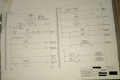
and here are couple of examples from my collections, don't have many with 120VAC...
those are done by different companies but they are for real machines that are being used right now.

so if you are to protest that "no real schematics was shown", why don't you show us what is your idea of "real schematic"?


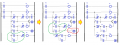
1728609738198.png


1728610270896.png
 
Last edited:

Thread Starter

Dhogan12345

Joined Oct 7, 2024
8
I wired up like in number two and it will not unlatch. I spoke with the instructor and he showed me his wired up. It has 5 DPDT relays. It works perfectly. He will not share the answer with us. I’m getting my ass kicked trying to figure this out. Anyone able to draw something up with only 5 DPDT relays?
 

panic mode

Joined Oct 10, 2011
4,995
I wired up like in number two and it will not unlatch.
no idea what that means... what is "number two"?
and what exactly will not unlatch and when...
the only way anyone can try to help you is if you share enough of info to replicate your efforts.


spoke with the instructor and he showed me his wired up. It has 5 DPDT relays. It works perfectly. He will not share the answer with us.
that is fine... your task is to come up wioth something that can work - regardless how many relays or contacts are used. at least this is my interpretation of what you wrote before about assignment.


I’m getting my ass kicked trying to figure this out. Anyone able to draw something up with only 5 DPDT relays?
sure...

solution is to FIRST make something that makes sense... and WORKS... and THEN optimize it....

using example of circuit i shared last, five relays are used.
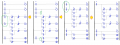
so number of relays is already there just need to reduce number of contacts. for starters one could try:
1. noticing that rungs 3 and 4 (relays K3 and K4), both start with NO contact from K1. this can be optimized to use only single K1 contact...
2. one can also do the same with K2 and lamps since K2 contact is common.
3. one can repeat the same thinking and apply it to PB and K1 since both are really the same thins (K1 is just used for contact expansion) etc.

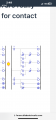
1728805806358.png

other things one could after such reductions are exhausted, is thinking of way to reorder elements in a rung. one of the objectives is to use complementary contacts grouped together.
so far that is the case... one can also go rogue and break away from convention that coils are always on the same side. i am really not fan of that but if this is merely scholarly competition, why not... once could put PB or K1 contact on the right side of the K3 and K4. then coils of those would still be energized only when button is pressed BUT... one would not need the last rung. lamps could be connected to K5 contacts that are powering K3 and K4.... but the lamps would still be powered on continuously. there may be other solutions and this one may not be reduced completely but it is late, i have shown thinking behind it. hope this puts you on a right track....

1728807755891.png
 
Last edited:

ericgibbs

Joined Jan 29, 2010
21,445
Hi Panic,
A neat solution, but this is homework for which the student will get the credit marks for his course.
If he is unable to solve the problem, it means he has failed the assignment.
Mod
 
Last edited:

panic mode

Joined Oct 10, 2011
4,995
post a picture of your implementation and video clip of operation....
also show relay part numbers because someone had hard time believing that this can work on AC
 
Last edited:
Top