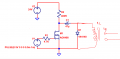
The relay, if it has a low operating current, will operate for an instant till the capacitor C1 discharges when M1 turns ON.
It may also operate for an instant when M1 turns OFF if D1 is disconnected.
When M1 is OFF, C1 is fully charged. When M1 turns ON, C1 discharges thorugh M1 and operates the Relay till C1 discharges.
When M1 turns OFF, the capacitor charges again through R2 and D1. If D1 is disconnected, the charging current through the Relay may operate for an instant till C1 is charged.
The relay, if it has a low operating current, will operate for an instant till the capacitor C1 discharges when M1 turns ON.
It may also operate for an instant when M1 turns OFF if D1 is disconnected.
When M1 is OFF, C1 is fully charged. When M1 turns ON, C1 discharges thorugh M1 and operates the Relay till C1 discharges.
When M1 turns OFF, the capacitor charges again through R2 and D1. If D1 is disconnected, the charging current through the Relay may operate for an instant till C1 is charged.
A potential problem with the circuit is the input signal timing. 500 microseconds is a very short time period when it comes to relay operation. Depending on the relay (relay part number?), its armature might not be able to respond in such a short time.
Also, 400 ohms and 47 uF is a time constant of almost 19 ms. Assuming the relay needs at least 85% of its rated coil voltage to pull in reliably (relay part number?), that is approx. two time constants. IOW, the time required for the capacitor to recharge to a useful voltage level is 76 times longer than the input signal allows.
The idea for the circuit is fine, but based on the input signal it needs significant adjustments.
And the time-constant for the relay turning on is also very short.
Assuming a small 24V relay with a coil resistance of about 1kΩ, the operate time-constant is only 47ms.
A potential problem with the circuit is the input signal timing. 500 microseconds is a very short time period when it comes to relay operation. Depending on the relay (relay part number?), its armature might not be able to respond in such a short time.
Also, 400 ohms and 47 uF is a time constant of almost 19 ms. Assuming the relay needs at least 85% of its rated coil voltage to pull in reliably (relay part number?), that is approx. two time constants. IOW, the time required for the capacitor to recharge to a useful voltage level is 76 times longer than the input signal allows.
The idea for the circuit is fine, but based on the input signal it needs significant adjustments.
I would say so.
Relay specs: 12vdc, 364 ohm coil, 10ms operate time and 5ms release time, max turn on voltage 9 volts, minimum turn off voltage .6 volts
With the diode connected correctly appears the relay would activate briefly when powered ON. Not sure if the pulse generator is constant or momentary but is .5ms pulse long enough to discharge the cap fully?
There is no inductive kick from the relay coil. The diode is not there for suppression.
When M1 turns on, the right side of C1 goes below GND. This reverse-biases the diode. The relay activates because it doesn't care about the direction of the current.
C1 discharges through the coil. If the input pulse is wide enough, C1 discharges completely.
When M1 turns off, the left side of C1 is pulled up to Vcc through R1 and the coil resistance, and C1 starts charging up. R1 and the coil form a voltage divider. When the voltage across the coil reaches 0.6 V, D1 starts to conduct. This prevents the C1 charging current from causing a false relay activation. Because the diode's conduction curve is, well, a curve, there is no sudden change in the relay coil current. It levels off at i = 0.6 / Rcoil, approx 2.4% of its rated value.
Thus, the current through the relay coil is exponential in both directions, and there is no inductive kick caused by high di/dt.
With all respect to ALL of you, this thread seems to be going nowhere. I'm in the middle of programming a PIC16F73 to interface a 32 contact membrane switch to record and play 32 messages on an ISD4003-05SY. I think it might work. Testing it now..
Relay specs: 12vdc, 364 ohm coil, 10ms operate time and 5ms release time, max turn on voltage 9 volts, minimum turn off voltage .6 volts
With the diode connected correctly appears the relay would activate briefly when powered ON. Not sure if the pulse generator is constant or momentary but is .5ms pulse long enough to discharge the cap fully?
This is a 24 V circuit, but the part number is for a 12 V coil. Driven by DC, that would be a major problem. But pulsed like this, I don't see a problem. The input pulse width and the size of C1 both work to limit the total energy in the relay coil to a safe value.
As C1 discharges from 24 V to 6 V (a safe low value), the total energy pumped into the coil is 0.0127 W-s. That's not much.
Rcoil = 364
C1 = 47 uF
1 time constant = 17.108 ms
So, first, as above, the input pulse width is too short for the cap to come anywhere near a complete discharge.
The relay coil voltage will decrease from 24 V to 3.36 V ( a very reasonable estimate of its drop-out voltage) in two time constants, or 34 milliseconds. Even it the full 24Vdc were applied for the full 34 ms, the coil would be just fine.
Over 0.5 ms, the coil voltage will decrease approx 0.7 V, from 24.0 V to 23.3 V. That's not much. With the fast, 50/50 drive signal, the average voltage across the coil is 12 V. And, with a release time of 5 ms, the relay armature is acting as the lowpass filter to turn the pulsed coil current into continuous contact closure.
Knowing all of that, it looks to me like the intent of the circuit is to use a 12 V relay in a 24 V application. This circuit has none of the RFI and peak current issues of a traditional PWM approach. Using the armature mass as the PWM filter is nice.
I'm in the middle of programming a PIC16F73 to interface a 32 contact membrane switch to record and play 32 messages on an ISD4003-05SY. I think it might work. Testing it now..
I'm in the middle of designing a no-extra-wires control system for my basement ceiling lights, with an AC solid state relay that uses just one power MOSFET.
That's correct.
I tested the circuit with a very similar 12 volt relay with a 390 ohm coil, results are:
Average voltage across the coil was -7 volts, 18ma with a dissipation 126mw. Total average current draw was 42ma or 1watt dissipation
Compared to connecting relay in series with R2 and driving the FET directly.
Total current draw 30ma with a dissipation of .72 watt.
11.7 volts across relay coil, 30ma with a dissipation of 390mw or 3 times more then the previous result.
That is not the intent of the circuit. It is a form of a buck regulator. The relay contacts are closed continuously as long as there is an input signal. The combination of the circuit and the relay act like a retriggerable monostable, but it isn't that either.

 Facebook
 Google
 GitHub
 Linkedin