Relay Advice

Thread Starter

EliCustom

Joined Sep 16, 2018
19
First time posting a picture, hopefully it worked
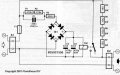
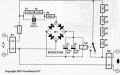
The circuit diagram is a soft start delay for a toroidal transformer 120VAC in, 120VAC out at 8.34A

What should the relay AC voltage be? Some spec it at 250 VAC. How much DC is the bridge rectifier supplying? Specs on relays have a 'coil voltage'. I can only assume this is the voltage needed to activate the relay.
Is there a relay anyone can recommend?
fD6o77r.jpg


Mod edit: fixed image upload
 
Last edited by a moderator:

MaxHeadRoom

Joined Jul 18, 2013
30,654
If the secondary is 120vac then the DC will be ~165vdc. If fed from the AC it will be a 120v AC relay.
That circuit seems like a little overkill for inrush reduction. Do you actually need it?
I have seldom found it necessary.
Max.
 

Thread Starter

EliCustom

Joined Sep 16, 2018
19
I have no idea why the picture can't be displayed. It would be nice if some of the members here could see it

The circuit diagram showed the soft start getting fed by 120VAC mains power. After the soft start comes the toroidal and the the unit to be powered. The toroidal will be 1kVA at 8.34A. Supposedly, anything greater than 300VA needs a soft start

Anyway, the circuit show a 2 470kOhm and a 220Ohm resistor in series. What would be the voltage going into the bridge rectifier?
 

JohnInTX

Joined Jun 26, 2012
4,787
I'm not really sure how you did that but it's fixed. It is best to upload the file itself to AAC rather than link to a 3rd party hosting service. It's more reliable and the image stays local to the thread.
Carry on!
 

Thread Starter

EliCustom

Joined Sep 16, 2018
19
I figured out how to do it. Maybe someone can provide some insight

The K1 should be the incoming 120VAC
The K2 will be going to the toroidal 1kVA transformer @ 8.34A

The B250C1500 is a bridge rectifier. How much voltage is coming out of that thing? I would also like to know how to calculate the voltage going into it.

The biggest question is the relay. Are there any recommendations as to what's needed?
 

ebp

Joined Feb 8, 2018
2,332
It is a bit of a Catch 22 situation. You don't know what voltage you'll get until you know what the coil resistance is.

R1 and R2 are just there to discharge the 330 nF cap for safety purposes. R3 is to limit the peak current to something less than 1 A. C1 will have an impedance of about 8k at 60 Hz. I'm guessing the original circuit was intended to be used with a 24 volt 16.7 mA (fairly common rating). Without the relay in circuit the the rest of the circuit will cheerfully detonate the electrolytic capacitors with over voltage.
 

Thread Starter

EliCustom

Joined Sep 16, 2018
19
The relay I would like to use has a coil resistance of 2.8kOhms

Would you add all the resistors in series? 470k+470k+220+2.8k
 

Alec_t

Joined Sep 17, 2013
15,117
What would be the voltage going into the bridge rectifier?
About 21VAC, according to LTspice: but to allow for the possibility of C1 failing short circuit I'd suggest using a mains voltage rated bridge rectifier (which would be little different in price).
Would you add all the resistors in series? 470k+470k+220+2.8k
Why? For calculating relay coil current you can ignore the 470k resistors.
 

Thread Starter

EliCustom

Joined Sep 16, 2018
19
Any particular mains voltage rated bridge rectifier that you would recommend? I don't have any idea about the specs to look for
 

ebp

Joined Feb 8, 2018
2,332
With nearly 1000 µF of filtering, that thing is going to take a very long time to charge to the pull-in voltage of the relay, and when it does pull it's going to do a poor job of it.

A 24 V 1 W zener diode could/should be added across the filter caps to prevent excessive voltage.

The 330 nF capacitor should ideally be an "X2" type which are designed for use across AC mains. The 220 ohm resistors should be a flameproof, preferably fusible type BUT it may be subjected to about 130 W instantaneous power at turn on. That will be very brief, but some film capacitors won't survive.

We aren't allowed to talk about these circuits, but since a moderator fixed the schematic to make it legible, I will suffer no rebuke.
 

Thread Starter

EliCustom

Joined Sep 16, 2018
19
The toroidal was intended to be an isolated power supply for testing circuits. I purchased a differential probe for my oscilloscope making the toroidal isolated power supply unnecessary. Nonetheless, I would still like to complete the project.

You stated 'A 24 V 1W zener diode could/should be added across the filter caps to prevent excessive voltage'. I'm assuming these are the 470uF capacitors going to the relay. Where would the zener be placed? Any way you could provide a simple diagram?

You also stated it would take a very long time to charge the pull-in voltage and do a poor job of it. What would you suggest as values for the caps? Would they still need a zener diode?
 

ArakelTheDragon

Joined Nov 18, 2016
1,366
The relay might be 250VAC, if its for a 220VAC network. The coil voltage is the DC voltage needed to activate the relay. A part number or model or something of the relay can help.
 

ebp

Joined Feb 8, 2018
2,332
The zener would go right across the filter capacitors and relay coil, cathode of the zener to the positive side, anode to the negative side. A 1N4749A would be suitable.

I'll come back later with filter values that are probably more suitable. From other things I've found on the web, the original circuit was intended for 240 VAC 50 Hz.

If the toroid is just for isolation, then I agree with Max that there is likely no reason for any sort of "soft start" and for some types of equipment softstart is a bad thing because it actually causes more stress, rather than less. One possible issue is that toroid cores have essentially zero air gap, whereas EI core transformers have a very small and ill-defined gap. With any transformer, if there is residual magnetism in the core when power is reapplied and the direction of the magnetizing force at power application is the same as the residual magnetism you can have a very high input transient current if the core is pushed into magnetic saturation. The air gap has some small benefit for this issue. Usually all that is required is a time delay fuse or circuit breaker. A breaker designed to do double duty as a switch can be a good choice because they generally have high quality robust contacts. The soft start circuit is presumably intended to degauss the core prior to application of full line voltage.
 

Thread Starter

EliCustom

Joined Sep 16, 2018
19
It's looking like the soft-start was a bad idea
Does anyone know the sequence? Does it go soft-start then the toroidal and then the device to be powered?

I would have ordered one of the transformers already but Hammond states in their documentation that a soft-start may be required

All the EI transformers seem to be rated for 115VAC/115VAC
Anybody know if they would be OK with 120VAC?
 

Alec_t

Joined Sep 17, 2013
15,117
Does anyone know the sequence? Does it go soft-start then the toroidal and then the device to be powered?
At power-up R4-R7 (40Ω total) are in series with the transformer primary winding, so the transformer and any collected load will be under-run. After a few seconds the relay pulls in and R4-R7 get bypassed, thus running the transformer at full power.
 

ebp

Joined Feb 8, 2018
2,332
Depending on the pull-in voltage of the relay you use, the delay with the two 470 µF capacitors will likely be something in the 2 second range. That is probably not unreasonable.

If you are testing something that you think would not respond well to slowly rising then rapidly stepped input voltage, you could always add an extra on-off switch on the secondary side.

Transformers can withstand very gross short term overload and moderate longer term (tens of seconds, at least) overload. Starting something like a motor that required nearly the full output current of the transformer when up to speed might be a bit dubious if it took a long time to get to speed because of "mechanical" loading. MaxHeadRoom could address that far better than I can..

The sorts of things that might not "like" the output of the transformer with the soft-start would include anything that directly rectified and filtered the AC input, such as switch mode power supplies. Switchers usually have their own circuit to limit the peak current when power is first applied, and the odd slow rise & fast step might interfere. You might also get into a situation where the switcher would start while the soft-start was doing its thing, then shut down again because the input current was limited by the soft start circuit. These things depend very much on the design of the switcher.

A relay that has slowly rising coil voltage will not achieve high contact pressure as soon as the contacts mate. This leads to high transient resistance and in turn can shorten the life of the contacts. That isn't a big disaster for this sort of circuit since replacing the relay isn't likely to be a big cost or down-time issue, and even if it were to weld closed the worst that will happen is the input fuse will blow. Slow opening is a more serious problem, but that isn't an issue with this circuit since the relay is not expected to open while current is flowing.

===
If a transformer is rated at 115 V with no other spec but is rated for 50 or 60 Hz and you want to use it at 60 Hz, it most definitely will be OK at 120 V since it is the "volt-second product" that matters (this again relates to magnetizing the core when there is no load). I used to use a surplus telephone ringing transformer as a step-up or step-down isolation transformer. It was intended for low voltage at 20 Hz, but was perfectly happy with 120 VAC at 60 Hz.

Costs are reduced in transformers by using the absolute minimum amount of iron and copper. Transformers from reputable companies like Hammond are usually quite conservative designs - at somewhat higher cost.
 

DickCappels

Joined Aug 21, 2008
10,661
(Some text removed for clarity)

We aren't allowed to talk about these circuits, but since a moderator fixed the schematic to make it legible, I will suffer no rebuke.
Currently there is a prohibition against discussing transformerless power supplies. This is not a transformerless power supply, but instead is it s mains connected circuit. The difference being that with a transformerless power supply one might mistakenly think that the output provides enough isolation from the power line so that it would be safe to touch both its output and earth, which sometimes in not the case. In the case of a mains operated circuit, it is clear that there is a hazard.
 
Top