Facebook
 Google
 GitHub
 Linkedin

Good day all,
I have a fairly simple question:
If I measure the voltage across a resistor in a chain of (3) equal resistors to determine the current flowing through it, how can I make the absolute voltage drop ground-referenced? Meaning, if you had (3) serially connected resistors from VCC to GND, and the middle one was being measured, how could I eliminate the voltage offset to ground?
Image attached:
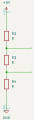
I understand the "current measurement" seems arbitrary since it is ostensibly equal throughout, but this question regards a more complicated project I'm involved in.
Another way of saying this is: "How do I format the differential voltage to be referenced to 0V?"
I have a fairly simple question:
If I measure the voltage across a resistor in a chain of (3) equal resistors to determine the current flowing through it, how can I make the absolute voltage drop ground-referenced? Meaning, if you had (3) serially connected resistors from VCC to GND, and the middle one was being measured, how could I eliminate the voltage offset to ground?
Image attached:
I understand the "current measurement" seems arbitrary since it is ostensibly equal throughout, but this question regards a more complicated project I'm involved in.
Another way of saying this is: "How do I format the differential voltage to be referenced to 0V?"