Rectifying and stepping down 480VAC to ~10vdc...

Status
Not open for further replies.

crutschow

Joined Mar 14, 2008
38,526
Won't the input side of the rectifier portion of the circuit still have the full peak to peak voltage coming into it? ...+650V
No, for that configuration the voltage across the diodes is only the volage drop across the opto input LED.
It would only see the high output voltage if there was no load on the bridge output.
Most of the voltage is dropped across the resistors (as shown in ron's diagram above).
If I remember my basic electronics from college correctly the current though the two 250k resistors in series should be around 1mA? ...which is roughly 1/2watt...
Correct, so each resistor dissipates about 1/4W maximum.
Would increasing the input resistance from the mains to say two 1M resistors only have the effect of increasing the time that the 24v signal takes to move up to the full output?
It may still still work, but it likely doesn't leave much margin to where it won't work at 24Vac.
Depends upon if the opto and the output transistor have enough gain to give 5V output with a much lower input current.
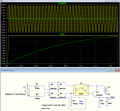
Sim below:
1697657920201.png
Just order the resistors when you order the opto.
why one needs to use two resistors in series rather than just a single resistor
I used two resistors to limit any accidental short current from either main's connection, and to reduce the voltage drop across each resistor (resistors do have a voltage limit based on their physical size, independent of their power limit).
 

ronsimpson

Joined Oct 7, 2019
4,702
Would increasing the input resistance from the mains to say two 1M resistors only have the effect of increasing the time that the 24v signal takes to move up to the full output?
Changing the input resistors changes the current through the LED. Current makes light. Light makes current flow in the Base of the transistors in the isolator. Yes there will be more current to charge up C1.
 

MisterBill2

Joined Jan 23, 2018
27,571
There are some wonderful little current sensors made for monitoring die heater current. They are a toroid with an LED indicator. I think that they are also available for using with PLC inputs. They are adequately insulated to be used with 480 volts, and totally isolated so they are safe to use. I suggest considering those for the application.
 

Thread Starter

chuggins143

Joined Dec 13, 2018
9
There are some wonderful little current sensors made for monitoring die heater current. They are a toroid with an LED indicator. I think that they are also available for using with PLC inputs. They are adequately insulated to be used with 480 volts, and totally isolated so they are safe to use. I suggest considering those for the application.
Do you have an example of this unit? ...PN or name?
 

Thread Starter

chuggins143

Joined Dec 13, 2018
9
----> https://www.crmagnetics.com/products/CR45-P76.aspx

Senses AC current, does not discern if the heater is open or the contact is open or is not energized...
That's similar to what I'm doing now with these...
https://www.amazon.com/gp/product/B0B56GSK8N/ref=ppx_yo_dt_b_search_asin_title?ie=UTF8&psc=1
...have a 200ohm resistor that I'm reading the voltage across... The problem is that I have some guys that can tear up an anvil and giving them cables with circuits imbedded has been an issue. They have a tendency to trip, step on, or just generally be too rough with the equipment and pull junctions apart.

So at this point I may just stay with what I'm doing and move the resistor component into my controls enclosure... (I currently have it encapsulated mid-wire between a BNC connector cable and a 1/8" headphone connector.) The clamps are cheap, but they're having to rig an external mechanism to get the signal when the units are wired a certain way.

Thanks for the tip!
chuggins143
 

MisterBill2

Joined Jan 23, 2018
27,571
Certainly there will need to be some logic to know when the current should be ON, but that logic is similar to detecting when the contacts have opened. And I was considering an installation in the more "Flintstone" resistant area next to the control contactor. I am aware of those who can break everything they come close to, and amazingly always do break it. But often they will stay out of the 480 volt cabinet, especially when (IF) they read the warning about "Danger, Hazard of Death" on the door. Not Shock hazard, that is far to mild.
 

Thread Starter

chuggins143

Joined Dec 13, 2018
9
Essentially how it's working now for the thermal cutouts that are line voltage is that if the incoming 0-10vdc signal from the current clamp is greater than zero (...or some threshold we can adjust) then there's current going through the clamp and the signal is on, the second the current drops to below the threshold then it's off.

For the cutouts that have 24vac going through them I have the rectifier (KBP307) AC inputs connected to each side of the cutout and when it drops out then there's the potential and run that output through a divider circuit to get down to an acceptable voltage that I can measure... zero is running and voltage rise indicates that it's dropped out.

Again, both of these work, but I'm looking for that better mouse trap... more of a universal hookup that wont mind high or low voltage... I originally built the systems for one groups products, but then we started testing products from one of our sister companies that do things differently. It's been a pain in my hind parts. Onward...
 
Status
Not open for further replies.
Top