Recommendation needed: enclosure for DC motor speed controller

Thread Starter

cazksboy

Joined Nov 9, 2009
63
Context: I bought a 12VDC fan intended for a car/truck radiator. It's hanging up in the window of my basement workshop, where I occasionally use acetone or kerosene to clean various metal parts in my clock repair hobby. Other members of my family are ultra-sensitive to even tiny amounts of chemical smells, so I use a fan to exhaust the fumes out the window. The fan hangs down in front of the screen, and on the other side of the screen is a glass window that opens or shuts with a crank handle - the only hassle is that every time I want to vent fumes, I have to go outside to open the top of the egress (for escaping in case of a fire) to allow the fumes to vent to the outside world, and then come back to the workshop to do whatever needs doing that day. The whole arrangement works well and the hassle isn't that big of a deal.

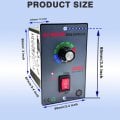
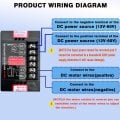
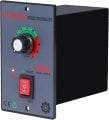
More context: I need to slow the fan down somewhat, because it's so powerful (2,150 rpm and 16" diameter). I chose it because it's flat & doesn't interfere with the machinery in my tiny workshop. But it's unnecessarily strong - it would work fine running a little slower. So I went to Amazon and bought a speed controller meant for brushless DC motors, and got the one in my picture attachments.

My question:
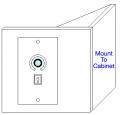
What enclosure should I use to house the controller? The standard electrical outlet boxes from Home Depot don't fit. The controller is clearly made to be panel mounted, but how can I safely mount it? Does the controller need to be ventilated? If so, any enclosure I use would need to be open to the air.
Whatever enclosure I end up using, I need to attach it to the wall of one of my tool cabinets at about eye-level simply because of how my tiny workshop is laid out.
Hope this is clear.01.jpg02.jpg04.jpg
 

Alec_t

Joined Sep 17, 2013
15,130
It looks self-contained already, so why do you want to enclose it? Can't you just make/buy a bracket to attach it to your tool cabinet? You could also DIY a cover to protect wiring connections.
 

Thread Starter

cazksboy

Joined Nov 9, 2009
63
It looks self-contained already, so why do you want to enclose it? Can't you just make/buy a bracket to attach it to your tool cabinet? You could also DIY a cover to protect wiring connections.
Funny you mentioned that - as soon as I posted my question I realized maybe I should make a bracket of some kind and simply attach it to the side of my tool cabinet. Hmm, I just realized how I could probably do it...
 

B-JoJo-S

Joined Jan 3, 2026
385
It's 12VDC. Low voltage. No need to enclose anything. What I'd do is take a thin sheet of plywood, 1/4", 1/8" maybe, cut out a rectangle to fit the controller into and then fasten the plywood to something convenient.
 
I don't have a 3D printer, nor do I know anyone with one. The idea doesn't appeal to me.
If you know how to design using Freecad/Autodesk or TinkerCad, you can make your design. Then you can send your .stl files to a 3D printing company and get it printed using ABS or any other suitable material.
You can also buy a ready-made ABS electronics project box and cut holes according to your requirements.
 

MisterBill2

Joined Jan 23, 2018
27,726
Before totally enclosing that speed controller, investigatehow much heat it produces. If it is a lot, the conteoller enclosure will need to be vented, or at least, not totally closed.
 

SamR

Joined Mar 19, 2019
5,510
Since you are handling, storing, and using a volatile liquid (acetone) in an enclosed space, the National Electrical Code (US) from the National Fire Protection Association applies making it a Class I location. That the acetone is not only stored but used makes it a Division 1 location. The Acetone makes it a Group D location due to its autoignition temperature. Hence Class I, Division 1, Group D applies and all electrical devices must meet that standard. This is what a Fire Marshall looks at when making an inspection of the premises. At the very least, all wiring in the area should be GFI protected if not following strict adherence to the NEC Class I, Division 1, Group D requirements. Basically, the same standard required in the Southern Building Code for an enclosed garage where gasoline is stored in the tank of a vehicle. IMHO
 

B-JoJo-S

Joined Jan 3, 2026
385
Since you are handling, storing, and using a volatile liquid (acetone) in an enclosed space, the National Electrical Code (US) from the National Fire Protection Association applies making it a Class I location. That the acetone is not only stored but used makes it a Division 1 location. The Acetone makes it a Group D location due to its autoignition temperature. Hence Class I, Division 1, Group D applies and all electrical devices must meet that standard. This is what a Fire Marshall looks at when making an inspection of the premises. At the very least, all wiring in the area should be GFI protected if not following strict adherence to the NEC Class I, Division 1, Group D requirements. Basically, the same standard required in the Southern Building Code for an enclosed garage where gasoline is stored in the tank of a vehicle. IMHO
I'm not arguing with you but I do want to ask one question: Does this apply to low voltage controls?
 

SamR

Joined Mar 19, 2019
5,510
Does this apply to low voltage controls?
Actually, it does. All of our telephones in Class I, Div. 1 areas had to be explosion proof which is why most of our control rooms were fresh air purged with airlocks to derate them to general purpose. It also prevented running copper cable wiring for computer communications or phones without explosion proof conduiting and why I had to have fiber optic cables installed instead. All of our 4-20mA 10VDC control wiring had to have intrinsically safe (basically non-sparking) barriers before exiting the purged control rooms. Otherwise, it would have to have been in rigid conduit with conduit seals, explosion proof fittings, and explosion proof connections to the explosion proof instruments. I was also involved in regularly scheduled electrical safety inspections of the operating areas as well as the main offices and labs. The NEC can be a real grizzly bear to deal with. Fire Marshal inspections of residences usually only occur when ratted out or in response to a fire. Volatile liquids fires in homes found to be in violation of NFPA regulations may be grounds for insurance not covering damages... Inspectors can be very picky! I did have a buddy ratted out for making candles in his apartment and the Fire Marshal made some very nasty threats of arrest, jail, and heavy fines if he had to return and ordered him to immediately cease and desist from any further candle making in the apartment.
 

MisterBill2

Joined Jan 23, 2018
27,726
CERTAINLY, living with other people's fears of a hazard, or perceived hazard, can inflict rather nasty burdens. No matter that nothing ever happens, that "But what if" that gets slammed around, supporting fears of that "what if" monster, is often very inconvenient.(using a polite word there.)
 
Top