RC Snubber for DC solenoid

MisterBill2

Joined Jan 23, 2018
27,887
@MisterBill2
"Supercaps" (for storing large amounts of power, often in lieu of a battery) are specified in both Farads and milliFarads.
OK, I have not yet had an occasion to use them, or even evaluate the various types available. And almost all of the rest of normal applications utilize much smaller values of capacitance. And none of my recent projects have required storing large amounts of power in a capacitor.
 

MrAl

Joined Jun 17, 2014
13,751
Hi Folks

I've been running around the internet for quite a bit trying to find the best solution for the system I am building. It is based around DC solenoids powered by 24vdc.

Parameters:
Load - 24vdc solenoid, 40ohm resistance
Relay - 24vdc actuated mechanical 240v AC max 10A max (resistive load)
Source - 24vdc
RCD Snubber to be placed parallel with load

My understanding is i would be best to implement an Resistor Capacitor Diode circuit to:
- reduce contact arcing on relay
- reduce emf
- reduce backward flow of current to other components.

I have investigated snubbing diodes, but my understanding is that they are slow to dissipate the energy so might impact closing time of the solenoid. I need the switching off of the solenoid to be as fast as possible.

Any help with choosing the right components would be much appreciated.

Basic schematic attached.

Many thanks
Hi,

The basic idea is in the form of what we might call conservation of volt seconds.
Volt seconds In = Volt seconds out.
That is, if you apply 10v to a coil for 2 second then that is 20 volt seconds (in the absence of saturation) you need to get 20 volt seconds out.
So you clamp voltage defines how long the energy will dissipate.
20 volt seconds dissipated at 2v takes 10 seconds, at 4v takes 5 seconds, at 5v takes 4 seconds, at 10v takes 2 seconds, at 20v takes 1 second.
This is the rule in the lack of saturation, but even with that we can show that the volt seconds stored will still dissipate faster with a higher clamp voltage so it's good to think about that.
If you need very fast dissipation, then think about using a circuit that could stand 2 times the voltage or even 10 times the voltage.
10 times the voltage applied will dissipate the volt seconds 10 times faster than at the applied voltage in general.
The limiting factor is of course the voltage rating of whatever turns on the coil, and the wire in the coil as to it's voltage rating and of course the other wiring and components involved.
 

Danko

Joined Nov 22, 2017
2,204
Delays of solenoid acting:
ON = 8 ms current increment,
OFF = 2 ms current decay.
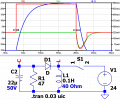
upload_2019-8-9_16-32-28.png
 
Last edited:

MisterBill2

Joined Jan 23, 2018
27,887
There also exists the possibility of adding a very brief reverse-voltage pulse to make the solenoids release even faster. But I don't know if this application would benefit from that much faster a release. It may also be that they would pull in faster if the drive circuit provided a higher voltage for pull-in and then dropped to a lower voltage for holding the valve open. That arrangement has been done many times for different applications.
 
Top